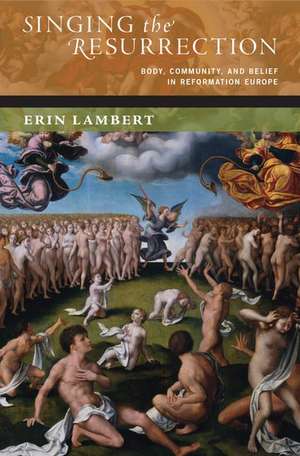
Singing the Resurrection: Body, Community, and Belief in Reformation Europe: The New Cultural History of Music Series
Autor Erin Lamberten Limba Engleză Hardback – 30 noi 2017




Preț: 510.46 lei
Preț vechi: 714.44 lei
-29%
Puncte Express: 766
Carte tipărită la comandă
Livrare economică 03-08 decembrie
Livrare prin curier în România Termenul estimat este afișat lângă disponibilitate.
Transport gratuit pentru acest produs Plată online sau ramburs, în funcție de opțiunile comenzii.
Retur gratuit în 14 zile Comandă securizată și suport în română.
Specificații
ISBN-13: 9780190661649
ISBN-10: 019066164X
Pagini: 240
Ilustrații: 15 halftones; 9 musical examples
Dimensiuni: 236 x 157 x 23 mm
Greutate: 0.44 kg
Editura: Oxford University Press
Colecția OUP USA
Seria The New Cultural History of Music Series
Locul publicării:New York, United States
ISBN-10: 019066164X
Pagini: 240
Ilustrații: 15 halftones; 9 musical examples
Dimensiuni: 236 x 157 x 23 mm
Greutate: 0.44 kg
Editura: Oxford University Press
Colecția OUP USA
Seria The New Cultural History of Music Series
Locul publicării:New York, United States
Recenzii
Lamberts approach is ambitious and thought-provoking, and the examination of one theological concept certainly has potential to yield new insight.
Singing the Resurrection is a generous-spirited book; the author handles the chosen material with respect and sensitivity throughout, in a work of sure-fotted scholarship that enriches our sense of the soundscape of the Reformation and of the audibility of belief.
Lambert presents a clear picture of how the Reformation created the opportunity for all churches to re-evaluate what they believed and how they would worship ... Her examples and stories inform the narrative, creating a scholarly informative, and entertaining book.
The book does not intend to offer close musical readings of works or sources, but rather to help nonspecialist readers learn how music was integrated with texts, images, beliefs, and the actions of believers across the fragmented religious landscape of the Reformation... Singing the Resurrection: Body, Community, and Belief in Reformation Europe offers a challenge to musicologists and historians: tell the stories of history using all the threads of culture. Integrating music into this story draws the people of the Reformation and their convictions more vividly into our own understanding of their worlds.
Singing the Resurrection is a generous-spirited book; the author handles the chosen material with respect and sensitivity throughout, in a work of sure-fotted scholarship that enriches our sense of the soundscape of the Reformation and of the audibility of belief.
Lambert presents a clear picture of how the Reformation created the opportunity for all churches to re-evaluate what they believed and how they would worship ... Her examples and stories inform the narrative, creating a scholarly informative, and entertaining book.
The book does not intend to offer close musical readings of works or sources, but rather to help nonspecialist readers learn how music was integrated with texts, images, beliefs, and the actions of believers across the fragmented religious landscape of the Reformation... Singing the Resurrection: Body, Community, and Belief in Reformation Europe offers a challenge to musicologists and historians: tell the stories of history using all the threads of culture. Integrating music into this story draws the people of the Reformation and their convictions more vividly into our own understanding of their worlds.
Notă biografică
Erin Lambert is Assistant Professor of History at the University of Virginia. Her research has been supported by the American Council of Learned Societies, the Council on Library and Information Resources, and the Social Science Research Council.