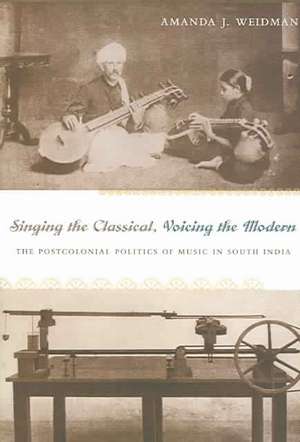
Singing the Classical, Voicing the Modern
Autor Amanda J Weidmanen Limba Engleză Paperback – 18 iul 2006
Descoperim în Singing the Classical, Voicing the Modern o analiză riguroasă a modului în care muzica Karnatic a fost redefinită în secolul al XX-lea pentru a servi idealurilor de identitate națională și modernitate. Structura volumului propune un parcurs progresiv, pornind de la „călătoria” viorii în India de Sud și continuând cu mutarea scenei muzicale de la curțile princiare către spațiul urban. Remarcăm cum Amanda J Weidman organizează materialul în șase capitole tematice care abordează succesiv genul, limbajul, muzicologia și impactul tehnologiilor de înregistrare asupra percepției autenticității. Reținem că, pentru a fi recunoscută drept „clasică”, muzica Karnatic a trebuit să adopte structuri occidentale — notații, conservatoare, formate de concert — rămânând în același timp un simbol al purității indiene. Această tensiune a generat ceea ce autoarea numește „politica vocii”, unde sunetul vocal devine depozitarul subiectivității moderne. Dacă New Mansions For Music de Lakshmi Subramanian v-a oferit cadrul teoretic al relocării muzicii din temple în domeniul public, această carte oferă instrumentele practice de înțelegere a modului în care vocea este construită ca metaforă a autenticității culturale. Analiza este susținută de 34 de ilustrații și o vastă bibliografie, transformând lectura într-o incursiune detaliată în istoria auralității. Spre deosebire de abordările pur tehnice, Amanda J Weidman integrează experiența sa de interpret cu rigoarea cercetării de arhivă, oferind un model de antropologie muzicală care pune sub semnul întrebării însăși definiția tradiției în fața tehnologiei.
Preț: 297.54 lei
Carte tipărită la comandă
Livrare economică 08-22 decembrie
Specificații
ISBN-10: 0822336200
Pagini: 368
Ilustrații: 34 illustrations
Dimensiuni: 154 x 227 x 22 mm
Greutate: 0.51 kg
Editura: Duke University Press
Locul publicării:United States
V-ar putea interesa
-
 SlipknotJason ArnoppPreț: 115.73 lei
-
 Bound for GloryWoody Guthrie-25%Preț: 59.48 lei79.45 lei
-
 Performing Rites: On the Value of Popular MusicSimon Frith-20%Preț: 366.60 lei457.00 lei
-
 -13%Preț: 282.88 lei324.01 lei
-
 Indian Music and the WestGerry Farrell-28%Preț: 519.65 lei716.96 lei
-
 One VoiceChristy Moore-24%Preț: 77.78 lei102.29 lei
-
 Sexing the Groove: Popular Music and GenderSheila WhiteleyPreț: 409.04 lei
-
 DuendeJason Webster-19%Preț: 75.74 lei93.33 lei
-
 Victor: An Unfinished SongJoan JaraPreț: 74.44 lei
-
 Dazzling StrangerColin Harper-26%Preț: 89.48 lei121.70 lei
-
 Simon & GarfunkelSpencer LeighPreț: 109.17 lei
-
 Adele: A Celebration of an Icon and Her MusicSarah-Louise James-33%Preț: 73.34 lei109.55 lei
De ce să citești această carte
Recomandăm această carte cercetătorilor și pasionaților de etnomuzicologie care doresc să înțeleagă mecanismele prin care o tradiție este „inventată” și oficializată. Cititorul va câștiga o perspectivă critică asupra modului în care politicile coloniale și de gen au modelat arta sunetului în India. Este un instrument esențial pentru a descifra relația complexă dintre voce, identitate națională și tehnologia modernă de reproducere audio.
Despre autor
Amanda J Weidman este un antropolog cultural și specialist în etnomuzicologie, recunoscută pentru cercetările sale asupra culturii performative din India de Sud. Formarea sa este dublă: academică, prin studii aprofundate de arhivă și teorie socială, și practică, fiind ea însăși o interpretă instruită în tradiția muzicii Karnatic. Această dublă perspectivă îi permite să analizeze fenomenul muzical nu doar ca obiect de studiu, ci ca experiență trăită. Lucrările sale se concentrează pe intersecția dintre tehnologie, modernitate și politicile de identitate în Asia de Sud, fiind publicate sub egida unor instituții prestigioase precum Duke University Press.
Descriere scurtă
Recenzii
Notă biografică
Textul de pe ultima copertă
Cuprins
Acknowledgements ix
Note on Transliteration of Spelling xvii
Introduction 1
1. Gone Native?: Travels of the Violin in South India 25
2. From the Palace to the Street: Staging “Classical” Music 59
3. Gender and the Politics of Voice 111
4. Can the Subaltern Sing?: Music, Language, and the Politics of Voice 150
5. A Writing Lesson: Musicology and the Birth of the Composer 192
6. Fantasic Fidelities 245
Afterword: Modernity and the Voice 286
Notes 291
Works Cited 325
Index 343