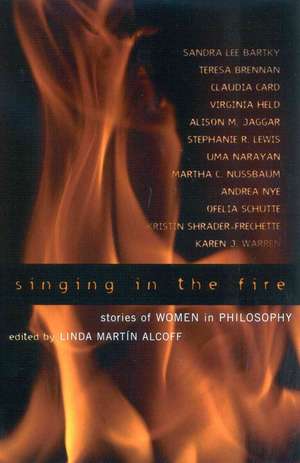
Singing in the Fire: Stories of Women in Philosophy
Editat de Linda Martín Alcoff Contribuţii de Sandra Bartky, Teresa Brennan, Claudia Card, Virginia Held, Alison Jaggar, Stephanie Lewis, Uma Narayan, Martha C. Nussbaum, Andrea Nye, Kristin Schrader-Frechette, Ofelia Schutte, Karen Warrenen Limba Engleză Paperback – 14 oct 2003
Singing in the Fire is a unique, groundbreaking collection of autobiographical essays by leading women in philosophy. It mines the experience of the generation that witnessed, and helped create, the remarkable advances now evident for women in the field. These women are leaders and innovators, looking back on how they have been treated, how they might have done things differently, and how we might make progress in future generations.
Preț: 319.75 lei
Preț vechi: 389.22 lei
-18%
Puncte Express: 480
Carte disponibilă
Livrare economică 09-23 noiembrie
Livrare prin curier în România Termenul estimat este afișat lângă disponibilitate.
Transport gratuit de la 400.00 lei Plată online sau ramburs, în funcție de opțiunile comenzii.
Retur gratuit în 14 zile Comandă securizată și suport în română.
Specificații
ISBN-13: 9780742513839
ISBN-10: 0742513831
Pagini: 171
Ilustrații: Illustrations
Dimensiuni: 146 x 226 x 14 mm
Greutate: 0.26 kg
Ediția:0192
Editura: Bloomsbury Publishing
Colecția Rowman & Littlefield
Locul publicării:New York, United States
ISBN-10: 0742513831
Pagini: 171
Ilustrații: Illustrations
Dimensiuni: 146 x 226 x 14 mm
Greutate: 0.26 kg
Ediția:0192
Editura: Bloomsbury Publishing
Colecția Rowman & Littlefield
Locul publicării:New York, United States
V-ar putea interesa
-
 Women and the Vote: A World HistoryJad Adams-16%Preț: 136.02 lei162.62 lei
 -
 Saving Safa: Rescuing a Little Girl from FGMWaris Dirie-27%Preț: 67.97 lei93.05 lei
 -
 -26%Preț: 74.44 lei100.24 lei
 -
 Redefining RapeEstelle B. FreedmanPreț: 214.51 lei
 -
 -9%Preț: 151.69 lei166.73 lei
 -
 Food and FemininityDr Kate Cairns-24%Preț: 197.75 lei261.60 lei
 -
 The Woman's Book of JoyEileen CampbellPreț: 88.42 lei
 -
 The Tattooed LadyAmelia Klem OsterudPreț: 128.56 lei
 -
 Honourable Friends?Caroline LucasPreț: 91.34 lei
 -
 Veiled and Unveiled in Chechnya and DaghestanIwona Kaliszewska-22%Preț: 170.17 lei219.19 lei
 -
 -17%Preț: 128.46 lei154.76 lei
 -
 Contract Children: Questioning SurrogacyDaniela Danna-18%Preț: 152.19 lei185.43 lei
Cuprins
Chapter 1 A Life Sentence in Bohemia
Chapter 2 How not to make the right career moves
Chapter 3 Finding my voice: reminiscence of an outlaw
Chapter 4 Taking oneself seriously, but not too
Chapter 5 Freethinking?
Chapter 6 Etc.
Chapter 7 What's a brown girl like you doing in the ivory tower? or, How I became a feminist philosopher
Chapter 8 'Don't smile so much': Philosophy and women in the 1970's
Chapter 9 At the feet of Mrs. Ramsey
Chapter 10 Autobiography of a whistle-blower
Chapter 11 Philosophy and life: A singular case of their interconnection
Chapter 12 Getting here from there
Chapter 2 How not to make the right career moves
Chapter 3 Finding my voice: reminiscence of an outlaw
Chapter 4 Taking oneself seriously, but not too
Chapter 5 Freethinking?
Chapter 6 Etc.
Chapter 7 What's a brown girl like you doing in the ivory tower? or, How I became a feminist philosopher
Chapter 8 'Don't smile so much': Philosophy and women in the 1970's
Chapter 9 At the feet of Mrs. Ramsey
Chapter 10 Autobiography of a whistle-blower
Chapter 11 Philosophy and life: A singular case of their interconnection
Chapter 12 Getting here from there
Recenzii
Each piece is well written, and the editing retains each woman's voice. An excellent addition to public as well academic collections.
Sexist and racist prejudice are as virulent in the academy as elsewhere. The statistics are familiar but the point is brought home by this collection of autobiographical essays by women philosophers. The contributors are among those who have made it, have found a relatively secure niche in their chosen profession. What they describe is the obstacles they encountered along the way. These range from discriminatory practices that are technically illegal to embarrassing little sexist jokes. What enabled these women to survive is their passion for philosophy and for teaching together with the support of at least one sympathetic soul-colleague, friend, or spouse. Their stories-detailed, circumstantial, and even-tempered-are both informative and moving. (Think of those women, perhaps equally talented, who are less indefatigable or less lucky and who have been left behind!)
These twelve war stories need to be read by young women entering philosophy and veterans alike. We can laugh (at the absurdities of venerable scholars acting as proverbial sexist fools), cry (with the authors as they face painful affronts to their dignity and self-esteem), and celebrate the immense courage of the generation of women who have worked to transform a particularly intransigent segment of academia, and open more doors for women in philosophy. The book is full of both fire and song. It is a book we need today.
I couldn't put down this moving, informative, and often witty collection of essays. They reveal important sources of feminist philosophy in the life experiences of women philosophers, not to mention glimpses of the normal, everyday misogyny that, alas, is still detectable in philosophy departments today, some three decades after the episodes reported here. These essays should be required reading for every graduate student in philosophy, male or female, and for the rest of the profession.
Singing in the Fire is able to bring women from all across the field of philosophy with completely different life stories together so that more can be learned of them as a whole, while their individual experiences allow the reader to have a greater understanding of who they are and where they come from. It is a great book with so many aspects of the field represented and many useful applications that it is a must for the shelves of all women philosophers, present as well as up and coming.
This superb volume reveals how misogyny and patriarchal normative structures and practices, within the alleged 'ethereal' and abstract field of philosophy, operate to denigrate and sexualize women as objects, rendering their bodies, identities, and concerns incompatible with the demands of the life of the mind. Singing in the Fire is an apt and effective metaphor for this collection of honest personal narratives by prominent women philosophers who forged their philosophical identities with courage, vision, and tenacity.
In various less spectacular ways than documented by tales of the arrogance and oafishness woman philosophers face, these essays drive home the impact of the autobiographical on the philosophical. When philosophers share the details of their lives, the impact extends to the reader.
Reading Singing in the Fire: Stories of Women in Philosophy is like attending a great dinner party, where every guest is smart and fascinating, an you stay too late, knowing you'll regret it at work the next day but you don't care, because you want to talk, really talk, to everyone there.
Sexist and racist prejudice are as virulent in the academy as elsewhere. The statistics are familiar but the point is brought home by this collection of autobiographical essays by women philosophers. The contributors are among those who have made it, have found a relatively secure niche in their chosen profession. What they describe is the obstacles they encountered along the way. These range from discriminatory practices that are technically illegal to embarrassing little sexist jokes. What enabled these women to survive is their passion for philosophy and for teaching together with the support of at least one sympathetic soul-colleague, friend, or spouse. Their stories-detailed, circumstantial, and even-tempered-are both informative and moving. (Think of those women, perhaps equally talented, who are less indefatigable or less lucky and who have been left behind!)
These twelve war stories need to be read by young women entering philosophy and veterans alike. We can laugh (at the absurdities of venerable scholars acting as proverbial sexist fools), cry (with the authors as they face painful affronts to their dignity and self-esteem), and celebrate the immense courage of the generation of women who have worked to transform a particularly intransigent segment of academia, and open more doors for women in philosophy. The book is full of both fire and song. It is a book we need today.
I couldn't put down this moving, informative, and often witty collection of essays. They reveal important sources of feminist philosophy in the life experiences of women philosophers, not to mention glimpses of the normal, everyday misogyny that, alas, is still detectable in philosophy departments today, some three decades after the episodes reported here. These essays should be required reading for every graduate student in philosophy, male or female, and for the rest of the profession.
Singing in the Fire is able to bring women from all across the field of philosophy with completely different life stories together so that more can be learned of them as a whole, while their individual experiences allow the reader to have a greater understanding of who they are and where they come from. It is a great book with so many aspects of the field represented and many useful applications that it is a must for the shelves of all women philosophers, present as well as up and coming.
This superb volume reveals how misogyny and patriarchal normative structures and practices, within the alleged 'ethereal' and abstract field of philosophy, operate to denigrate and sexualize women as objects, rendering their bodies, identities, and concerns incompatible with the demands of the life of the mind. Singing in the Fire is an apt and effective metaphor for this collection of honest personal narratives by prominent women philosophers who forged their philosophical identities with courage, vision, and tenacity.
In various less spectacular ways than documented by tales of the arrogance and oafishness woman philosophers face, these essays drive home the impact of the autobiographical on the philosophical. When philosophers share the details of their lives, the impact extends to the reader.
Reading Singing in the Fire: Stories of Women in Philosophy is like attending a great dinner party, where every guest is smart and fascinating, an you stay too late, knowing you'll regret it at work the next day but you don't care, because you want to talk, really talk, to everyone there.