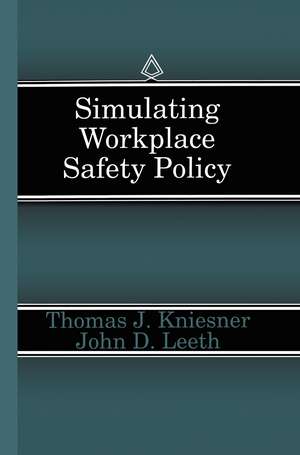
Simulating Workplace Safety Policy: Studies in Risk and Uncertainty, cartea 6
Autor Thomas J. Kniesner, John D. Leethen Limba Engleză Paperback – 27 sep 2012




Preț: 905.13 lei
Preț vechi: 1103.82 lei
-18%
Puncte Express: 1358
Carte tipărită la comandă
Livrare economică 11-25 noiembrie
Livrare prin curier în România Termenul estimat este afișat lângă disponibilitate.
Transport gratuit pentru acest produs Plată online sau ramburs, în funcție de opțiunile comenzii.
Retur gratuit în 14 zile Comandă securizată și suport în română.
Specificații
ISBN-13: 9789401042833
ISBN-10: 9401042837
Pagini: 236
Ilustrații: XVII, 215 p.
Dimensiuni: 155 x 235 x 12 mm
Greutate: 0.34 kg
Ediția:Softcover reprint of the original 1st ed. 1995
Editura: SPRINGER NETHERLANDS
Colecția Springer
Seria Studies in Risk and Uncertainty
Locul publicării:Dordrecht, Netherlands
ISBN-10: 9401042837
Pagini: 236
Ilustrații: XVII, 215 p.
Dimensiuni: 155 x 235 x 12 mm
Greutate: 0.34 kg
Ediția:Softcover reprint of the original 1st ed. 1995
Editura: SPRINGER NETHERLANDS
Colecția Springer
Seria Studies in Risk and Uncertainty
Locul publicării:Dordrecht, Netherlands
V-ar putea interesa
-
 Occupational Health in Developing CountriesJ. Jeyaratnam-18%Preț: 125.17 lei152.61 lei
 -
 The Semantic Turn: A New Foundation for DesignKlaus Krippendorff-18%Preț: 929.97 lei1134.11 lei
 -
 Health and Safety at WorkJeremy StranksPreț: 348.35 lei
 -
 Occupational AudiometryMaryAnne Maltby-15%Preț: 423.18 lei497.86 lei
 -
 Preț: 472.93 lei
 -
 -15%Preț: 431.43 lei507.57 lei
 -
 -15%Preț: 420.28 lei494.45 lei
 -
 Guidelines for Determining the Probability of Ignition of a Released Flammable MassCcps (Center for Chemical Process Saf-8%Preț: 631.25 lei686.14 lei
 -
 -23%Preț: 749.88 lei973.87 lei
 -
 -15%Preț: 619.39 lei728.69 lei
 -
 The Psychology of Safety HandbookE. Scott Geller-18%Preț: 1416.02 lei1726.85 lei
 -
 Noise and Hearing V 1Luxon-5%Preț: 1038.50 lei1093.16 lei
Public țintă
ResearchCuprins
1 Introduction.- Why OSHA Did Not Prevent the Tragic Fire.- U.S. Workplace Injuries and Illnesses.- Workplace Safety Programs in the United States.- Econometrically Studying Job Safety.- The Simulation Approach to Studying Job Safety.- Summary of Key Simulation Results.- Notes.- 2 The Economics of Workplace Safety.- Labor Market Equilibrium with Work-Related Health Hazards.- Workplace Safety Policy.- The Need for Numerical Simulation Research.- Conclusion.- Notes.- 3 The Simulation Model.- A Mathematical Description of Hedonic Labor Market Equilibrium.- Numerical Simulation Techniques.- Parameterizing the Simulation Model.- Initial Numerical Simulation Results.- Sensitivity Checks.- Calibrating the Simulation Model.- Conclusion.- Appendix 3A: Mathematical Derivation of the Continuous Model.- Appendix 3B: Structural Equations and Initial Parameter Values.- Notes.- 4 The Safety Policy System.- Numerical Simulation Details.- Numerical Simulation Results.- Two Possible Refinements in WC and OSHA.- Conclusion.- Appendix 4A: Structural Equations and Initial Parameter Values.- Notes.- 5 Asymmetric Information Problems in Workers’ Compensation Insurance.- Labor Market Equilibrium.- Numerical Simulation Details.- Numerical Simulation Results.- Conclusion.- Notes.- 6 Policy Implications.- OSHA During the 1970s Versus the 1980s.- Reforming OSHA.- Workers’ Compensation Insurance and Safety.- Reforming Workers’ Compensation.- Conclusion.- Notes.- References.