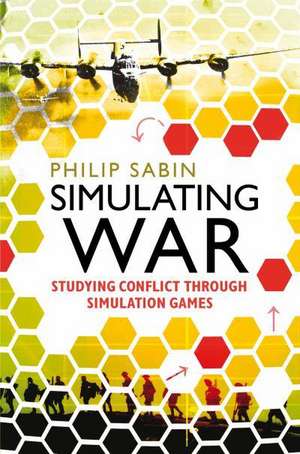
Simulating War: Studying Conflict through Simulation Games
Autor Professor Philip Sabinen Limba Engleză Paperback – 24 apr 2014
Recomandăm Simulating War studenților la studii de securitate, ofițerilor militari și cercetătorilor care doresc să transforme analiza istorică într-un instrument predictiv și educațional. Professor Philip Sabin valorifică trei decenii de experiență la King's College London pentru a demonstra că un „wargame” nu este doar un hobby, ci o metodă riguroasă de modelare a dinamicii conflictelor. Descoperim aici un echilibru rar între rigoarea academică și aplicabilitatea practică, volumul oferind cititorului competențele necesare pentru a proiecta propriile simulări.
Textul este structurat progresiv: prima parte fundamentează teoretic utilitatea educațională a simulării, a doua parte detaliază mecanicile de design (de la componente la dinamica comenzii), iar ultima parte oferă studii de caz aplicate. Putem afirma că această lucrare completează perspectiva oferită de Historical Simulation and Wargames de Riccardo Masini; în timp ce Masini explorează valoarea jocurilor analogice pentru cercetarea istorică, Professor Philip Sabin merge mai departe, oferind un manual tehnic care include opt simulări gata de utilizat, cu hărți și regulamente incluse.
În contextul operei autorului, dacă în Lost Battles accentul era pus pe reconstrucția bătăliilor antice, Simulating War reprezintă o sinteză metodologică matură. Autorul explică procesul de integrare și testare, facilitând tranziția de la înțelegerea teoretică la execuția practică prin utilizarea unor instrumente precum Cyberboard. Este o resursă esențială care recalibrează modul în care tacticile militare sunt studiate în mediul academic și profesional.
Preț: 204.25 lei
Preț vechi: 265.73 lei
-23%
Carte disponibilă
Livrare economică 17 noiembrie-01 decembrie
Livrare express 31 octombrie-06 noiembrie pentru 103.44 lei
Specificații
ISBN-10: 1472533917
Pagini: 416
Ilustrații: 26 colour illus
Dimensiuni: 156 x 234 x 26 mm
Greutate: 0.64 kg
Editura: Bloomsbury Publishing
Colecția Bloomsbury Academic
Locul publicării:London, United Kingdom
V-ar putea interesa
-
 -32%Preț: 256.21 lei377.70 lei
 -
 The Cambridge History of Greek and Roman WarfarePhilip Sabin-23%Preț: 1240.13 lei1610.55 lei
 -
 Torture and DemocracyDarius RejaliPreț: 445.76 lei
 -
 The Sling and the StoneThomas X HammesPreț: 129.14 lei
 -
 -23%Preț: 72.84 lei94.59 lei
 -
 Lost Battles: Reconstructing the Great Clashes of the Ancient WorldProfessor Philip Sabin-38%Preț: 180.19 lei289.79 lei
 -
 Preț: 78.62 lei
 -
 Military Adaptation in WarWilliamson MurrayPreț: 393.18 lei
 -
 Preț: 128.72 lei
 -
 National Guard's State Partnership ProgramDave Pruitt-26%Preț: 500.73 lei674.99 lei
 -
 -16%Preț: 91.66 lei109.58 lei
 -
 Harvey, R: MavericksRobert Harvey-34%Preț: 47.90 lei73.02 lei
De ce să citești această carte
Această lucrare este indispensabilă celor care vor să înțeleagă mecanismele din spatele deciziilor militare. Cititorul câștigă nu doar o bază teoretică solidă în modelarea conflictelor, ci și instrumente practice: opt jocuri complete pe care le poate asambla și juca. Este recomandarea noastră principală pentru profesioniștii din apărare și studenții la istorie militară care caută să depășească lectura pasivă în favoarea învățării interactive.
Descriere
In this book, Philip Sabin explores the theory and practice of conflict simulation as a topic in its own right, based on his thirty years of experience in designing wargames and using them in teaching. Simulating War sets conflict simulation in its proper context alongside more familiar techniques such as game theory and operational analysis. It explains in detail the analytical and modelling techniques involved, and it teaches you how to design your own simulations of conflicts of your choice. The book provides eight simple illustrative simulations of specific historical conflicts, complete with rules, maps and counters.
Simulating War is essential reading for all recreational or professional simulation gamers, and for anyone who is interested in modelling war, from teachers and students to military officers.
Cuprins
Part I: Theory
1. Modelling War
2. Accuracy vs Simplicity
3. Educational Utility
4. Simulation Research
Part II: Mechanics
5. Designing the Components
6. Modelling Conflict Dynamcs
7. Modelling Command Dynamics
8. Integration and Testing
Part III: Examples
9. Ancient Warfare
10. World War Two
11. Tactical Combat
Conclusion
Appendix 1: Assembling the Components
Appendix 2: Finding Published Simulations
Appendix 3: Basic Mathematics
Appendix 4: Using Cyberboard
Appendix 5: Kartenspiel
Notes
Bibliography
Index
Recenzii
In Simulating War Professor Sabin provides us with a scholarly and very useable toolkit that allows us to supplement the dry data of statistical analysis or computer simulation with the realities of human interaction and the play of Clausewitz's "chance". Wargaming is a neglected and misunderstood art in the modern military: this book does much to put that right, and should be on the shelf of any thinking military professional.
Anyone with an interest in wargaming, be it professional or recreational, must buy this book... Simulating War is a clear, logical and balanced guide that provides all the building blocks and insights necessary to design manual games and then use them to best effect. This expert knowledge will be just as useful to military planners, trainers and educators alike, to gaming software developers, operational analysts, those in experimentation and to recreational wargamers.
Quite simply, in terms of describing manual map hex grid war gaming, Sabin has written the most readable book on this topic to appear in a long time. It is well-written, entertaining and presents a lot of original material and new ideas on war-game design.
I recommend this book to all who are interested in the art, craft, theory and practice of board wargame design and play... Even old hands at the hobby will find Sabin's discursive mini-essays valuable.
Simulating War deserves to be widely read, not only by hobbyists, but also by game designers, other wargame professionals, military historians, and others called upon to teach about warfare and conflict (whether in university, military, or other professional settings)... I, for one, would heartedly recommend [the book] to both grognards and academic colleagues alike.