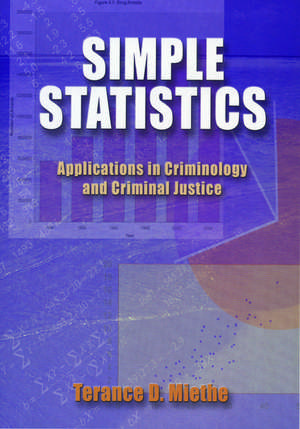
Simple Statistics: Applications in Criminology and Criminal Justice
Autor Terance D. Mietheen Limba Engleză Paperback – 15 sep 2006
Preț: 789.47 lei
Preț vechi: 1081.46 lei
-27%
Puncte Express: 1184
Carte tipărită la comandă
Livrare economică 01-15 decembrie
Livrare prin curier în România Termenul estimat este afișat lângă disponibilitate.
Transport gratuit pentru acest produs Plată online sau ramburs, în funcție de opțiunile comenzii.
Retur gratuit în 14 zile Comandă securizată și suport în română.
Specificații
ISBN-13: 9780195330717
ISBN-10: 0195330714
Pagini: 336
Ilustrații: figures & tables
Dimensiuni: 164 x 238 x 24 mm
Greutate: 0.5 kg
Editura: Oxford University Press
Colecția OUP USA
Locul publicării:New York, United States
ISBN-10: 0195330714
Pagini: 336
Ilustrații: figures & tables
Dimensiuni: 164 x 238 x 24 mm
Greutate: 0.5 kg
Editura: Oxford University Press
Colecția OUP USA
Locul publicării:New York, United States
V-ar putea interesa
-
 Issues in Educational ResearchJ.p. Keeves-23%Preț: 825.60 lei1072.20 lei
 -
 The Professional StrangerMichael H. AgarPreț: 272.01 lei
 -
 Ethnography and Qualitative Design in Educational ResearchMargaret Diane Lecompte-23%Preț: 720.26 lei935.40 lei
 -
 Theories of Delinquency: An Examination of Explanations of Delinquent BehaviorDonald J. Shoemaker-11%Preț: 338.83 lei382.63 lei
 -
 -28%Preț: 517.73 lei718.74 lei
 -
 -17%Preț: 182.65 lei220.87 lei
 -
 -40%Preț: 474.80 lei791.41 lei
 -
 -40%Preț: 471.54 lei789.48 lei
 -
 -39%Preț: 382.62 lei626.48 lei
 -
 Terrorism and Sexual Violence. the Case of the Great Lakes RegionClaudia Forster-TownePreț: 159.47 lei
 -
 -23%Preț: 741.38 lei962.84 lei
 -
 EdubloggingKristina SchneiderPreț: 411.19 lei
 -
 -15%Preț: 532.50 lei626.47 lei
 -
 Preț: 276.93 lei
Recenzii
What makes Simple Statistics distinctive is its remarkable balance between extremely technical statistics texts that are not written in a student-friendly fashion and oversimplified texts. Miethe writes in an exceptionally readable style, challenging students without intimidating them. Another key strength is the book's use of actual crime data, demonstrating the real-world applications of major statistical concepts.
Throughout this book, the author explains the relevance of statistical techniques
Throughout this book, the author explains the relevance of statistical techniques
Cuprins
- 1. Introduction to Statistical Thinking
- Some Definitions and Basic Ideas
- Math Phobia, Panic, and Terror in Social Statistics
- The Practical Value of Social Statistics and Statistical Reasoning
- Types of Statistical Methods
- Pedagogical (Teaching) Approaches
- 2. Garbage In, Garbage Out (GIGO)
- Measurement Invalidity
- Sampling Problems
- Faulty Causal Inferences
- Political Influences
- Human Fallibility
- 3. Issues in Data Preparation
- Why Is Data Preparation Important?
- Operationalization and Measurement
- Coding and Inputting Statistical Data
- Available Computer Software for Basic Data Analysis
- 4. Displaying Data in Tables and Graphic Forms
- The Importance of Data Tables and Graphs
- Types of Tabular and Visual Presentations
- Hazards and Distortions in Visual Displays and Collapsing Categories
- 5. Modes, Medians, Means, and More
- Modes and Modal Categories
- The Median and Other Measures of Location
- The Mean and Its Meaning
- Choice of Measure of Central Tendency and Position
- 6. Measures of Variation and Dispersion
- The Range of Scores
- The Variance and Standard Deviation
- Population Versus Sample Variances and Standard Deviations
- 7. The Normal Curve and Sampling Distributions
- The Normal Curve
- Z-Scores as Standard Scores
- Reading a Normal Curve Table
- Other Sampling Distributions
- 8. Parameter Estimation and Confidence Intervals
- Sampling Distributions and the Logic of Parameter Estimation
- Inferences from Sampling Distributions to One Real Sample
- Confidence Intervals: Large Samples
- Confidence Intervals: Small Samples
- 9. Introduction to Hypothesis Testing
- Confidence Intervals Versus Hypothesis Testing
- Basic Terminology and Symbols
- 10. Hypothesis Testing for Means and Proportions
- Types of Hypothesis Testing
- Issues in Testing Statistical Hypotheses
- 11. Statistical Association in Contingency Tables
- The Importance of Statistical Association and Contingency Tables
- The Structure of a Contingency Table
- Developing Tables of Total, Row, and Column Percentages
- The Rules for Interpreting a Contingency Table
- Specifying Causal Relations in Contingency Tables
- Assessing the Magnitude of Bivariate Associations in Contingency Tables
- Issues in Contingency Table Analysis
- 12. The Analysis of Variance (ANOVA)
- Overview of ANOVA and When It Is Used
- Partitioning Variation into Between- and Within-Group Differences
- Hypothesis Testing and Measures of Association in ANOVA
- Issues in the Analysis of Variance
- 13. Correlation and Regression
- The Scatterplot of Two Interval or Ratio Variables
- The Correlation Coefficient Regression Analysis
- Issues in Bivariate Regression and Correlation Analysis
- 14. Introduction to Multivariate Analysis
- Why Do Multivariate Analysis?
- Types of Multivariate Analysis