Cantitate/Preț
Produs

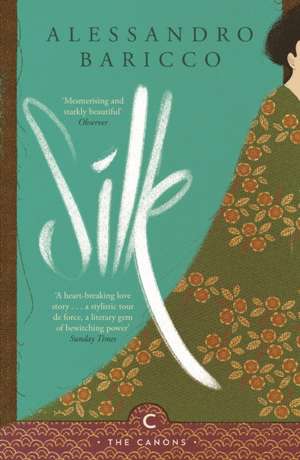
Silk: Canongate Canons

Autor Alessandro Baricco Traducere de Ann Goldstein
en Limba Engleză Paperback – aug 2019

Ca și Ocean Sea, o altă scriere emblematică a lui Alessandro Baricco, acest roman explorează profunzimile dorinței umane și ale melancoliei, dar dintr-o perspectivă mult mai minimalistă și concentrată. Suntem de părere că forța acestei povești rezidă tocmai în ceea ce rămâne nespus, în spațiile albe dintre rânduri care pulsează de o tensiune erotică mută. Ne-a atras atenția modul în care Baricco transformă o expediție comercială din secolul al XIX-lea într-o odisee interioară despre fragilitatea pasiunii. Premisa ne poartă în anul 1861, alături de Hervé Joncour, un negustor francez a cărui viață așezată este perturbată de călătoriile lungi spre o Japonie aflată încă sub aura misterului. Acolo, sub privirea lui Hara Kei, Joncour dezvoltă o obsesie dureroasă pentru o femeie cu care nu va schimba niciun cuvânt și pe care nu o va atinge niciodată. Relația lor se consumă prin bilete indescifrabile și gesturi ritualice, o formă de sclavie emoțională care îl urmărește pe protagonist înapoi în Franța. Stilul lui Baricco, redat în limba engleză de Ann Goldstein, este de o precizie aproape matematică, dar încărcat de o poezie a efemerului. Spre deosebire de Burning Silk de Destiny Kinal, care plonjează în senzorialitatea lumii parfumierilor, Silk alege calea abstracției și a sugestiei. Nu este un roman despre mătase ca marfă, ci despre mătase ca metaforă a unei legături invizibile și fine care se poate destrăma la cea mai mică atingere a realității. Credem că această lectură oferă o experiență contemplativă rară, în care ritmul lent al călătoriilor de epocă se împletește cu o analiză fină a regretului.

Citește tot Restrânge

Din seria Canongate Canons

Carte disponibilă

Livrare economică 19 septembrie-03 octombrie
Livrare express 05-11 septembrie pentru 1539 lei

Livrare prin curier în România Termenul estimat este afișat lângă disponibilitate.
Transport gratuit de la 40000 lei Plată online sau ramburs, în funcție de opțiunile comenzii.
Retur gratuit în 14 zile Comandă securizată și suport în română.

Specificații

ISBN-13: 9781786896421
ISBN-10: 1786896427
Pagini: 160
Ilustrații: No
Dimensiuni: 126 x 198 x 17 mm
Greutate: 0.12 kg
Ediția:Main - Canons
Editura: Canongate Books
Colecția Canongate Canons
Seria Canongate Canons


De ce să citești această carte

Recomandăm Silk celor care caută o proză scurtă, dar densă, unde fiecare cuvânt cântărește greu. Este o carte despre dorința care nu are nevoie de atingere pentru a fi devastatoare. Cititorul va câștiga o perspectivă unică asupra modului în care obsesia poate transforma o viață obișnuită, totul într-un stil literar rafinat care amintește de stampele japoneze: simplu, elegant și profund mișcător.


Despre autor

Alessandro Baricco este unul dintre cei mai apreciați scriitori italieni contemporani, cunoscut pentru stilul său inovator și capacitatea de a îmbina teme filozofice cu o narativitate lirică. Născut în Torino, Baricco a debutat cu succes în literatură, dar s-a remarcat și ca eseist, dramaturg și muzicolog. Opera sa, care include titluri celebre precum Ocean Sea și monologul „Novecento”, a fost tradusă în numeroase limbi și a primit distincții internaționale prestigioase. Silk rămâne cea mai cunoscută lucrare a sa la nivel global, fiind adaptată și pentru marele ecran, confirmând statutul său de maestru al atmosferei și al emoției reținute.


Notă biografică

Alessandro Baricco was born in Turin in 1958. He is the author of thirteen novels, as well as a number of essay and short story collections, a modern rendition of The Iliad and a theatrical monologue. He has won the Prix Médicis Étranger in France and the Selezione Campiello, Viareggio and Palazzo al Bosco prizes in Italy.

Ann Goldstein is a frequent translator from the Italian. She has translated works by, among others, Elena Ferrante, Pier Paolo Pasolini, Alessandro Baricco, Erri De Luca and Roberto Calasso.

Descriere

In 1861 French silkworm merchant Hervé Joncour travels to Japan, where he encounters the mysterious Hara Kei. He develops a painful longing for Kei's beautiful concubine - but they cannot touch; they don't even speak. And he cannot read the note she sends him until he has returned to his own country. But the moment he does, Joncour is enslaved.Subtle, tender and surprising, Silk is an evocative tale of erotic possession.

Extras

1.

Although his father had imagined for him a brilliant future in the army, Hervé Joncour ended up earning his living in an unusual profession that, with singular irony, had a feature so sweet as to betray a vaguely feminine intonation.

For a living, Hervé Joncour bought and sold silkworms.

It was 1861. Flaubert was writing Salammbô, electric light was still a hypothesis and Abraham Lincoln, on the other side of the ocean, was fighting a war whose end he would not see.

Hervé Joncour was thirty-two years old.

He bought and sold.

Silkworms.


2.

To be precise, Hervé Joncour bought and sold silkworms when the silkworms consisted of tiny eggs, yellow or grey in colour, motionless and apparently dead. Merely in the palm of your hand you could hold thousands of them.

"It's what is meant by having a fortune in your hand."

In early May the eggs opened, freeing a worm that, after thirty days of frantic feeding on mulberry leaves, shut itself up again, in a cocoon, and then, two weeks later, escaped for good, leaving behind a patrimony that in silk came to a thousand yards of rough thread and in money a substantial number of French francs: assuming that everything happened according to the rules and, as in the case of Hervé Joncour, in a region of southern France.

Lavilledieu was the name of the town where Hervé Joncour lived.

Hélène that of his wife.

They had no children.


3.

To avoid the devastation from the epidemics that increasingly afflicted the European stock, Hervé Joncour tried to acquire silkworm eggs beyond the Mediterranean, in Syria and Egypt. There lay the most exquisitely adventurous aspect of his work. Every year, in early January, he left. He traversed sixteen hundred miles of sea and eight hundred kilometres of land. He chose the eggs, negotiated the price, made the purchase. Then he turned around, traversed eight hundred kilometres of land and sixteen hundred miles of sea, and arrived in Lavilledieu, usually on the first Sunday in April, usually in time for High Mass.

He worked for two more weeks, packing the eggs and selling them.

For the rest of the year he relaxed.


4.

"What's Africa like?" they asked.

"Weary."

He had a big house outside the town and a small workshop in the centre, just opposite the abandoned house of Jean Berbeck.

Jean Berbeck decided one day that he would never speak again. He kept his promise. His wife and two daughters left him. He died. No one wanted his house, so now it was abandoned.

Buying and selling silkworms, Hervé Joncour earned a sufficient amount every year to ensure for him and his wife those comforts which in the countryside people tend to consider luxuries. He took an unassuming pleasure in his possessions, and the likely prospect of becoming truly wealthy left him completely indifferent. He was, besides, one of those men who like to witness their own life, considering any ambition to live it inappropriate.

It should be noted that these men observe their fate the way most men are accustomed to observe a rainy day.


5.

If he had been asked, Hervé Joncour would have said that his life would continue like that forever. In the early Sixties, however, the pebrine epidemic that by now had rendered the eggs from the European breeders useless spread beyond the sea, reaching Africa and even, some said, India. In 1861, Hervé Joncour returned from his usual journey with a supply of eggs that two months later turned out to be almost entirely infected. For Lavilledieu, as for many other cities whose wealth was based on the production of silk, that year seemed to represent the beginning of the end. Science appeared incapable of understanding the causes of the epidemic. And the whole world, as far as the farthest regions, seemed a prisoner of that inexplicable fate.

"Almost the whole world," Baldabiou said softly. "Almost", pouring a little water into his Pernod.

6.

Baldabiou was the man who, twenty years earlier, had come to town, headed straight for the mayor's office, entered without being announced, placed on the desk a silk scarf the colour of sunset, and asked him

"Do you know what this is?"

"Women's stuff."

"Wrong. Men's stuff: money."

The mayor had him thrown out. He built a silk mill, down at the river, a barn for raising silkworms, in the shelter of the woods, and a little church dedicated to St Agnes, at the intersection of the road to Vivier. Baldabiou hired thirty workers, brought a mysterious wooden machine from Italy, all wheels and gears, and said nothing more for seven months. Then he went back to the mayor and placed on his desk, in an orderly fashion, thirty thousand francs in large bills.

"Do you know what this is?"

"Money."

"Wrong. It's the proof that you are an idiot."

Then he picked up the bills, put them in his wallet, and turned to leave.

The mayor stopped him.

"What the devil should I do?"

"Nothing: and you will be the mayor of a wealthy town."

Five years later Lavilledieu had seven silk mills and had become one of the principal centres in Europe for breeding silkworms and making silk. It wasn't all Baldabiou's property. Other prominent men and land-owners in the area had followed him in that curious entrepreneurial adventure. To each one, Baldabiou had revealed, without hesitation, the secrets of the work. This amused him much more than making piles of money. Teaching. And having secrets to tell. He was a man made like that.


7.

Baldabiou was also the man who, eight years earlier, had changed Hervé Joncour's life. It was when the epidemics had first begun to hurt the European production of silkworm eggs. Without getting upset, Baldabiou had studied the situation and had reached the conclusion that the problem would not be solved; it would be evaded. He had an idea; he lacked the right man. He realised he had found him when he saw Hervé Joncour passing by the café Verdun, elegant in the uniform of a second lieutenant of the infantry and with the proud bearing of a soldier on leave. He was twenty-four, at the time. Baldabiou invited him to his house, spread open before him an atlas full of exotic names, and said to him

"Congratulations. You've finally found a serious job, boy."

Hervé Joncour listened to a long story about silkworms, eggs, pyramids and travel by ship. Then he said

"I can't."

"Why not?"

"In two days my leave is over--I have to return to Paris."

"Military career?"

"Yes. It's what my father wanted."

"No problem."

He seized Hervé Joncour and led him to his father.

"You know who this is?" he asked, after entering the office unannounced.

"My son."

"Look harder."

The mayor sank back in his leather chair, beginning to sweat.

"My son Hervé, who in two days will return to Paris, where a brilliant career awaits him in our army, God and St Agnes willing."

"Exactly. Only, God is busy elsewhere and St. Agnes detests soldiers."

A month later Hervé Joncour left for Egypt. He travelled on a ship called the Adel. In the cabins you could smell the odour of cooking, there was an Englishman who said he had fought at Waterloo, on the evening of the third day they saw dolphins sparkling on the horizon like drunken waves, at roulette it was always the sixteen.

He returned six months later--the first Sunday in April, in time for High Mass--with thousands of eggs packed in cotton wool in two big wooden boxes. He had a lot of things to tell. But what Baldabiou said to him when they were alone was

"Tell me about the dolphins."

"The dolphins?"

"About when you saw them."

That was Baldabiou.

No one knew how old he was.


8.

"ALMOST the entire world," said Baldabiou softly. "Almost", pouring a little water into his Pernod.

An August night, past twelve. Normally at that hour, Verdun had already been closed for a while. The chairs were turned upside down, neatly, on the tables. He had cleaned the bar, and all the rest. He had only to turn off the lights and lock up. But Verdun was waiting: Baldabiou was talking.

Sitting across from him, Hervé Joncour, with a spent cigarette between his lips, listened, unmoving. As he had eight years before, he was letting this man methodically rewrite his destiny. His voice came out thin and clear, punctuated by swallows of Pernod. He didn't stop for many minutes. The last thing he said was

"There is no choice. If we want to survive, we have to get there."

Silence.

Verdun, leaning on the bar, looked over at the two of them.

Baldabiou was busy trying to find another drop of Pernod in the bottom of the glass.

Hervé Joncour placed the cigarette on the edge of the table before saying

"And where, exactly, might it be, this Japan?"

Baldabiou raised his walking stick and pointed it beyond the roofs of Saint-August.

"Straight that way."

He said.

"At the end of the world."


9.

In those days Japan was, in effect, on the other side of the world. It was an island made up of islands, and for two hundred years had existed in complete isolation from the rest of humanity, rejecting any contact with the continent and prohibiting any foreigner from entering. The Chinese coast was almost two hundred miles distant, but an imperial decree had taken care to make it even farther, by forbidding throughout the island the construction of boats with more than one mast. Following a logic in its way enlightened, the law did not, however, prohibit emigration: but it condemned to death those who attempted to return. Chinese, Dutch and English traders had tried repeatedly to break through that absurd isolation, but they had been able only to set up a fragile and dangerous smuggling network. They had got little money, many troubles and some legends, good for selling in the ports, in the evening. Where they had failed, the Americans, thanks to the force of arms, succeeded. In July of 1853 Commodore Matthew C. Perry entered the bay of Yokohama with a fleet of modern steamships, and delivered to the Japanese an ultimatum in which he "hoped for" the opening of the island to foreigners.

The Japanese had never before seen a ship capable of crossing the sea against the wind.

When, seven months later, Perry returned to receive the answer to his ultimatum, the military governor of the island yielded, signing an agreement in which he sanctioned the opening of two ports in the north of the island to foreigners, and the start of some modest commercial relations. From now on--the commodore declared with a certain solemnity--the sea around this island is not so deep.


10.

Baldabiou knew all these stories. In particular he knew a legend that turned up repeatedly in the accounts of those who had been there. They said that that island produced the most beautiful silk in the world. It had been doing so for more than a thousand years, following rites and secrets that had achieved a mystic precision. What Baldabiou thought was that it was not a legend but the pure and simple truth. Once, he had held between his fingers a veil woven of Japanese silk thread. It was like holding between his fingers nothingness. So when everything seemed to be going to hell because of the pebrine and the infected eggs, what he thought was,

"That island is full of silkworms. And an island that no Chinese merchant or English insurer has managed to get to for two hundred years is an island that no infection will ever reach."

He didn't confine himself to thinking this: he said it to all the silk producers of Lavilledieu, after calling them together at Verdun's café. None of them had ever heard talk of Japan.

"We should cross the whole world to buy healthy eggs in a place where when they see a foreigner they hang him?"

"Hanged him," Baldabiou clarified.

They didn't know what to think. An objection occurred to some.

"There must be a reason that no one in the world has thought of going there to buy eggs."

Baldabiou could bluff by reminding them that in the rest of the world there was no Baldabiou. But he preferred to say things as they were.

"The Japanese are resigned to selling their silk. But the eggs, no. They hold on to them tightly. And if you try to carry them off that island, what you do is a crime."

The silk producers of Lavilledieu were--some more, some less--gentlemen, and would never have thought of breaking the law in their own country. The theory of doing so on the other side of the world, however, seemed to them eminently sensible.


11.

It was 1861. Flaubert was finishing Salammbô, electric light was still a hypothesis and Abraham Lincoln, on the other side of the ocean, was fighting a war whose end he would not see. The silkworm breeders of Lavilledieu joined together in a consortium and collected the considerable sum necessary for the expedition. To them all it seemed logical to entrust it to Hervé Joncour. When Baldabiou asked him to accept, he answered with a question.

"And where, exactly, might it be, this Japan?"

Straight that way. At the end of the world.

He left on October 6th. Alone.

At the gates of Lavilledieu he embraced his wife, Hélène, and said to her simply

"You mustn't be afraid of anything."

She was a tall woman, she moved slowly, she had long black hair that she never gathered on to her head. She had a beautiful voice.

Recenzii

“Silk has the brilliant colors . . . and the enchantment of a miniature. . . . Vividly erotic.” --Newsday

“A riveting, lyrical love story, an accomplished historical fiction, a compact, condensed . . . epic about human hearts in crisis.” --Alan Cheuse, All Things Considered

“A book with language to savor. . . . It seems as guileless as a folk tale but propels a reader with real force.” --Denver Post

“A heart-breaking love story. . . A stylistic tour de force [and] a literary gem of bewitching power.” --The Sunday Times