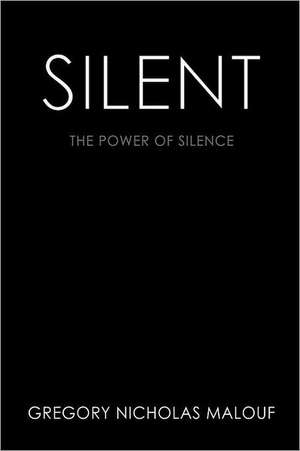
Silent
Autor Gregory Nicholas Maloufen Limba Engleză Paperback – 17 iul 2012
All too many of us create an outer persona or ego self in order to cope with the fear and anxiety we feel on a daily basis. Our ego self normalizes these intense emotions and stops us from feeling anything at all as we drive ourselves towards our goals of financial status and success. In his book, Silent, Gregory Nicholas Malouf asks that we start to recognize what we feel and in doing so, face our truth. Once we are able to acknowledge, accept and forgive ourselves for being afraid, we are able to stop running away, live in the present and so create the life we most desire. In the spirit of Eckhart Tolle and Marianne Williamson, Malouf, founder of Epsilon Healing Academy, frankly reveals his journey from an abusive childhood that will shock you and move you, to his empty existence as a wealthy and highly successful entrepreneur living 'the dream'. A real account of life at its worst and the lessons Malouf learnt to transform it to life at its best, to reconnect with your true, inner self and find the power of the silence within to lead the life you most desire.
Preț: 107.95 lei
Puncte Express: 162
Carte tipărită la comandă
Livrare economică 01-15 iulie
Specificații
ISBN-13: 9781614483212
ISBN-10: 1614483213
Pagini: 290
Dimensiuni: 152 x 229 x 16 mm
Greutate: 0.39 kg
Editura: Morgan James Publishing
ISBN-10: 1614483213
Pagini: 290
Dimensiuni: 152 x 229 x 16 mm
Greutate: 0.39 kg
Editura: Morgan James Publishing
V-ar putea interesa
-
 Our Garden BirdsMatt Sewell-20%Preț: 84.86 lei106.37 lei
 -
 The Animal Kingdom: A Very Short IntroductionPeter Holland-22%Preț: 53.22 lei68.07 lei
 -
 -14%Preț: 354.29 lei413.76 lei
 -
 Dinosaur PaleobiologyStephen L. Brusatte-19%Preț: 501.99 lei619.74 lei
 -
 Preț: 208.29 lei
 -
 BirdscapesJeremy MynottPreț: 156.25 lei
 -
 Crows and JaysSteve Madge-31%Preț: 390.02 lei562.80 lei
 -
 Bird BingoLaurence King PublishingPreț: 131.82 lei
Recenzii
"Becoming our most effective, content self is not a foolish pipe dream or a myth. It is our birthright, and something that is within the grasp of each and every one of us. Not one of us can change our past, but all of us have the power to shape our future."
-Gregory Nicholas Malouf, founder of Epsilon Healing Academy
"Silent offers each reader a guided journey on a healing path to his or her authentic self. It is the candle that will enable you to illuminate your inner light, and in the darkness help you learn how to reflect on and hear your truth so that you can ultimately live it. It is empowering, challenging, and inspiring to anyone seeking personal growth."
- Dr. Jane Greer, psychotherapist , author of What About Me? Stop Selfishness From Ruining Your Relationship
"Gregory Malouf has the courage to share his darkest moments both at the hands of others and his own choices. He shares what I call an "inside out" story where someone takes an experience they would've never chosen to happen to them and turns it inside out, transforming his world and the world around him for the better. Gregory lays out so well what I believe to be our only personal power--that each of us has the power to choose to be the kind of person we want to be."
--Daryn Kagan, Host, The Daryn Kagan Show, author and creator, DarynKagan.com
-Gregory Nicholas Malouf, founder of Epsilon Healing Academy
"Silent offers each reader a guided journey on a healing path to his or her authentic self. It is the candle that will enable you to illuminate your inner light, and in the darkness help you learn how to reflect on and hear your truth so that you can ultimately live it. It is empowering, challenging, and inspiring to anyone seeking personal growth."
- Dr. Jane Greer, psychotherapist , author of What About Me? Stop Selfishness From Ruining Your Relationship
"Gregory Malouf has the courage to share his darkest moments both at the hands of others and his own choices. He shares what I call an "inside out" story where someone takes an experience they would've never chosen to happen to them and turns it inside out, transforming his world and the world around him for the better. Gregory lays out so well what I believe to be our only personal power--that each of us has the power to choose to be the kind of person we want to be."
--Daryn Kagan, Host, The Daryn Kagan Show, author and creator, DarynKagan.com
Notă biografică
Gregory Nicholas Malouf, a successful Australian businessman and entrepreneur, suffered constant abuse as a child. He became a workaholic at 19, earning six figures each week, throwing lavish parties and traveling anywhere in the world he wanted. He thought he was living the 'perfect life'. At age 50, when his world collapsed, he realized that he was living a lie. He suffered from anxiety and obsessive control disorder - two of the many addictions that had ruled his life - why? He had not been able to confront the truth of his past. Malouf now desires to help others by sharing in explicit detail his life experiences and the lessons he learnt to liberate the mind and body. Malouf has written Silent and founded the Epsilon Healing Academy for those of you who believe what he needed to believe - that there must be a better way. And there is!
Extras
CHAPTER ONE
What a Journey . . . Thank God It Is Over!
“Not until we are lost do we begin to understand ourselves.”
—Henry David Thoreau
I was about three years old, and I was lying in my bed with the sheets pulled up just below my eyes, staring at the ceiling. The streetlight shone through the curtain and revealed a triangular pattern of light and shadows across the ceiling.
I lay there, hour after hour, staring blankly and waiting for the world to erupt, the violence to start, the deafening noise to rock my world. Sometimes I would be lucky and drift off to sleep well into the early hours of the morning. I escaped the physical torment, but often had nightmares.
We are conditioned to believe things aren’t that loving. We call for love through our pain, and hear the pain of others screaming for help in healing from their childhood circumstances in reply. How do we free ourselves of these childhood afflictions? We have no idea for many years to come what normal is.
It is as if we walk around for most of our lives with a film of tinted glass covering our very being. It softens the impact of the world around us. We live within this flimsy covering, which offers us the illusion that we are okay.
Our experiences shape our thoughts, words, actions, and reactions. Yet we live almost blind to them, excusing ourselves daily for the subliminal discomfort in which we live. We need time to be—just be, nothing more—and a little silence to help us feel the pains we have grown accustomed to not feeling, feelings we have buried deep within.
When do we stop and take a good look at ourselves? Unfortunately, it is sometimes a little too late. Why do we wait for the dark night of the soul— extreme discomfort in our lives—before we look within (if indeed we look at all)? What is it about pain that makes us so comfortable? Is it the fact that it occurred when we were most vulnerable? Did it form such a part of our makeup that we now use it as the excuse for who we are and what we have become?
Is pain an excuse either for not doing much or for doing too much, thereby exerting the pressure of unrealistic expectations on ourselves and those around us? The pressure of our expectations can leave us grossly disappointed, more often than not, because those expectations are not met.
Do we identify with the drama in our lives and consider it as normal? The drama played out repeatedly in our daily lives gives us a sense of who we are. Although it is not real, we believe it is all we have. It has become who we are— an illusionary state of being, our reality, our lives—played out by drama and our reactions to our past, not inner peace felt in the present moment. Drama has become what we say and do, shaping our reactions to and interactions with others—often inappropriately.
Without drama, what do we have? Our fear is that we would have nothing in the absence of drama. What could we possibly talk about that would ensure people would listen? Definitely not a good-news event or happening, as no one would be interested in that, we think!
It is amazing how much comfort we find in the drama of life and how much comfort it provides our self-proclaimed “sorrowful” souls. If we hear the drama from another, our lives are made easier because we know our lives aren’t that bad. If we speak and act out our drama, we do so to control or seek the attention and comfort of others, merely creating an illusion of our need for the love and attention we so desperately seek.
Stopping this pattern of behavior takes real courage. It requires us to stand for ourselves and not separate from others, but unite with them. It requires the courage to say, “I no longer dwell in a place that criticizes and condemns. I will only dwellin a place where I seek the experiences that speak of joy and happiness—the same places that will bring me peace of mind.”
We criticize and condemn because we hold our past fears within, repressing those fears in order to forget them—yet we cannot forget them.
The violence and abuse became so muted in my psyche that every day I lived a lie, which was observable by the compassionate or enlightened souls, pitied by others, and condemned as bad by many. The lie continued. For as long as I can remember, I needed to prove myself to others. I sought approval from anyone, as I rarely (if ever) felt it while growing up.
When I was eight years old and in fourth grade, my father asked me for my exam results. As my grades had fallen, I told him the results would be available the next day. I had tucked them away in the bottom drawer of my wardrobe, and I hoped he would not remember to ask me again.
I was particularly nervous the next day, and when I arrived home from school, my father was sitting in his favorite lounge chair. I said hello and went straight to my room. My heart sank when I heard him ask, “Have you got your results, son?”
My heart pounding, I nervously replied, “Yes, I will get them.” I retrieved the results and took them to him.
Silence fell over the room; even the cleaner stopped all activity around the home. A tirade of verbal and physical abuse began. His voice was thunderous as he unrelentingly bellowed his condemnation. Within minutes, the belt from around his waist was lashing across my back and legs. The leather belt burned into my skin thirty times, if not more. The next day, no part of my back and legs was visible other than the welts and severe bruising. This was a bad episode.
Abuse often followed financial loss. There must have been serious losses at the horses that particular week.
Continually seeking to fulfill the parts of ourselves that are devoid of love, we track through life in all manner of ways. Our exteriors portray only a glimmer of who we truly are. We are afraid to show the vulnerable side of our Self that could not possibly be loved. Wasn’t it in this state of being our love of Self was lost? Believing any occurrence—bad or indifferent—is personally directed at us, we develop an ego, which is the survival mechanism designed to protect and ultimately destroy everything it experiences.
We begin searching for instant gratification, which eventually drives us. This searching and gratification becomes our escape valve. “What can I acquire next?” Material gain, self-pity, friendship, or a relationship—any gratification will do! We push forward relentlessly, seeking joy where it cannot possibly be found, but seeking it nonetheless.
We carry on through our lives with smiles and laughter, which seem real enough at the time. As our lives continue to improve with material things and things outside us, we believe we are genuinely happy. Regardless of the bumpy roads and potholes we cross each day, we drive on, our smiles and laughter convincing us—and others—that everything is just rosy. Inside, however, we are lost and starved of authentic connection to our Self and those others.
Our conversations become engrossed in judgments, petty jealousies, and criticisms. What matters is that the world we see runs how we see it. Any deviation from that world must be brought into line or eliminated. Our disconnection to Self makes us fear not being in control. This need to control everything as we want it and how we believe we want it leaves us forever wanting and never satisfied. This drives our seeking behaviors and creates our cycle of pain.
Our camouflage is so complete that we can only attract likeminded others to share in our glorious path to material gain or validation. It drives our constant need to be right, our need to be accepted for what we do, and reinforces and validates our behavior. Because we know no better, we choose the path of most resistance, believing it is the least resistance. This path, which we are conditioned to take early in our lives, feeds our anxiety. Each of us seeks something from another in the race to win all—all but nothing and all for nothing. When all is said and done, we are left with nothing. And when we are left with nothing, our greatest opportunity is presented to us.
Do we need to wait until nearer our final hours or that dark moment from the unseen when our dependency on other things collapses to see the truth in this? Or will we act now and open our eyes to know there may be another way? Maybe we can have everything we desire and feel total joy with what we have in our lives and those we hold close and dear.
We hide from the truth, repressing it—as we did when we were children— because it was too painful. When our anger is repressed from an early age, it turns to rage, and our love turns to fear. Still, we magnificently battle to disguise our torment and our grief with outer expressions of determination, confidence, and self-righteousness. We want to be Mr. or Mrs. Happy-Go-lucky! Nothing is a problem, so don’t make anything a problem—or else! We are untouchable, ready for anything, and constantly willing to please until and unless things just don’t go our way again.
I woke exhausted one night from a deep sleep. Screams and obscenities shattered the night silence. My senses were on high alert within seconds. In my haste, I crashed into a half-open door, which knocked me backward to the ground. But I jumped to my feet to protect the one I loved without knowing exactly how that was going to happen.
There was no time to think. As I ran into the room, my father was sitting on top of my mother. Her clothes had been ripped from her body and her airline tickets removed. She’d purchased them because she wanted to go somewhere—anywhere—to get away from him. He threw her from the bed to the wardrobe. His hands were around her throat, strangling her. My mother was fighting, kicking, and cursing; and I, helplessly watching, was begging them both to stop.
He relented for a moment, and she ran from the room to another and slammed the door. He followed, and the abuse from both sides continued. She tried to open the door, and he pulled it closed. She opened it again, gripping the door by its side and pulling hard. His hand was on the door lever, pulling it closed, with her fingers wedged between the door and the frame. All I could see were her fingers and the red nail polish she wore. I visualized her fingers being broken as he pulled even harder.
Fear for her consumed me. I wondered what to do. Without a thought, I jumped on his back and whispered in his ear, “If you don’t stop, I will kill you in your sleep; I will put a knife through your heart.”
The abuse ended immediately. I did not know it then, but I had just lost my childhood.
It is no wonder that we cannot speak of love, joy, peace, and happiness or rejoice in it when we get it!
Why is it people are afraid to speak of happiness, peace, joy and love? Do we fear being ridiculed, perhaps? After all, look what we have put up with in our lives: survival of the fittest, innocence lost, a separation from true Self, and a “you against the world” mentality. It is no wonder many fear retribution for the joy of being.
Wasn’t it stripped in one way or another from you in your youth?
How sad is it that the scenes play out on the larger scale of life and affect so many of us in unimaginable ways—war, famine, and hardship for so many. We are all connected. Each of us plays our bit in the fear-based reality we have come to believe is real. Our unity unconsciousness is a group manifestation, through our powerful creating energy, of our individual unloving, fear-based thoughts, words, and actions.
You are a beautiful soul temporarily lost from your inner, all-knowing Self, searching and yet not knowing what you are searching for. We keep up appearances to protect our identities: the who and what we have made of ourselves. Our ego self was self-made to protect us by the torment of our life experiences. The who and what are ready to ridicule anything or anyone that doesn’t fit into the mold you created to protect your Self. It was a tough mold, impenetrable by anyone other than a mirror of your self—the victim mold that is always at the behest of others. Each person is looking for what can be gained from the other, until that, too, becomes resented and untrusted. Yet we continue to create drama to resolve issues, playing the hero or the poor victim, depending on our circumstances. What it is we seek, and from whom?
We are all motivated to discover who and what we are. That is our purpose in life. Our experiences shape our decisions. Yet what are the experiences on which we rely? To look closely at this very question is a start. All that is required is for us to stop, rest, and think quietly for a moment to offer us a glimpse of doubt that perhaps our reality is not as solid as we thought.
When we watch television news, listen to a radio to hear the news, or read a daily paper, it must confirm at some level that all is not well. Our world is a world in crisis and denial; some of us live beyond our means, and others are greatly deprived.
Our reality requires that to fill the void we feel within, we need to consume, on an ever-increasing scale, things outside us. We consume in such quantity, believing there is not enough to go around, and any threat to that belief is venomously defended. Nations are destroyed, and cultures are wiped out without any respect to their ancient teachings. Children are killed or maimed and left to survive without family or loved ones.
When do we stop the fear of realizing what is important and turn around to say, “Enough is enough”? When do we stand united in our love for each other across nations, races, and all boundaries?
A Moment in Silence
Rest the mind, and feel what it is you feel. Feeling is the key to living, to understanding more about the Self than anything before it. It is what a physical being is here for: to feel the experience of life and unite it with your true Self. Let yourself take time to rest the mind and feel what it is you truly feel.
Put this book down just for a moment. Try. You deserve the rest.
(If you’d like to receive a free audio of a guided version of this meditation, go to my website: www.epsilonhealingacademy.com)
From a very early age, I acted out my unloved self.
When I was eleven, I fancied an older girl—she was twelve! Really, I fancied her eighteen-year old sister. Life wasn’t working for me on that occasion. “Jackie” and I ended up at a drive-in movie car park. It was as if we were both searching for the same thing—love. You see, Jackie’s sister, Nola, looked after her, because they didn’t have a dad, and their mum was never around. It was my first sexual experience at the ripe young age of eleven. Jackie and I were in the front seat, with another mate and his girl in the back. Both were scrambling at each other’s clothes! My heart was pounding. Although I cannot remember it as clearly as other events, I am sure it would have been a messy affair.
Telling my mates about it later was just as much fun as the act itself. I was the hero—the boy of the moment—and I was on top of the world.
The next day, Nola, who was babysitting, became the quest! She let me take her top off and play with her breasts. I felt the love, all right. Nola taught me how to slow down, and among other things, to kiss. Feeling the love became an obsession. Now I was on a roll. I’d succeeded with conquest number two! My mates thought this was magic. I was not a poor little helpless boy—no, not me. I was king for an hour—a minute, it didn’t matter—as long I could distance myself from the helpless little boy I once felt I was.
The conquests never stopped thereafter, and the lack of love was playing itself out. For the next twenty years, it didn’t matter whom I hurt or how much I got hurt. My life simply revolved as it began—loveless. I desperately searched for something outside myself. Women were the grand mummy of all prizes—and the older they were, the better! Did I know any better? How should another soul be treated, especially the opposite sex? I didn’t know. I learned that was all it was to have sex—provide for them, protect them, and be in control—but I did what I wanted.
The cry for love has not stopped. More and more people are crying out for love—and even worse, they are afraid to admit it. They sit in silence—all for the wrong reasons. The silence is not from within, but from without, and it becomes the silence of incessant thinking.
There is screaming in our heads for escape—but from what? We don’t know. We haven’t a clue, because we live in fear of people knowing about us or our vulnerable past—the tormented past buried deep within, where people cannot see, that keeps us entrapped in a world of make-believe and illusion. This past consumes us with fear, so we portray ourselves as people who have it all, are unafraid, are victims, are disadvantaged, and who need to be rescued by a handsome prince or perhaps the person prepared to take on the world, believing we are right and everything else is wrong.
Do you just give up, believing you are wrong and everything else is right? Have you ever wondered why you cannot sit still, brushing it off as a mere excuse for the way you are? Or does your leg, arm, or finger twitch when sitting at work or in church, or at a restaurant or at home with the family? I heard once that this type of activity burns up to 1,200 calories per day. It seems to me like a good excuse not to think about such nervous disorders any longer.
We cannot sit still because we are unfulfilled, needing more to satisfy our insatiable thirst for outer experiences. All this is done at the expense of our healthand that of our loved ones. “I haven’t enough” is the mantra. We need to stop— just for a little while—and turn our thinking inwards. We don’t need to do this for long, just for long enough to feel what it is that we so love, yet so hate, and to ask why this contradiction exists.
Confrontational as it must be for all of us, our truth needs to be told, the truth about our lives that has distorted our views and created our alter egos. The complete truth. Be unafraid to face your truth, because fear is what has kept you in the prison of your mind. Fear has kept us from standing and being heard. It isn’t good enough for us anymore. Dare to ask why you don’t feel good about your unease. You must ask yourself this question with courage and in the face of all past beliefs. Why? To free your Self from the many restrictions you live your life by and to find the peace and love within. The love that resides in each and every one of us is hidden by the shame and guilt we carry through our lives. Truth is the only remedy for this shame. It is in the awareness of past events that resolution of those events can eliminate all carried and toxic shame that created the other you, the ego self, or adapted other self, that was self-created to protect you. Challenge yourself, and ask the hard questions!
You hear the voices of many who are amazed that you dare ask about your life experiences, which are all too often too shameful for anyone to admit to, or the voices in your subconscious repressed by your experiences, forbidding you to search for the answer that you need. It’s all too easy to forget—to repress your feelings and instead live your life in anxiety and concern for the future. You miss the moment when life means something: this very moment!
Know this: Only the truth will set you free. Find the courage, ask the questions, and challenge the status quo. Enough is enough. Do you feel sometimes as helpless as a little boy or girl standing in a room, watching someone you love get beaten, powerless to do anything about it? What story made you feel helpless, worthless, or powerless?
Another Moment in Silence
Sit for a moment in silence and breathe slowly. Focus on your breath. Slow your world down for just a few moments and feel how it feels.
In an instant, a small window of pure rest will be felt. It is in that instant that you are no longer helpless.
Eleven was a big year for me. It was the first time that the world I knew was to completely shatter. It was the first time my family and I were exposed to public ridicule. The police arrested my father for suspicion of murder and prostitution racketeering. My father ran illegal casinos. I used to frequent them often—either in the back seat of Mum’s car at an ungodly hour, dragging him out of the place, or as a guest, sitting and watching my father play cards with the petty criminals and the desperate. It was lucrative for me when I went with him. I would sit at the casino tables with a world of saddened lives around me, listen to their laughter and down-on-their-luck snipes at life, and collect tips from almost every winning hand, obviously given me to impress the club owner: a tip for the son.
It felt good, all that attention and making a profit. Who could ask for more?
The body of man had been stored under the roof of my father’s coffee house. The smell got to be too much, the body was moved, and when an investigation for the missing man ensued, the bloated body was discovered. The police took Dad into custody, and he was released on bail.
Over the course of the next three years, before my father’s acquittal, our family went through a living hell. Mum was a strong woman, and I’m sure for our sake she hung in with him for this period, attending every court hearing and legal challenge. It was a difficult time for everyone. We were taught to keep our heads up, shut up, and power on, regardless.
I recall attending school just after the complete front page of the local newspaper read: “Local businessman charged with murder.” I had no idea what to expect; however, what occurred probably scarred me more than any other event for the next forty years. I was in year eight, my second year of high school. A young mate whom I considered a great friend at the time—we had sleepovers, and often ate at one another’s homes—walked straight up to me and said, “I can’t talk to you anymore. My parents don’t want me to be your friend any longer because your dad’s a murderer.” His parent’s judgment of the situation before my father was acquitted scarred me for years.
The sickness I felt in the pit of my stomach I can still feel today as I reflect on those feelings. I was dazed by these comments, and nothing became relevant for at least a month or two thereafter. For the rest of my life, I would feel the need to continually prove myself. My confidence was gone, and my ego was about to rule everything I did from then on.
Is it the judgments of others that make us conform to a set of rules that we dare not break, even at our own expense? We have created this world in which we exist—where we are the beginning and the end. If we are not, then aren’t we doomed at the hands of so many who would take everything from us and leave us destitute and abandoned? Isn’t this the belief we have been conditioned by?
Have we all been so wronged that we cast our judgments freely, believing we are right and that we cannot possibly be wrong? Our experiences tell us we must be right. We all think the same way: I need my mates/my relationship, because they validate my life journey, don’t they?
But what do these judgments say of us? We don’t dare admit that our lives have lacked compassion and love to sustain us. We think, Look at me; there is nothing wrong with me. I am at the pinnacle of success, my home life is great, and my mates support me, until, of course, something goes drastically wrong.
Any feeling of lacking is a fear-based association with a belief that there is not enough to go around. This fear influences our actions and reactions. We demand something from someone for our gain until that illusion no longer exists and a new illusion replaces it. Each of us who believes that we exist as a separate entity to others will always be out to gain in any relationship. “What can I get out of this?” The more we can see ourselves getting, the more we adapt to another’s beliefs, and we don’t even recognize our motives until much later in life, if we are lucky.
When we no longer feel there is any more to gain, then the relationship turns sour. Our own judgments and criticisms side with another to form a new set of circumstances and beliefs, which are often made up, fictitious by the nature, and ignorant by design. These new beliefs enable us to project that which we feel is lacking in ourselves. What can we gain from this new set of circumstances, regardless of whom (even including our loved ones) we unknowingly hurt or affect?
How can we know any better when the world we have created cannot exist where we are not its center? We are the beginning and the end of all we are. How can we see what deepened hurts we feel? To show any weakness shows our vulnerability, and that means an end to the world as we know it. To many of us, this will be a fate worse than death.
Why can’t we look at the world and know things don’t feel right? And further, we ignore all the tell-tale signs, which appear as if in neon lights above our heads, yet we still refuse to look within. The answer to this question is too easily ignored by most of us on our quest to find the Holy Grail. Our inner sanctuary of knowledge, wisdom, and above all, peace, is the defining moment when changes occur so simply that our own lives and those of our loved ones can change forever. Is this not the belief we have been conditioned to?
Our judgments have been passed on from previous experiences and our thoughts in relation to those experiences. As we understand it, those thoughts and beliefs are then projected forward to shape our future. Past thoughts precede other past thoughts, and so on, and the cycle doesn’t end. The past blends into past, experiences blend into more experiences, all reflecting the same outcomes and reaffirming our misguided beliefs. We continually try to change events, doing more of the same thing, but all the while expecting a different result. It is no wonder the world appears mad—mad by design—or that our design does not allow us to create anew.
Who is to blame for this state of our internal affairs? There must be someone— anyone but ourselves—because the world we know exists as separate from us and thereby deserves condemnation, doesn’t it?
We are truly all responsible for each other, and surely any attack on another is an attack on the very Self. To know this is the first part of freedom. To know this is to stop the cycle of fear based on our past beliefs. Why is it that if our lives are so good we feel so ordinary—and when do we realize that our lives are not as good as they could be? Often we are alone when we have those moments. Does this give us a feeling of insecurity? Does it stir up the emotions and insatiable appetite for doing something to avoid feeling concerned and to disguise the fact that we are hurting?
Knowing this unease is awareness of self. It is the start of the healing process or the knowledge that you are not responsible for the way you were conditioned to live. By owning this—taking responsibility for your life—you can transform it to such a degree that life puts before you all the things you’ve ever wanted, desired, or dreamed possible. Your world will then be full of love, peace, and abundance.
Is it not worth the look? Did we act out when we were young and continue to do so as we shut our eyes, ever hopeful for the best?
It was a cold winter night. We had waited three days to fill our lives with meaning and were bored from doing a million things that amounted to nothing. Those things of little meaning were full of drama and were done to sustain our insatiable appetite for the lack that was felt within. We were doing anything but feel. We were taught feelings could not be trusted; thus, our feelings were discarded. We learned not to express our needs and wants very early in life. We replaced them with anything to avoid the pain of feeling those scars left from our early years.
It was a typical Friday night, and the local community hall was going off—girls, boys, and youth bands! Yep! It was all too exciting—girls and more girls! Love was on tap, if you were really lucky. All of us were competing for the affection of the opposite sex. You had to be in top gear for this event, but who could love me? Where was the courage to talk? Was talk all we were after? Who could possibly have told us, taught us, or even guided us? After a drop of courage, all would be well; the ego would do the rest—anything, everything in an attempt to medicate. It was a great veil to disguise the pain of the past. In effect, we were each saying, “I love my ego. Thank you, self, for inventing it; you truly are a master creator.” We would meet in the thick scrub outside the hall with a bottle of Johnny Walker—always Johnny Walker! The sweetness of scotch whiskey often made us sick, but down it went, a bottle at a time shared between two, and that was just the beginning. Within ten minutes, the effects were felt, the courage shining forth like a peacock with feathers spread. The laughing and fun began.
Oh, yeah, it was good to be twelve!
Cannot the greatest euphoria of all—the silence within—replace the need for substance abuse? Why do so many of us seek the need to abuse ourselves and excuse ourselves for denying who we are and who we have become? We are, perhaps, afraid of our own shadows; we have no trust in the inner Self and no Self- love. Each of us is an all-loving Self; that is how we were created: We were born as an innocent (child), angelic, loving Self. Our life experiences conceal that pure Self. To be in tune with that Self is to enjoy—truly enjoy—the company and love of our family and our children, and better still, the company of our inner Self and the place from where all love flows. When connected to our inner Self, it is the greatest euphoria ever felt.
We cower in our secret lives, often living two lives, and maybe more. The world is made up of secrets—each with an identity and company to match. Yet can we still not see the pain that is hidden beneath the clothes we wear? Oh yes, it takes courage to take on these personalities—these ways of life that give us false meaning, however distorted. The more we rely on them, the more protective we become of them, and the grander our stature needs to be compensated.
Our images of the perfect family, perfect life, and perfect mates have been created individually by us. We have become so disjointed that the world we see is played as if on a projector screen. The movie we play is drama, and from that drama we create more drama. It is our life—it is what we are and what we have lived with, according to our view and perceived reality—but it manifests havoc across all aspects of life. We see, live, hear, and believe in drama, and we choose to do nothing about it until we have no choice and our lives become unmanageable. Don’t keep ignoring it!
Encourage yourself to look within—to embrace the silence that exists within us and all things around us for just a moment. Just for a moment, rest your mind. Love awaits you—it is your love of Self. It resides in the only place it can be heard in the stillness and silence of Self. It is your core energy source. Your brothers and sisters need you, your neighbors need you, and your loved ones need you. Where are you? Come home (the home of Self-love) for just a moment, so that you might see clearly!
Your life can be anything you choose—anything! There is no limit or limitation other than the limit you apply to it. The ego cannot achieve what you seek, because it is made out of an illusion of self. It is a base of separateness from all people and all things that separates from the world around you. It takes without giving. It cannot love, because it is born from fear. It is a survival tool to disguise your many pains. You have been abandoned for long enough. Surely, it is time to come home.
What level of uneasiness do we need to feel before we relent or search for another way? Do our actions set alarm bells ringing, or do we simply turn the bell off, making excuses so that the path we follow and the consequences we will face seem to be of no concern? You cannot escape the reality of the consequences, and those consequences, at some point, are going to hurt. You feel it in the pit of your stomach at the first sign of being exposed to the fact that all is not right; still, you ignore the signs.
From a very young age, I preferred to medicate and to bury my feelings.
It was a regular school day, and I was hiding the pains of my private life, listening to no one except maybe the compassionate geography teacher, who was not like the rest. He was a priest, and he seemed to care about me. He could smile and be proud that I was in his class. It was an odd feeling to have someone care. I thought I might even listen back!
Then there was news that the cool kid in the class was supplying marijuana for five bucks a filled matchbox. My friends and I asked him to give us a box. Never had we laughed so much as we did after getting stoned! The more we laughed, the more pimples we got, because our laughter was rewarded with an attack of the munchies! The rest of the time, life was sheer bloody painful.
The old man was still fighting court battles. The town had all but turned its back on us—once the wealthiest family in town. The brothers of the murdered man visited with guns to ask my father questions. We were herded into our room for fear of trouble at the O.K. Corral. The gambling and legal bills were consuming all of his wealth, and the only part of our lifestyle that gave us some level of dignity—my father’s money—was going down the drain. The abuse on the family was still as much a part of our lives. We wanted to deaden the pain.
At twelve, I used marijuana; at thirteen, I used LSD; at fourteen, I used cocaine; and at fifteen, I was needling coke straight into my veins. At sixteen, I did anything I could. At eighteen, I was snorting heroin; at nineteen, I came to a dead stop. I did not use another drug. It was time to go to work; my family was broke. That meant I was going to work!
My obsession with money became my freedom. I would never let my past experiences happen to me again. I would be in control of my destiny. I always thought that money was the answer.
I remember my mother dropping my father off at the Mandarin Club in the city. I was only seven. We were from a town a hundred kilometers south of the city. I was excited when I saw the high rise buildings. I remember saying to my mother and brother, who were in the car, “One day, I am going to build a building like that.” Thirty years later, I did.
The thing I can remember well about my father was his ability in business. It never ceased to amaze me. He taught me well, although his methods of holding the money weren’t so good.
I never stopped burying my feelings.
How do we know what our loved ones, friends, or neighbors are feeling? We are quick to judge them. Is their pain different from ours? Are not all pains the separation we feel from everything around us, including our own Self? Aren’t judgments our own past fears made manifest into reality? How can we escape our condemnation of another? It is not possible, for what we dislike in another is something we fear in ourselves.
Think for a moment about stopping the chatter and criticisms that we all hook into based on previous thoughts and experiences in our lives. What would we have to talk about? God forbid if we looked like we did not conform, or if we did not see the wrong in others when it is so blatantly obvious that they are wrong.
We judge people because they are new on the block, they challenge our way of thinking, or they are quite obviously out to conspire against us. They are different. They complain too much. They don’t have money, so they cannot be successful. They are dark-skinned, they are light-skinned, or they are not from here. They don’t listen, they don’t understand us, or they try too hard. She’s always smiling; what does she want from us? She’s too nice for this job. She’s too skinny (or too fat). My wife doesn’t understand me. He expects too much from me. On and on we go.
Each time we speak, how many judgments do we make? Indeed, what else would we talk about? We must project to control, feel good about ourselves, fit in, separate, or dare anyone to disagree with our reasoning. We might as well be saying, My reasoning is sound, because I lived a hard time and survived. I made myself against all odds, and no one is going to be able to touch me again. Just ask my ego. It’s easy to find—but be careful how you ask.
To live in a present moment environment is to say, I trust in my Self. I no longer rely on past experiences and thoughts that did not serve me well, as this is what has kept me from knowing who I am or from being who I wish to be: happy, joyful, and complete as part of the all that is, a part of everything and everyone. Now I will let down my guard and release the chains that have imprisoned me for so long. Now I will rest, and the joy of living in every moment is mine.
I needed to surrender and live freely in the present moment. The hardest challenge to surrendering was to unconditionally forgive all those in my past whom I believed had played a part in the trauma of my life experiences. I needed a new framework! I needed not to blame, but instead to thank those I felt had wronged me for helping me get to the point in my life where I could actually feel liberated and at peace. These people had been instrumental in my lessons, and I love them for it.
For several years, I toyed around with different businesses, and at age twenty-seven I entered into the property game. The first sale was made within a week, and six weeks later, I received my first commission check. It was only the smell of money, and I was off on the greatest hunt of them all: freedom! I could feel it, and I thought money was the answer.
Not surprisingly, I was fixated on the chase for money. I was always exceptionally giving of it, as if it was a toy, a plaything. The hunt was relentless, and everything I desired materialistically was going to be mine. There was no second-guessing—I was going to own anything I wanted. I was going to have security for my family and take them around the worldto every continent, if that was what they desired. Wasn’t that showing love? I knew no better. It was the best of me. It was what I had learned. However, they were my desires, and in my obsession I couldn’t see or realize theirs.
Work was never nine to five. I recall my first business required sixteen hours of work a day, and I didn’t even know the suburb where I opened my first real estate agency. All I knew was that it was an excellent suburb after I overheard a boardroom meeting of directors speak of it, and that they were looking for the right applicant to set up a real estate franchise in one of the largest areas of the city. Of course, I put my hand up for the role, and I was met with limited resistance before the owner of the franchise company, a friend of mine, awarded it to me.
Within six weeks, I was open. My first wife, who was inexperienced in administration, sat at the front of the office; I sat at the rear. The rental was $2,000 dollars per week—a lot of money at that time. Such was my desire that I worked the first year, sixteen hours a day, and I popped pills to keep me awake and antibiotics to keep colds and flu under control. I was completely driven with desperate yearning to succeed, and failure wasn’t an option. I demanded freedom and an escape from my past. All things outside me became an obsession. In the first year of my agency opening, we were within the top ten franchises within the country.
I was divorced five years later. I had a beautiful daughter with my first wife, and the guilt I felt for many years after made sure of my commitment to her. I had an additional drive to work, and the only time I would leave work behind was to make sure I attended every available time allowed for my daughter. At twelve, she came to live with my second wife and me—one of the greatest days of my life.
We attract into our lives the circumstances that give us the greatest opportunity for growth at the very times we need them. My first marriage was riddled with difficulties. Communication was poor, there seemed to be a lot of competition for time together as opposed to work or attention sought, and the fighting was constant. History was repeating itself, and there was no escaping it. Learning and inner knowledge was needed, and I knew neither. I thought more work was the answer. It wasn’t.
I kept acquiring all things materialistic, and work continued to be the be-all and end-all of my life. I fixated on outside material gain to fill the even larger hole I felt. In hindsight, I realize that the guilt I felt from my childhood had not been dealt with, and the guilt from feelings of abandoning my firstborn made the guilt worse. Guilt acquired guilt. Negative energy attracted more negative energy.
It was twenty-three years before I looked up. Another marriage had broken, and the only woman I truly loved—the woman of my second marriage—was gone. I had two more children and more guilt than I can ever recall feeling. My marriage to my second wife and the birth of my three children were the greatest moments of my life. Now my life was in tatters—all were gone. I was undergoing counseling or regressing in anger and self-pity.
God had not had meaning in my life since I was a young child. I believed in nothing other than self-survival. I was a fighter and thought I had to take on the world—and I did, quite successfully. But when my second wife left me, it was over. Without her, the desire was gone. It was a long way from being three years of age, waiting for the violence in my parents’ household to start, before I looked up and wondered, Could there be more? Dare I ask?
I did ask, and to all those who played a large part in my experiences, I love you and thank you for helping me find my path back to a loving Self.
Forty-seven years on, my healing began. What a journey. Thank God, it was over.
CHAPTER TWO
Whispering Images that Never Fade
“Awareness is the greatest agent for change.”
—Eckhart Tolle
This chapter relates to two types of life: one that is over nurtured and another that is under nurtured. The question is, are the outcomes any different?
Too often we create images of our self, our ego self, by what we hear others say to us or from those who took care of us or were responsible for us when we were children. Thereafter, we go through life judging others by the same whispered images.
“You are not good enough!”
“You can’t do that!”
“Who do you think you are?”
“Don’t do that!”
“How does someone like you think you can have that?”
“Look at you! Get yourself together! You’re hopeless!”
“You’re an idiot!”
“You’re too fat!”
“You’re too skinny!”
“You don’t look after yourself!”
At the end of a session with a group of work colleagues in which I talked about the importance of the inner, loving Self, and related some aspects of my past and the absence of it in my life, a young man came up and asked to speak with me. He told me that when he was growing up, his life was one of sheer bliss. His mother and father, who are still together and inseparable, nurtured him and provided for all of his needs. They loved him unconditionally, but at age twenty-two, he was finding it difficult to live within his own skin. He felt constantly stressed.
He described his life as “horrible, living with himself.” Every night, he would go out with his friends and speak about all things in his life he could only dream of—money and living the life. He went on to explain how he was constantly stressed about money and referred to the two bills he currently had which were causing him enormous anxiety. He said that his dad, who hated seeing him stressed, had agreed to pay for one of them.
Here were two diametrically opposed lives—his and mine—resulting in the same set of feelings from completely different circumstances. I thought, How is this possible?
If it is love that we seek—and he was given unconditional love, and I was given love only sparingly—then why did the feeling of not living comfortably within our own skin affect each of us the same?
Over my lifetime, it was money that I sought. The purpose of my drive for money and material gain, I believed, was to achieve my freedom. It was through this belief that I felt I would be untouchable—and here resided my freedom. Without material gain, I could not live in my own skin. I thought it was the means by which I could create a world where no one but me could ever control me again and my self-image could be achieved. It was the means by which I could escape the horrible past. I found myself seeking it out and was driven to achieve one achievement after the other, then yet another.
We were two people with completely different beginnings, yet both in the same place.
The images we create in our children can be flawed, regardless of the circumstances of love or the lack of love. The lessons we provide our children create the images with which they will see themselves—within or without—which seem to either under prepare or over prepare them for the world in which they live. Ours is a world of make-believe and myth. It is a belief in all things outside us. We see ourselves as indestructible, invulnerable, and worthy on the inside as long as we have all the things on the outside.
Let us take one of the simplest “don’ts” and convert it to a whispering image. To our children, we say, “Don’t climb that tree.” What we create is fear in our children. Now while there is ground for this belief and our role as caregiver and parent is to ensure the child’s safety, the reality is somewhat different. What we are teaching our children is fear, of course. The children will climb that tree in our absence. They will play and explore. The difference is that our children will climb the tree with an element of fear attached to the experience. Instead of confidence and knowledge of how to play safely, the children will be left with an element of fear. We create fear and want in many areas of our children’s lives from our own fear. We pass on our fears in nearly all areas of our lives.
Perhaps we need to look at that part of us and our teachings. What is it we are teaching, and how did those teachings come about? How many “don’ts” does it take to create the whispering images that create fear—and then want—within us? Perhaps we have to adopt new strategies to prepare our young ones for what lies ahead. We should take the time to supervise, explain, and allow them—in the safety of that supervision—to experience life with confidence and trust. Does a “don’t” suffice?
In my life, I had been under nurtured and abused, whereas my colleague had been over nurtured. Let us look at these two lives and try to understand these realities, both for ourselves, as parents or teachers, and for our children, for whom we are responsible. Simultaneously we should try to adjust our thinking to our life purpose, which is to live as a fearless Self. We all have the same purpose we must align with if we are to truly experience peace and prosperity.
By the time I went into my working life with my toughened shield of survival and mental fixations, I was filled with images of my ego self, subliminal images of lack of self-worth, self-confidence, and self-love. If a compliment was paid me, I would question and distrust the giver of the message. How could you like me? How could you compliment me? Are you just saying that to make me feel better? My mind could picture these subliminal messages. Words, for me, became images in my head. Yet it was those images that ultimately further glorified my self-grandeur. I needed more success to distance myself even further from my past. I’m succeeding, so keep pushing harder! I kept going so as never to return to the place that represented the past. I wanted to bury it deep within, and never allow being judged again.
Here is the funny part. I didn’t even know that this was my state of being. I had no idea. A driven soul normally doesn’t have any idea, because it simply doesn’t look at the signs. There are plenty of signs, yet the driven mind sees no barriers, and if there was one, it would be dismissed.
Negative words that were spoken would be met with immediate resentment and retribution. When called upon to defend my position, it was all too easy to attack. If a relationship suited me, the attack would turn to forgiveness, and then later open to attack again. No basis of stability can possibly exist in an unhealed mind. The notions of trust or lack of trust—being the persecutor or victim—play over and over to maintain an image and a sense of belonging.
Feeling deprived of something will create an attack in us. Our experiences have taught us of lacking. Through lacking, we attach to things. We label these attachments as things that are necessary. These things could be people, material possessions, or love. This is how we are taught. Love becomes an attachment. Things become an attachment. When we feel deprived, we project our lacking of this attachment onto another and attack them. You feel, in this sense of lacking, that something is being taken from you; hence you project, then attack.
The images in my head could never fade, because there was no place of healing or true expression of feelings. Feelings were dead; the images had replaced them. The images I created were so devoid of love that I only expressed images of love out loud. I was eccentric by conditioning, expressing laughter and love loudly, because I yearned for love and humor. By choice, friendships were minimal; after all, could I trust likeminded individuals sticking together in fear? We don’t let too many people into our lives, because someone might see a flaw or have a different opinion—one that we don’t like.
Acquaintances were all too easy. There was much to be gained: among them, a sense of self-worth, validation, and acceptance.
Rebellion and fearlessness are born from fear. Never say die, fight for everything, and create everything you dreamed possible. Keep going. Keep acquiring, for you are untouchable now. And those images are still there, whispering sweet nothings in your ear. “You are not good enough.” The voice would whisper back, “Prove me wrong.”
A beautiful word is said, and attachment results, leaving you looking for more beautiful words, yet believing none, because the images were real to you. After all, you were conditioned from a young age.
When I met my second wife, she often spoke loving words and was supportive in many ways. I felt a real loving connection, yet due to my past experiences, I feared intimacy. While I loved hearing her loving words, I could not trust them completely. We often broke up and then would make up so that I could hear more loving words.
I would affirm her by what I perceived as loving action and words to show my loving intention; however, like me, she could not hear them much past the moment those words were spoken. She chose instead to continuously act out her jealous behavior from her own fear of abandonment.
You are conditioned early to stop believing in your inner Self and only to believe in your outer you, the separate you, the survivor. A picture of fear comes to replace any picture of inner trust and confidence. Outer pain suppresses inner love.
The exchange begins. “You give me this and I will give you that.” But the people involved are rarely content! Yet the young boy or girl within constantly calls out, These images I see are not me. Look, I will prove you wrong. Look what I can do. You do, however, believe in the images, and they never fade—no matter how much you acquire. Love and trust doesn’t exist here.
You are told, “You cannot do this,” and you respond, “Yes, I can” to prove the images wrong—resisting, taunting, and controlling whichever way. Anxiety and concern are constant companions, which you actually make your friends. You hear the advice from someone less healed than you: “Leave the chip on your shoulder.” This now drives you and guides you.
The time of the breakdown of my first marriage was the time I first started making serious money. I could not understand my unease or the guilt I felt for the breakdown of the marriage, or the feeling that I was abandoning my little girl. I asked my father, “Why do I feel so uneasy, and why can’t I stop doing? I have no rest in me.”
My father replied on the rare occasion we spoke, “Son, don’t worry about it! Leave the chip on your shoulder—it will drive you.”
The images are now your servants. You use them, for they are creating your world. Your perception of your freedom lies within them. How clever we are to create a world in which we are free from fear and pain. No wonder we are given the title of creators, creating in the image and likeness of God.
Yet what are we creating? We create distortion and illusion in place of joy and bliss.
Yes, we will prepare ourselves for the challenges and negativity we will surely face in this world. We will similarly prepare or under prepare our loved ones for what we believe exists in our reality—often in defense of what we see to be real, based on what we have or have not achieved, or based on what we have been taught. Our words and actions will be passed on. As a result of our teachings, we will pass on those whispering images of who we are and what we have made of our adapted self. If the images made us who we are—regardless of how distorted— then we believe in the images. They are us and are bred in us, and therefore we believe they must be right. Look what I have created, we say, believing in the images of who we have made of our self.
Do we pass them on? Of course we do—just like our parents, and their parents before them, did. It is generational.
“You did a good job.” You ask within, nervous of the retribution for failure, Did I? We are comforted by the fact that we have been given a reprieve from the retribution that will follow for failure, but we ask ourselves, When will they change their minds and realize I did not do a good job? When will I stop doing a good job? The driven mind continues on its path.
Do we ever escape the images? No, not without awareness! Why do we wait for crisis in our lives before we look within to heal that unhealed part of us? The healing must come, as it is our physicality that creates the opportunity for remembering the true inner Self, the healed Self, complete, all-loving Self. We must return to it, for it is how we were created. It is inherent to us; hence we feel anxiety when we are separated from it. Why would we feel anxiety if being separated from the all-loving Self did not affect our value system? That instinctive aspect of Self that goes beyond physicality.
We look at a person who has been nurtured and ask, Why? What basis has he or she for discomfort? What images he or she subjected to? And it is here that the other half of the puzzle is answered. Are we overprotected and under prepared for the world at large? Have we nurtured our children to the point of inability? “Don’t do that! I will do that for you! Let me do it! When are you going to learn?” What responsibility do we give our young? Cannot a six-year-old pick up his or her clothing and put it in the laundry bin? A seventeen-year-old can babysit a sibling. A child can help with the housework.
All of us need to experience life to know who we are. Without the experience, what would be the purpose of us being here? Life must surely have a purpose.
We have a purpose here on earth, which is to experience everything we are. In that experience, we grow and become more conscious. Teaching a loved one to believe in the inner Self and trust in that Self is the greatest gift we can give.
Consciousness is our connectedness with love, allowing us to be conscious of all the beautiful things within and around us. We cannot see the beautiful things outside of us, no matter how hard we try, unless we see the beautiful things within us. Without love of Self, felt deep within, the images of what you see are devoid of love. Therefore, everything we see is questioned, mistrusted, or distorted, because it cannot come from a loved-based place and thereby sustain trust and bliss within it. What we see, in effect, is not real; ours is a world of illusion. As we continue our discussion, you will soon come to understand in a healed Self the world’s illusion is self-manifested for a purpose.
Life has a meaning and an intentional purpose.
Now the experience and purpose come into question. How do we know love without its opposite, fear? Yet love has no opposite, as it is the conscious energy of creation. It is the essence of all life. We would not understand the perfection and wholeness of that love unless we experienced its opposite: the self-manifested (ego) opposite of fear. Love, being the construct of all creation, knows no fear; therefore, it has no opposite. Love is real; ego manifestation is a distortion of true reality.
To explain further, how would you know what the idea of “left” is if you did not know what “right” is, what “fat” is if you did not know “skinniness,” or what “tall” is if you did not know “shortness”?
If we are born into a loving environment, that does not mean we are exempt from fear or pain, which were self-created for a reason. Our loved ones protect us and look after us so well that we no longer feel capable to look after ourselves. Two bills are in the mail, and we fall apart. Stress over the slightest thing becomes all too much to bear, and we project our concerns onto others, manifesting more of the same. Sadly, we wonder how kids from good homes and apparently wonderful lives commit suicide. Perhaps they were over nurtured and thus were under prepared for the world they would be exposed to.
Our purpose is not to abuse, enmesh, or abandon our children, nor is it to nurture our children to the point where they are incapable. We over nurture children only to satisfy a deep yearning or fulfill a deep-seated need of our own as parents, teachers, or caregivers. If we express love and it comes from a sense of lacking within us we can, in a sense, restrict our children from expressing their own creativity and pure potentiality. We must encourage them to use their creative and imaginative aspects to solve their problems and the many questions that life poses. We must teach them to trust themselves and trust in their inner Self without fear and thereby stop the cycle of whispering images. They must learn to solve issues for their healthy development, which will allow them to grow into functioning adults.
The answers are found in the silence of the inner Self, the silence that will be their home when faced with life’s challenges. This silent place is the only place of knowing! By connecting to the inner Self, we restore our trust and love in our Self.
The outside world projects lifestyles of the rich and famous, and so we yearn for that which someone else has. We feel unworthy of the images we have created of ourselves. We say, “I can’t do that,” yet in an equally loud voice say, “I can do anything,” feeling it deep within the recesses of our minds, but not believing it. We do not believe it because we have grown to rely on our teachings. Perhaps we have had everything done for us or have not been able to express a point of view. Perhaps we have had someone always there to over protect us and solve our problems, defend our cause, over esteem us, and make us feel nothing is good enough for us. Worthlessness sets its mark. Anxiety forms as much a part of our lives as it does the lives of the abused and abandoned child.
The time to prove those whispering images wrong begins as we fight to gain the upper hand. There is no escape from this. This is the very reason we are here. We need to know who and what we are—and who and what we wish to become.
For most of us, to do nothing is to deny our very existence. In the effort to prove images wrong, the doing becomes misguided, poorly perceived, and poorly directed. People or things outside us become our quests and our trophies. We say, “Look who I am or what I have!” The images are a constant reminder of why we are doing or not doing things, regardless of the relationships or the material gain we have or don’t have. Things outside of you can never fulfill you and can only satisfy the images that you see of yourself. But they won’t fade until you choose to recognize that they are a part of an unhealed past. In the inner silence of Self we can start to identify with this truth. It is in the silent place of knowing that our answers to our discomfort can be recognized.
It is in the awareness of this—and of those false images—that true healing can begin.
Fulfillment can only be felt in the body. Do you feel at peace, or are you constantly feeling a sense of lack, always thinking of the future, and delving constantly into the past? Are the images that whisper sweet nothings forever keeping you in a place of wanting? Do these images make you feel you are never achieving enough, nor appreciating or accepting what you have accomplished or what you have in your life in the present?
It’s time to look for a new path. Can you see the signs of disillusionment in neon lights before you? Are you happy? Is the happiness short lived? Does it vary between highs and lows, love and hate? Do you truly know what joy is? Have you felt it for more than a day or a week without reacting to or creating drama? When was the last time you stopped for a moment and were grateful for everything in your life? Do you genuinely feel loved and secure? Do you know what love and security really are? Do you genuinely feel love in your life?
Our thinking never ceases its identification with our mind long enough to align with our inner Self. We are literally trapped within our minds and are constantly acting out those images that never fade.
The images are working overtime, keeping us from this place of knowing. To recognize such peace and joy would completely deny what we have created: the end to all we have grown to rely on and believe so well. Do not say I am wrong, we are saying. Do not attack my sense of self, my sense of worth. It is all there is, and it is all I have.
How wrong we are!
CHAPTER THREE
Dancing with Your Shadow
The shadow holds our deepest secrets. It is the choreographer of our dance of life; it constructs our performance.
There are two of you: your inner Self, all-loving soul and your ego self, or shadow. The shadow is who you have created, and it takes over the body. To not create your shadow is to believe you are doomed to a life of toil or torment.
While we all understand ego and the many interpretations given to it, some will argue it is good and some that it is bad.
I describe it as a negative, dark force that was self-created by an unloved self that lives in fear. It is the self that needs to impress, be continually validated, and control or manipulate for its false needs and wants. We think the ego guides us well because it was self-created in order that we can survive and provide for our false needs and wants that become our selfish attachments. Such is the fear that we live by and with.
Your shadow is who you have become. You dance to its song, for the song is your survival. It is your other self that is nothing more than an illusion of the real you. The ego or adapted other was created for your benefit or detriment by you—the master creator. The ego’s benefit is to experience all there is to experience, and the detriment is that the end can only be death. The cycle of life continues, for even in death is a benefit: the death of an old way or misguided teaching.
It is our shadow that will lead us to this path—a new beginning with new fulfillment and loving meaning.
It is our purpose and innermost desire to experience life to the fullest; yet we are not conscious of this purpose, believing instead that we are at the whim of life, not the creator of it.
Your shadow is created after birth by the physical nature of the form you are. Its appearance will take on, and reflect the essence of who you will become by your conditioning and learning. You create your shadow, but everything within it is the illusion you are taught to see. The image is the shape and form of your physical being. It is an energy of physical form that is similar, but directly opposed to, its host, your soul. It will follow its creator and act as you command. It believes it will protect you from harm; yet harm is all it knows.
If you are attacked, it will attack. If you jump, it will jump. If you sit, it will sit. Stand, and it will follow. Walk, and it will do the same. Sit in silence, and it will sit with you—reluctantly. It is your constant companion and a mere reflection of the false you.
The Shadow Effect
Sit in grief and draw a picture of what your shadow will look like.
It will create thought, and then use the body to create pain to feed the thought. It will resist everything, for it trusts nothing, and resistance creates negativity. A cycle of more negativity continues.
Letting go is the mantra of the soul. Holding on is the mantra of the shadow.
My world was one of make-believe, yet I thought it was one of success and gain—even happiness, due to outward things; hence the need for more of them. I did not even know at the time the definition of joy, because I had so little of it to cross reference. Everything I did was from the point of escapism, yet I did not know it. I created a world with tenacity and doing. My incessant thinking was relentless, and so was my relentless doing. In that relentless place of doing, great energy was exerted. My shadow vibrated for all to see, and it was an attraction for many—many who gave up rather than fight. They hung on, and I hung on to them.
What, however, did I attract but more of the fear I had grown to know so well? My shadow danced for the world to see. More wasn’t enough to allow me to escape the past—the place I knew well and could not escape, no matter how hard I tried. I needed to dance. My life was a dance show, and nothing more.
I had a passion for doing, and doing was the engine of the vehicle I drove. Attracting others was easy. Others wanted to jump on board, not knowing how to get to that place called success. The passion was so intense that it inspired others to action. I became the center of other people’s dreams and the escape from their reality. We were the same, yet different; we had the same goals and dreams, but with different physical expression. Mine was driven. Relationships danced a while or faded away.
Relationships came and went. The toll was too much for some; in fact, most of my relationships—if not all of them— ultimately failed.
I found I was particularly good at what I did—surprisingly so! I searched relentlessly for the vehicle that would lead me out of the dark, forbidding place I had lived in for so long—my childhood drama—and onto the path to somewhere—anywhere but where I was. I found a path, and it all appeared good. Yet what was I creating around me? I was creating a world of people, events, and material gain to fill the void of the discomfort and hate I felt inside myself. I was inspired for my own gain, and such was my obsessive control that I believed I could help them by my desires. My ego self, or dancing shadow, had no realization of another’s desires.
I liked myself when I was successful, and my shadow danced for all the wrong reasons. Surrounded by love—but not knowing what real love was—I could not see it. All I could see was the need to control, protect, and acquire more and more so that I could feel good. I owned a business that employed twenty people—then thirty, then forty, and on we went.
I needed to build a high-rise building, then a shopping center, and then more, because it was there to do. My shadow danced with happiness for the world to see. I felt sporadic happiness until the goal was complete— but then what?
“Just one more thing and I will finish” was something I had said to my loved ones for a decade. I needed that shopping center, as it would underpin the financial position I created. It needed to expand to underpin its value—and so the task of doing continued. Each event took energy for itself, leaving little for its host to share with itself and give where giving would be well deserved and appreciated. I kept the energy up for everyone else of like kind so their performance underpinned my own. I needed it to survive. It was the law of return on investment, or give and take. Other than material possession through business, where were love and joy as true rewards for the effort and personal gain acquired over a decade or two?
The next real estate development needed to be built to acquire the cash flow to sustain the expansions elsewhere. One thing was underpinning another, and the shadow continued to dance to its own tune—leading, never following. Imagine all this vibrancy without clarity of vision: It was well-organized chaos, passion, and control, and obsession was its method of communication.
Our shadow dominates our life and separates us from our conscious, loving, inner Self. It is made apart from the Self, yet formed in the image and likeness of us. We become so enmeshed with it that we no longer feel the pain it creates. In my own case, my pain was expressed every day from people dancing to my needs, not their own, and resentment was the ultimate winner. We think, Here is proof for all to see: a dancing shadow. We will follow what it says and see where it leads us. It seems strong, resilient, and invulnerable. We may get something from this; let’s dance with it.
We can become the glue for other people’s lives. Have you ever felt that way or referred to yourself as “the glue”? Creating a world for yourself and others while the essence and energy of you is drained, you continue to hold on, fix, or resist, which sets you back on the path, looking for more to fill the void you feel inside. Nothing is fulfilling. If this is so, you need to just let go. Trust!
Who suffers the consequences of your actions? Who else but the ones you love or believe you love. Can a person who does not like his or her true Self truly like or love another?
We are not talking of the shadow self created out of the fear we were fed. That self lives on fear, creating drama to feel content and alive. Rather, we are talking about the true Self that was created at birth, the Self in perfect harmony with all that exists. It is all-loving and accepting of all that is.
I would come home to my beautiful wife and seek love in return. After all, didn’t my efforts deserve that? What I received was the stark reality of what I was creating. High-intensity energy drained the essence of all I loved, leaving no room for my loved ones to be who they were. My world was based on expectation and result. Everyone had to fit within my world. I believed material things were a gift and an expression of my love, not realizing what the definition of a loving relationship was. I did not realize what a healthy relationship was or what love was in its true sense.
It was many years before I knew what love and being in a healthy relationship were. To love is to let those you love be as they wish to be, not expecting anything in return from them, having no expectation of them, and having time for them. To love is to listen unconditionally, to share, to be vulnerable and open, to be comfortable and accept the other for who he or she is and what he or she says, containing your reactions in a compassionate manner, expressing your needs, and being accepting of theirs.
Your shadow cannot accept love or a healthy relationship. It will sit in grief and despair because the other failed to meet something you expected and didn’t receive. The shadow will be relentless at fulfilling your life, however amiss. It cares little about how another is fulfilling his or her life. It will control, judge, or play victim to meet its goal, and when that end is met it looks for more. We become so centered to the false self that we cannot see the needs of others, and we become disappointed when they no longer fit within our needs. Your shadow is nothing more than a shadow. It has no power other than the false sense of power you give to it.
You may say things like, “I’m doing it for them, how ungrateful they are.” Slowly, the shadow absorbs the other’s energy, and the craving intensifies the need to control and manipulate. The shadow needs to dance to its own tune, hoping all others will reinforce it. It continues to search for all things outside it to keep up the charade. We search in places we don’t want and cannot refuse the journey, even though our inner Self demands we stop. What do we stop for— more of the same? Won’t we lose everything? Have we got enough to protect ourselves? We keep dancing, forever in fear and never realizing it. How can you rest? The world you created is showing signs of wear and tear, but you must fight to restore and reinforce your creation. Resistance becomes torment. Relationships lose their gloss.
The more we fight, the more our lessons intensify, and the more we are drained of the vital energy of life. We search for it in others to prop us up. The false self needs to constantly be validated and seeks approval to medicate itself. It never stops dancing. It can’t stop dancing, for it knows no other way other then death. We become fickle and attached to the highs, and suffer many lows in disappointment.
When I arrived home from work each day, I was met with anxiety, resentful silence, and uneasy smiles. Misinterpretation was normal, for love was not adequately expressed by either side. The children—who could only love—were disappointed once again because of the negative energy felt within the home, and they would quietly suffer as a result. In the recesses of their minds, they would quietly wonder why, but they learned that this was normal.
Gratitude no longer resided in this home, and our shadows would walk cautiously, fearing attack. The bodies were exhausted, but ready to attack. Both sides were locked in a duality of minds; both relied on their own self-opinions and beliefs. Disappointment wears its host down. The egos were playing their roles perfectly.
Our shadows are all we have to guide us on our paths. Many people find this a difficult concept to accept. Our egos contain our subliminal or hidden messages, and fuel our misguided beliefs and false perceptions. We have relied strongly on our adapted self to protect us throughout our lives. Any reaction we may have to this statement is given because our egos are not taking responsibility for our lives. Yes, the ego must control us, but it will take no responsibility, because that is its control mechanism and its belief in the distortion it creates.
We cannot follow the inherent values we failed to see or choose to look for. They have become clouded by a false reality that is self-created from the pain of our past. The ego is born from the pain of the past; that is why it is frail and ready to attack. The ego knows its foundation is weak and based on fear. It will always seek validation to feel the missing love, and when things do not work, it will blame.
The ego will be your constant reminder that you need to keep seeking acceptance from others. It will tell you to make a phone call, then another; to send text messages, looking for a reply and more validation; and to spend to make yourself feel better, then show off your wares to others, as if to say, “Look at me.” Yet we fail to be able to ‘not-do,’ just to sit within, sit with Self and feel whatever it is that we feel. The path of doing is endless, because true feeling has been lost to fear.
We see a world full of everything we want, but we learn to keep wanting. We search out the means by which we can acquire this new reality or we become disheartened and give up on it completely and live with judgments and criticisms. The lives we were dealt were unkind and unjust—or overly kind, to the point of our loss of Self-worth.
We think, What value will I follow but the value I place on survival, acquisition, control, opinion, or judgments? Surely I will follow no other. I can no longer believe in any inherent value I abandoned long ago or once believed to be right in the time when innocence knew itself within. This belief would mean I could no longer have what I have or the belief that those values abandoned me and left me forever wanting. It must mean I am wrong—and I cannot possibly be wrong, because that would make others right. If I am wrong, then I must be less than what I have made of myself—the person I made against all odds.
When we reunite with love of Self, we start to feel the pain within and see the image we have created. The fickle, impermanent world we know deep within that we created is merely an illusion, a drama, an act; yet we have hung onto it tightly. The past and future became the intense focus; incessant thinking becomes a prison, and we believe that this is the normal process of life.
The only moment that will ever mean anything to us is now: this very moment with a loved one, this glass of wine and a good companion, the Self in silence and meditation, being aware of true Self, talking with our children and seeing the smiles on their faces, laughter overheard from another room, writing in a journal and realizing our blessings, acknowledging with gratitude the many wonderful things in our lives, taking the time to see and experience these things, or forgiving someone! These are the only moments that mean anything at all.
Life has blessed us with many wonderful sights and sounds, yet how often do we see or hear them? Rarely, if at all, for the world we see consumes our every thought. We become blind and deaf to the point of numbness.
You are numb, and it is no wonder you cannot feel anything, as a shadow can’t feel. Who has shown you another path? And if they have, were you ready to perceive it, like you are now? Deep within, you know contentment is lacking; you feel separate from everything and everyone but still do not understand why.
Let Life Show You
Let a new song guide you. Let it be the sounds of nature: the blowing of the wind
Hear the wonderful sounds you are blessed with each and every day and fail to acknowledge: the laughter of children playing, the happiness of your partner, or the sound of a friend’s voice.
These are the only sounds that will ever mean anything.
We can choose today—right now—to connect with life in many ways. This is the beginning of present-moment awareness. Observe all the things around you, and then feel what it is to
feel in those moments of pleasure and silent rest.
We must learn to reconnect with our inner Self. In our inner Selves, our minds will connect with our spirits, and the peace that we have only ever desired will be found in abundance.
All our lives, we have either been over conditioned or under conditioned for the material world of which we are each a part. We judge abundance as if we are deserving of it. It is our inheritance and birthright to have all that we desire. We are here to create, yet we fail to create what we most desire. Now, while there is good reason in the creative plan of evolution for this, the moment we choose to heal and see past our belief in lack of what we think we don’t have in our life, the quicker and more imminent abundance will be made real in our lives. While we believe there is scarcity in our lives, pleasures within it are substituted with judgments and criticism of those pleasurable things. We believe pleasurable things are beyond our reach. We might judge money and the people who have it, for example. We might judge sex as if it is a bad thing and should be limited or restrained, and we might judge anything else that gives us these pleasures and joy. These judgments then become our lessons and opinions, which we pass on or teach.
Let go of limited thoughts and attitudes. Just drop them. Accept people for what they have, and desire all you wish to desire without feeling any guilt or judgment. Whatever you desire, you can have. The secret to having is in the gratitude of receiving. The shadow lacks gratitude; it holds on to resentment and the past. Through fear, it believes nothing is forever and everything is susceptible to loss, so attachments become all too important. The shadow self believes what it has is never enough, and it is never satisfied. We create a world where limitation, and having without appreciation, or not having, becomes our reality. Attachments to people and things then become far too important.
Whether you are deprived of love and filled with lack, or overly loved and deprived of the tools to face the world we know, you are here to experience life to the fullest, and you will. It will also be your choice to feel the depth of pain in those experiences or celebrate in them. It is your choice alone. Your suffering will be directly linked to the length of time you allow your shadow to lead. The longer you fail to recognize or own the truth of your life, face the lessons you have been taught, and question their validity, the longer you will suffer.
To deny the very essence of us—the all-loving, resourceful, and complete Self—can only bring painful experiences which we must face. We cannot escape the reality of being all that we can be and therefore experience the multitude of possibilities awaiting us. How can we decide to deny ourselves the opportunity to be all we can be? We create the very things we need to evolve; it is our life purpose, who we are and, why we are here. It is through those experiences that we understand the relationship to the all-loving Self. We must all return to the loving, complete, and joyful Self that we are! In this state of being—referred to as our divine state of being—all that we seek is given, and all that we desire is made manifest.
The process of understanding this is made possible by, of course, the ego—our shadow. Yes, the thing that attempts to control you will ultimately destroy you. The ego is the very thing that will reunite you with your true Self. The constant fear that this aspect of your physicality will manifest in you assures your return to the peace that exists within Self. Be thankful, with no guilt of anything you have ever done. Recognize what it is you have done instead, and be grateful for this awareness. It is the experience of it that has brought you to this point in your life and to experience a new reality. It is your soul’s purpose to experience love, peace, and joy in this physical form, with all life’s ups and downs, and to live comfortably within it.
It is when we connect to our divine Self—our true inner Self—that all we have in our lives and all we have achieved or acquired can be fully appreciated. It is here that we do not depend on anything outside of Self. Thereby, what we have and who we have in our lives can be completely appreciated. There is no reason— through expectation, control, or feelings of never having enough—to cause anguish, because those behaviors will not exist in our lives. What we do thereafter become acts of love, and what we have will be totally appreciated, enjoyed, and accepted. Our lives take on a different meaning; we become grateful for the things in our lives. In gratitude, our lives will flower.
The shadow, by comparison, with all its suppressed secrets and hidden messages, needs to constantly seek out. Even when abundance is all around us, the shadow is never satisfied. Our failure to see that creates a hostile, unloving reality. When we are free of the affliction of an unloved self, the sight becomes all too clear. Life is instantly made easy. We no longer attach ourselves to people and things. Many of us create numerous attachments in our lives, although we do not even realize this until they are taken away from us.
A Simple Observed Attachment
A simple attachment to observe in this moment may be your mobile phone. Leave it for a day, and make no calls or text messages. Observe and feel your reaction. If this activity creates a body sensation or pain through anxiety, then you are attached to it. Your pain and anxiety means that you cannot be without your phone because you fear sitting with your Self. You fear being alone because you may have to face your feelings.
The need for contact and to feel loved, accepted, part of something, or validated becomes an attachment. A constant attachment to an outer form is such a common practice that very few of us even realize our attachments. It is only when they are taken away that the reality of these attachments is felt. Often, attachments are brought to the light of awareness through adversity, such as when a person or a material possession we are attached to is taken away from us.
Hence, there is a need to connect to the silence within to start the process of unraveling the truth of our lives that has limited our enjoyment of life. There is nothing lacking in our lives! Everything that happens to us happens for a reason.
When we grasp this concept, live it, know that nothing can harm us, and know that nothing is lacking in our lives because we feel complete wholeness in Self, we release ourselves from attachments to outer form, which create resistance and anxiety within us, and thereby we stop the drama of life and the pain associated with it. Then, in the outer form, outer things will be enjoyed, accepted, and appreciated in gratitude, and more will be readily given. Without attachment, the people or objects that were once those attachments become the joys of life’s abundance.
The transition of this, while difficult for most to understand, is in fact one of the greatest joys of life. The gifts of life are ours for the asking, while attachment will create resistance and anxiety and stop or limit more abundance. The limiting of abundance then fuels the need for more through feelings of scarcity, and the cycle of not receiving and forever wanting continues.
The shadow will unceasingly attach to an outer form, for it cannot accept non-resistance, letting go, and just believing in the process of life. The shadow was made by us to control, as we were controlled, and thus its dance must be distorted. By contrast, when we connect with our true Self, the joy in being who we are allows us the freedom to enjoy all the people and things around us. In this connection, all that we acquire or experience—money, a car, a house, sex, relationships, children, holidays, sitting in a park, going for a walk, or exercising—is made and appreciated in complete joy. Joy is felt when acceptance is the connecting point to life’s blessings, and being aware of those blessings is the key.
A Boy Outside the Gate
When your soul has a blindfold on through its human life, it is virtually in an obsessed-like state; its outlook has been depressed, and its future—severed as the trap of your mind—is now in play. Look at your shadow, as it is leading the dance.
The reason? The blindfold , the ego, does not allow the light to come through, so it keeps your thoughts in darkness, enjoying the control it has over you.
Fear is now the ruler—uncontrollable jealousy, irrational behavior and swinging emotions that cannot be understood, less alone explained. These emotions are now running riot inside your head.
The pain you endure is self-inflicted; your wounds and scars are bleeding in the form of words, life's colorful theatre, now on stage.
And actually, these souls are very easy to identify.
Look at these souls; look closely. They seem to be stuck— caught in a deep place, going over and over the same thing, just rehashing it—and why? They cannot see their life’s lesson they set out for; they believe they are lost. They have been abandoned; self-pity feels good and comforts their ego.
Will you allow the ego to suppress all that is good—to tell you that there is no spirituality? No enlightenment and no hope?
Let the ego go! To take off the blindfold is the highest level of detachment!
Meditate and breathe, and look inside you. Connect to your inner Self. Let the light of your inner Self enlighten you, allowing all to be, without judgment and only good intentions, as there is only good within us all.
And only good will stand to serve you. Now your shadow no longer is. It is your true Self that leads your dance.
What a Journey . . . Thank God It Is Over!
“Not until we are lost do we begin to understand ourselves.”
—Henry David Thoreau
I was about three years old, and I was lying in my bed with the sheets pulled up just below my eyes, staring at the ceiling. The streetlight shone through the curtain and revealed a triangular pattern of light and shadows across the ceiling.
I lay there, hour after hour, staring blankly and waiting for the world to erupt, the violence to start, the deafening noise to rock my world. Sometimes I would be lucky and drift off to sleep well into the early hours of the morning. I escaped the physical torment, but often had nightmares.
We are conditioned to believe things aren’t that loving. We call for love through our pain, and hear the pain of others screaming for help in healing from their childhood circumstances in reply. How do we free ourselves of these childhood afflictions? We have no idea for many years to come what normal is.
It is as if we walk around for most of our lives with a film of tinted glass covering our very being. It softens the impact of the world around us. We live within this flimsy covering, which offers us the illusion that we are okay.
Our experiences shape our thoughts, words, actions, and reactions. Yet we live almost blind to them, excusing ourselves daily for the subliminal discomfort in which we live. We need time to be—just be, nothing more—and a little silence to help us feel the pains we have grown accustomed to not feeling, feelings we have buried deep within.
When do we stop and take a good look at ourselves? Unfortunately, it is sometimes a little too late. Why do we wait for the dark night of the soul— extreme discomfort in our lives—before we look within (if indeed we look at all)? What is it about pain that makes us so comfortable? Is it the fact that it occurred when we were most vulnerable? Did it form such a part of our makeup that we now use it as the excuse for who we are and what we have become?
Is pain an excuse either for not doing much or for doing too much, thereby exerting the pressure of unrealistic expectations on ourselves and those around us? The pressure of our expectations can leave us grossly disappointed, more often than not, because those expectations are not met.
Do we identify with the drama in our lives and consider it as normal? The drama played out repeatedly in our daily lives gives us a sense of who we are. Although it is not real, we believe it is all we have. It has become who we are— an illusionary state of being, our reality, our lives—played out by drama and our reactions to our past, not inner peace felt in the present moment. Drama has become what we say and do, shaping our reactions to and interactions with others—often inappropriately.
Without drama, what do we have? Our fear is that we would have nothing in the absence of drama. What could we possibly talk about that would ensure people would listen? Definitely not a good-news event or happening, as no one would be interested in that, we think!
It is amazing how much comfort we find in the drama of life and how much comfort it provides our self-proclaimed “sorrowful” souls. If we hear the drama from another, our lives are made easier because we know our lives aren’t that bad. If we speak and act out our drama, we do so to control or seek the attention and comfort of others, merely creating an illusion of our need for the love and attention we so desperately seek.
Stopping this pattern of behavior takes real courage. It requires us to stand for ourselves and not separate from others, but unite with them. It requires the courage to say, “I no longer dwell in a place that criticizes and condemns. I will only dwellin a place where I seek the experiences that speak of joy and happiness—the same places that will bring me peace of mind.”
We criticize and condemn because we hold our past fears within, repressing those fears in order to forget them—yet we cannot forget them.
The violence and abuse became so muted in my psyche that every day I lived a lie, which was observable by the compassionate or enlightened souls, pitied by others, and condemned as bad by many. The lie continued. For as long as I can remember, I needed to prove myself to others. I sought approval from anyone, as I rarely (if ever) felt it while growing up.
When I was eight years old and in fourth grade, my father asked me for my exam results. As my grades had fallen, I told him the results would be available the next day. I had tucked them away in the bottom drawer of my wardrobe, and I hoped he would not remember to ask me again.
I was particularly nervous the next day, and when I arrived home from school, my father was sitting in his favorite lounge chair. I said hello and went straight to my room. My heart sank when I heard him ask, “Have you got your results, son?”
My heart pounding, I nervously replied, “Yes, I will get them.” I retrieved the results and took them to him.
Silence fell over the room; even the cleaner stopped all activity around the home. A tirade of verbal and physical abuse began. His voice was thunderous as he unrelentingly bellowed his condemnation. Within minutes, the belt from around his waist was lashing across my back and legs. The leather belt burned into my skin thirty times, if not more. The next day, no part of my back and legs was visible other than the welts and severe bruising. This was a bad episode.
Abuse often followed financial loss. There must have been serious losses at the horses that particular week.
Continually seeking to fulfill the parts of ourselves that are devoid of love, we track through life in all manner of ways. Our exteriors portray only a glimmer of who we truly are. We are afraid to show the vulnerable side of our Self that could not possibly be loved. Wasn’t it in this state of being our love of Self was lost? Believing any occurrence—bad or indifferent—is personally directed at us, we develop an ego, which is the survival mechanism designed to protect and ultimately destroy everything it experiences.
We begin searching for instant gratification, which eventually drives us. This searching and gratification becomes our escape valve. “What can I acquire next?” Material gain, self-pity, friendship, or a relationship—any gratification will do! We push forward relentlessly, seeking joy where it cannot possibly be found, but seeking it nonetheless.
We carry on through our lives with smiles and laughter, which seem real enough at the time. As our lives continue to improve with material things and things outside us, we believe we are genuinely happy. Regardless of the bumpy roads and potholes we cross each day, we drive on, our smiles and laughter convincing us—and others—that everything is just rosy. Inside, however, we are lost and starved of authentic connection to our Self and those others.
Our conversations become engrossed in judgments, petty jealousies, and criticisms. What matters is that the world we see runs how we see it. Any deviation from that world must be brought into line or eliminated. Our disconnection to Self makes us fear not being in control. This need to control everything as we want it and how we believe we want it leaves us forever wanting and never satisfied. This drives our seeking behaviors and creates our cycle of pain.
Our camouflage is so complete that we can only attract likeminded others to share in our glorious path to material gain or validation. It drives our constant need to be right, our need to be accepted for what we do, and reinforces and validates our behavior. Because we know no better, we choose the path of most resistance, believing it is the least resistance. This path, which we are conditioned to take early in our lives, feeds our anxiety. Each of us seeks something from another in the race to win all—all but nothing and all for nothing. When all is said and done, we are left with nothing. And when we are left with nothing, our greatest opportunity is presented to us.
Do we need to wait until nearer our final hours or that dark moment from the unseen when our dependency on other things collapses to see the truth in this? Or will we act now and open our eyes to know there may be another way? Maybe we can have everything we desire and feel total joy with what we have in our lives and those we hold close and dear.
We hide from the truth, repressing it—as we did when we were children— because it was too painful. When our anger is repressed from an early age, it turns to rage, and our love turns to fear. Still, we magnificently battle to disguise our torment and our grief with outer expressions of determination, confidence, and self-righteousness. We want to be Mr. or Mrs. Happy-Go-lucky! Nothing is a problem, so don’t make anything a problem—or else! We are untouchable, ready for anything, and constantly willing to please until and unless things just don’t go our way again.
I woke exhausted one night from a deep sleep. Screams and obscenities shattered the night silence. My senses were on high alert within seconds. In my haste, I crashed into a half-open door, which knocked me backward to the ground. But I jumped to my feet to protect the one I loved without knowing exactly how that was going to happen.
There was no time to think. As I ran into the room, my father was sitting on top of my mother. Her clothes had been ripped from her body and her airline tickets removed. She’d purchased them because she wanted to go somewhere—anywhere—to get away from him. He threw her from the bed to the wardrobe. His hands were around her throat, strangling her. My mother was fighting, kicking, and cursing; and I, helplessly watching, was begging them both to stop.
He relented for a moment, and she ran from the room to another and slammed the door. He followed, and the abuse from both sides continued. She tried to open the door, and he pulled it closed. She opened it again, gripping the door by its side and pulling hard. His hand was on the door lever, pulling it closed, with her fingers wedged between the door and the frame. All I could see were her fingers and the red nail polish she wore. I visualized her fingers being broken as he pulled even harder.
Fear for her consumed me. I wondered what to do. Without a thought, I jumped on his back and whispered in his ear, “If you don’t stop, I will kill you in your sleep; I will put a knife through your heart.”
The abuse ended immediately. I did not know it then, but I had just lost my childhood.
It is no wonder that we cannot speak of love, joy, peace, and happiness or rejoice in it when we get it!
Why is it people are afraid to speak of happiness, peace, joy and love? Do we fear being ridiculed, perhaps? After all, look what we have put up with in our lives: survival of the fittest, innocence lost, a separation from true Self, and a “you against the world” mentality. It is no wonder many fear retribution for the joy of being.
Wasn’t it stripped in one way or another from you in your youth?
How sad is it that the scenes play out on the larger scale of life and affect so many of us in unimaginable ways—war, famine, and hardship for so many. We are all connected. Each of us plays our bit in the fear-based reality we have come to believe is real. Our unity unconsciousness is a group manifestation, through our powerful creating energy, of our individual unloving, fear-based thoughts, words, and actions.
You are a beautiful soul temporarily lost from your inner, all-knowing Self, searching and yet not knowing what you are searching for. We keep up appearances to protect our identities: the who and what we have made of ourselves. Our ego self was self-made to protect us by the torment of our life experiences. The who and what are ready to ridicule anything or anyone that doesn’t fit into the mold you created to protect your Self. It was a tough mold, impenetrable by anyone other than a mirror of your self—the victim mold that is always at the behest of others. Each person is looking for what can be gained from the other, until that, too, becomes resented and untrusted. Yet we continue to create drama to resolve issues, playing the hero or the poor victim, depending on our circumstances. What it is we seek, and from whom?
We are all motivated to discover who and what we are. That is our purpose in life. Our experiences shape our decisions. Yet what are the experiences on which we rely? To look closely at this very question is a start. All that is required is for us to stop, rest, and think quietly for a moment to offer us a glimpse of doubt that perhaps our reality is not as solid as we thought.
When we watch television news, listen to a radio to hear the news, or read a daily paper, it must confirm at some level that all is not well. Our world is a world in crisis and denial; some of us live beyond our means, and others are greatly deprived.
Our reality requires that to fill the void we feel within, we need to consume, on an ever-increasing scale, things outside us. We consume in such quantity, believing there is not enough to go around, and any threat to that belief is venomously defended. Nations are destroyed, and cultures are wiped out without any respect to their ancient teachings. Children are killed or maimed and left to survive without family or loved ones.
When do we stop the fear of realizing what is important and turn around to say, “Enough is enough”? When do we stand united in our love for each other across nations, races, and all boundaries?
A Moment in Silence
Rest the mind, and feel what it is you feel. Feeling is the key to living, to understanding more about the Self than anything before it. It is what a physical being is here for: to feel the experience of life and unite it with your true Self. Let yourself take time to rest the mind and feel what it is you truly feel.
- Just for a moment, stop and listen to the silence.
- Feel your body, your breath, your heartbeat.
- Do it for you. Be Self-(ish). This is not for anyone else.
- You do not need to please anyone else.
- Feel the life in your silence, and rest.
- Breathe slowly.
Put this book down just for a moment. Try. You deserve the rest.
(If you’d like to receive a free audio of a guided version of this meditation, go to my website: www.epsilonhealingacademy.com)
From a very early age, I acted out my unloved self.
When I was eleven, I fancied an older girl—she was twelve! Really, I fancied her eighteen-year old sister. Life wasn’t working for me on that occasion. “Jackie” and I ended up at a drive-in movie car park. It was as if we were both searching for the same thing—love. You see, Jackie’s sister, Nola, looked after her, because they didn’t have a dad, and their mum was never around. It was my first sexual experience at the ripe young age of eleven. Jackie and I were in the front seat, with another mate and his girl in the back. Both were scrambling at each other’s clothes! My heart was pounding. Although I cannot remember it as clearly as other events, I am sure it would have been a messy affair.
Telling my mates about it later was just as much fun as the act itself. I was the hero—the boy of the moment—and I was on top of the world.
The next day, Nola, who was babysitting, became the quest! She let me take her top off and play with her breasts. I felt the love, all right. Nola taught me how to slow down, and among other things, to kiss. Feeling the love became an obsession. Now I was on a roll. I’d succeeded with conquest number two! My mates thought this was magic. I was not a poor little helpless boy—no, not me. I was king for an hour—a minute, it didn’t matter—as long I could distance myself from the helpless little boy I once felt I was.
The conquests never stopped thereafter, and the lack of love was playing itself out. For the next twenty years, it didn’t matter whom I hurt or how much I got hurt. My life simply revolved as it began—loveless. I desperately searched for something outside myself. Women were the grand mummy of all prizes—and the older they were, the better! Did I know any better? How should another soul be treated, especially the opposite sex? I didn’t know. I learned that was all it was to have sex—provide for them, protect them, and be in control—but I did what I wanted.
The cry for love has not stopped. More and more people are crying out for love—and even worse, they are afraid to admit it. They sit in silence—all for the wrong reasons. The silence is not from within, but from without, and it becomes the silence of incessant thinking.
There is screaming in our heads for escape—but from what? We don’t know. We haven’t a clue, because we live in fear of people knowing about us or our vulnerable past—the tormented past buried deep within, where people cannot see, that keeps us entrapped in a world of make-believe and illusion. This past consumes us with fear, so we portray ourselves as people who have it all, are unafraid, are victims, are disadvantaged, and who need to be rescued by a handsome prince or perhaps the person prepared to take on the world, believing we are right and everything else is wrong.
Do you just give up, believing you are wrong and everything else is right? Have you ever wondered why you cannot sit still, brushing it off as a mere excuse for the way you are? Or does your leg, arm, or finger twitch when sitting at work or in church, or at a restaurant or at home with the family? I heard once that this type of activity burns up to 1,200 calories per day. It seems to me like a good excuse not to think about such nervous disorders any longer.
We cannot sit still because we are unfulfilled, needing more to satisfy our insatiable thirst for outer experiences. All this is done at the expense of our healthand that of our loved ones. “I haven’t enough” is the mantra. We need to stop— just for a little while—and turn our thinking inwards. We don’t need to do this for long, just for long enough to feel what it is that we so love, yet so hate, and to ask why this contradiction exists.
Confrontational as it must be for all of us, our truth needs to be told, the truth about our lives that has distorted our views and created our alter egos. The complete truth. Be unafraid to face your truth, because fear is what has kept you in the prison of your mind. Fear has kept us from standing and being heard. It isn’t good enough for us anymore. Dare to ask why you don’t feel good about your unease. You must ask yourself this question with courage and in the face of all past beliefs. Why? To free your Self from the many restrictions you live your life by and to find the peace and love within. The love that resides in each and every one of us is hidden by the shame and guilt we carry through our lives. Truth is the only remedy for this shame. It is in the awareness of past events that resolution of those events can eliminate all carried and toxic shame that created the other you, the ego self, or adapted other self, that was self-created to protect you. Challenge yourself, and ask the hard questions!
You hear the voices of many who are amazed that you dare ask about your life experiences, which are all too often too shameful for anyone to admit to, or the voices in your subconscious repressed by your experiences, forbidding you to search for the answer that you need. It’s all too easy to forget—to repress your feelings and instead live your life in anxiety and concern for the future. You miss the moment when life means something: this very moment!
Know this: Only the truth will set you free. Find the courage, ask the questions, and challenge the status quo. Enough is enough. Do you feel sometimes as helpless as a little boy or girl standing in a room, watching someone you love get beaten, powerless to do anything about it? What story made you feel helpless, worthless, or powerless?
Another Moment in Silence
Sit for a moment in silence and breathe slowly. Focus on your breath. Slow your world down for just a few moments and feel how it feels.
In an instant, a small window of pure rest will be felt. It is in that instant that you are no longer helpless.
Eleven was a big year for me. It was the first time that the world I knew was to completely shatter. It was the first time my family and I were exposed to public ridicule. The police arrested my father for suspicion of murder and prostitution racketeering. My father ran illegal casinos. I used to frequent them often—either in the back seat of Mum’s car at an ungodly hour, dragging him out of the place, or as a guest, sitting and watching my father play cards with the petty criminals and the desperate. It was lucrative for me when I went with him. I would sit at the casino tables with a world of saddened lives around me, listen to their laughter and down-on-their-luck snipes at life, and collect tips from almost every winning hand, obviously given me to impress the club owner: a tip for the son.
It felt good, all that attention and making a profit. Who could ask for more?
The body of man had been stored under the roof of my father’s coffee house. The smell got to be too much, the body was moved, and when an investigation for the missing man ensued, the bloated body was discovered. The police took Dad into custody, and he was released on bail.
Over the course of the next three years, before my father’s acquittal, our family went through a living hell. Mum was a strong woman, and I’m sure for our sake she hung in with him for this period, attending every court hearing and legal challenge. It was a difficult time for everyone. We were taught to keep our heads up, shut up, and power on, regardless.
I recall attending school just after the complete front page of the local newspaper read: “Local businessman charged with murder.” I had no idea what to expect; however, what occurred probably scarred me more than any other event for the next forty years. I was in year eight, my second year of high school. A young mate whom I considered a great friend at the time—we had sleepovers, and often ate at one another’s homes—walked straight up to me and said, “I can’t talk to you anymore. My parents don’t want me to be your friend any longer because your dad’s a murderer.” His parent’s judgment of the situation before my father was acquitted scarred me for years.
The sickness I felt in the pit of my stomach I can still feel today as I reflect on those feelings. I was dazed by these comments, and nothing became relevant for at least a month or two thereafter. For the rest of my life, I would feel the need to continually prove myself. My confidence was gone, and my ego was about to rule everything I did from then on.
Is it the judgments of others that make us conform to a set of rules that we dare not break, even at our own expense? We have created this world in which we exist—where we are the beginning and the end. If we are not, then aren’t we doomed at the hands of so many who would take everything from us and leave us destitute and abandoned? Isn’t this the belief we have been conditioned by?
Have we all been so wronged that we cast our judgments freely, believing we are right and that we cannot possibly be wrong? Our experiences tell us we must be right. We all think the same way: I need my mates/my relationship, because they validate my life journey, don’t they?
But what do these judgments say of us? We don’t dare admit that our lives have lacked compassion and love to sustain us. We think, Look at me; there is nothing wrong with me. I am at the pinnacle of success, my home life is great, and my mates support me, until, of course, something goes drastically wrong.
Any feeling of lacking is a fear-based association with a belief that there is not enough to go around. This fear influences our actions and reactions. We demand something from someone for our gain until that illusion no longer exists and a new illusion replaces it. Each of us who believes that we exist as a separate entity to others will always be out to gain in any relationship. “What can I get out of this?” The more we can see ourselves getting, the more we adapt to another’s beliefs, and we don’t even recognize our motives until much later in life, if we are lucky.
When we no longer feel there is any more to gain, then the relationship turns sour. Our own judgments and criticisms side with another to form a new set of circumstances and beliefs, which are often made up, fictitious by the nature, and ignorant by design. These new beliefs enable us to project that which we feel is lacking in ourselves. What can we gain from this new set of circumstances, regardless of whom (even including our loved ones) we unknowingly hurt or affect?
How can we know any better when the world we have created cannot exist where we are not its center? We are the beginning and the end of all we are. How can we see what deepened hurts we feel? To show any weakness shows our vulnerability, and that means an end to the world as we know it. To many of us, this will be a fate worse than death.
Why can’t we look at the world and know things don’t feel right? And further, we ignore all the tell-tale signs, which appear as if in neon lights above our heads, yet we still refuse to look within. The answer to this question is too easily ignored by most of us on our quest to find the Holy Grail. Our inner sanctuary of knowledge, wisdom, and above all, peace, is the defining moment when changes occur so simply that our own lives and those of our loved ones can change forever. Is this not the belief we have been conditioned to?
Our judgments have been passed on from previous experiences and our thoughts in relation to those experiences. As we understand it, those thoughts and beliefs are then projected forward to shape our future. Past thoughts precede other past thoughts, and so on, and the cycle doesn’t end. The past blends into past, experiences blend into more experiences, all reflecting the same outcomes and reaffirming our misguided beliefs. We continually try to change events, doing more of the same thing, but all the while expecting a different result. It is no wonder the world appears mad—mad by design—or that our design does not allow us to create anew.
Who is to blame for this state of our internal affairs? There must be someone— anyone but ourselves—because the world we know exists as separate from us and thereby deserves condemnation, doesn’t it?
We are truly all responsible for each other, and surely any attack on another is an attack on the very Self. To know this is the first part of freedom. To know this is to stop the cycle of fear based on our past beliefs. Why is it that if our lives are so good we feel so ordinary—and when do we realize that our lives are not as good as they could be? Often we are alone when we have those moments. Does this give us a feeling of insecurity? Does it stir up the emotions and insatiable appetite for doing something to avoid feeling concerned and to disguise the fact that we are hurting?
Knowing this unease is awareness of self. It is the start of the healing process or the knowledge that you are not responsible for the way you were conditioned to live. By owning this—taking responsibility for your life—you can transform it to such a degree that life puts before you all the things you’ve ever wanted, desired, or dreamed possible. Your world will then be full of love, peace, and abundance.
Is it not worth the look? Did we act out when we were young and continue to do so as we shut our eyes, ever hopeful for the best?
It was a cold winter night. We had waited three days to fill our lives with meaning and were bored from doing a million things that amounted to nothing. Those things of little meaning were full of drama and were done to sustain our insatiable appetite for the lack that was felt within. We were doing anything but feel. We were taught feelings could not be trusted; thus, our feelings were discarded. We learned not to express our needs and wants very early in life. We replaced them with anything to avoid the pain of feeling those scars left from our early years.
It was a typical Friday night, and the local community hall was going off—girls, boys, and youth bands! Yep! It was all too exciting—girls and more girls! Love was on tap, if you were really lucky. All of us were competing for the affection of the opposite sex. You had to be in top gear for this event, but who could love me? Where was the courage to talk? Was talk all we were after? Who could possibly have told us, taught us, or even guided us? After a drop of courage, all would be well; the ego would do the rest—anything, everything in an attempt to medicate. It was a great veil to disguise the pain of the past. In effect, we were each saying, “I love my ego. Thank you, self, for inventing it; you truly are a master creator.” We would meet in the thick scrub outside the hall with a bottle of Johnny Walker—always Johnny Walker! The sweetness of scotch whiskey often made us sick, but down it went, a bottle at a time shared between two, and that was just the beginning. Within ten minutes, the effects were felt, the courage shining forth like a peacock with feathers spread. The laughing and fun began.
Oh, yeah, it was good to be twelve!
Cannot the greatest euphoria of all—the silence within—replace the need for substance abuse? Why do so many of us seek the need to abuse ourselves and excuse ourselves for denying who we are and who we have become? We are, perhaps, afraid of our own shadows; we have no trust in the inner Self and no Self- love. Each of us is an all-loving Self; that is how we were created: We were born as an innocent (child), angelic, loving Self. Our life experiences conceal that pure Self. To be in tune with that Self is to enjoy—truly enjoy—the company and love of our family and our children, and better still, the company of our inner Self and the place from where all love flows. When connected to our inner Self, it is the greatest euphoria ever felt.
We cower in our secret lives, often living two lives, and maybe more. The world is made up of secrets—each with an identity and company to match. Yet can we still not see the pain that is hidden beneath the clothes we wear? Oh yes, it takes courage to take on these personalities—these ways of life that give us false meaning, however distorted. The more we rely on them, the more protective we become of them, and the grander our stature needs to be compensated.
Our images of the perfect family, perfect life, and perfect mates have been created individually by us. We have become so disjointed that the world we see is played as if on a projector screen. The movie we play is drama, and from that drama we create more drama. It is our life—it is what we are and what we have lived with, according to our view and perceived reality—but it manifests havoc across all aspects of life. We see, live, hear, and believe in drama, and we choose to do nothing about it until we have no choice and our lives become unmanageable. Don’t keep ignoring it!
Encourage yourself to look within—to embrace the silence that exists within us and all things around us for just a moment. Just for a moment, rest your mind. Love awaits you—it is your love of Self. It resides in the only place it can be heard in the stillness and silence of Self. It is your core energy source. Your brothers and sisters need you, your neighbors need you, and your loved ones need you. Where are you? Come home (the home of Self-love) for just a moment, so that you might see clearly!
Your life can be anything you choose—anything! There is no limit or limitation other than the limit you apply to it. The ego cannot achieve what you seek, because it is made out of an illusion of self. It is a base of separateness from all people and all things that separates from the world around you. It takes without giving. It cannot love, because it is born from fear. It is a survival tool to disguise your many pains. You have been abandoned for long enough. Surely, it is time to come home.
What level of uneasiness do we need to feel before we relent or search for another way? Do our actions set alarm bells ringing, or do we simply turn the bell off, making excuses so that the path we follow and the consequences we will face seem to be of no concern? You cannot escape the reality of the consequences, and those consequences, at some point, are going to hurt. You feel it in the pit of your stomach at the first sign of being exposed to the fact that all is not right; still, you ignore the signs.
From a very young age, I preferred to medicate and to bury my feelings.
It was a regular school day, and I was hiding the pains of my private life, listening to no one except maybe the compassionate geography teacher, who was not like the rest. He was a priest, and he seemed to care about me. He could smile and be proud that I was in his class. It was an odd feeling to have someone care. I thought I might even listen back!
Then there was news that the cool kid in the class was supplying marijuana for five bucks a filled matchbox. My friends and I asked him to give us a box. Never had we laughed so much as we did after getting stoned! The more we laughed, the more pimples we got, because our laughter was rewarded with an attack of the munchies! The rest of the time, life was sheer bloody painful.
The old man was still fighting court battles. The town had all but turned its back on us—once the wealthiest family in town. The brothers of the murdered man visited with guns to ask my father questions. We were herded into our room for fear of trouble at the O.K. Corral. The gambling and legal bills were consuming all of his wealth, and the only part of our lifestyle that gave us some level of dignity—my father’s money—was going down the drain. The abuse on the family was still as much a part of our lives. We wanted to deaden the pain.
At twelve, I used marijuana; at thirteen, I used LSD; at fourteen, I used cocaine; and at fifteen, I was needling coke straight into my veins. At sixteen, I did anything I could. At eighteen, I was snorting heroin; at nineteen, I came to a dead stop. I did not use another drug. It was time to go to work; my family was broke. That meant I was going to work!
My obsession with money became my freedom. I would never let my past experiences happen to me again. I would be in control of my destiny. I always thought that money was the answer.
I remember my mother dropping my father off at the Mandarin Club in the city. I was only seven. We were from a town a hundred kilometers south of the city. I was excited when I saw the high rise buildings. I remember saying to my mother and brother, who were in the car, “One day, I am going to build a building like that.” Thirty years later, I did.
The thing I can remember well about my father was his ability in business. It never ceased to amaze me. He taught me well, although his methods of holding the money weren’t so good.
I never stopped burying my feelings.
How do we know what our loved ones, friends, or neighbors are feeling? We are quick to judge them. Is their pain different from ours? Are not all pains the separation we feel from everything around us, including our own Self? Aren’t judgments our own past fears made manifest into reality? How can we escape our condemnation of another? It is not possible, for what we dislike in another is something we fear in ourselves.
Think for a moment about stopping the chatter and criticisms that we all hook into based on previous thoughts and experiences in our lives. What would we have to talk about? God forbid if we looked like we did not conform, or if we did not see the wrong in others when it is so blatantly obvious that they are wrong.
We judge people because they are new on the block, they challenge our way of thinking, or they are quite obviously out to conspire against us. They are different. They complain too much. They don’t have money, so they cannot be successful. They are dark-skinned, they are light-skinned, or they are not from here. They don’t listen, they don’t understand us, or they try too hard. She’s always smiling; what does she want from us? She’s too nice for this job. She’s too skinny (or too fat). My wife doesn’t understand me. He expects too much from me. On and on we go.
Each time we speak, how many judgments do we make? Indeed, what else would we talk about? We must project to control, feel good about ourselves, fit in, separate, or dare anyone to disagree with our reasoning. We might as well be saying, My reasoning is sound, because I lived a hard time and survived. I made myself against all odds, and no one is going to be able to touch me again. Just ask my ego. It’s easy to find—but be careful how you ask.
To live in a present moment environment is to say, I trust in my Self. I no longer rely on past experiences and thoughts that did not serve me well, as this is what has kept me from knowing who I am or from being who I wish to be: happy, joyful, and complete as part of the all that is, a part of everything and everyone. Now I will let down my guard and release the chains that have imprisoned me for so long. Now I will rest, and the joy of living in every moment is mine.
I needed to surrender and live freely in the present moment. The hardest challenge to surrendering was to unconditionally forgive all those in my past whom I believed had played a part in the trauma of my life experiences. I needed a new framework! I needed not to blame, but instead to thank those I felt had wronged me for helping me get to the point in my life where I could actually feel liberated and at peace. These people had been instrumental in my lessons, and I love them for it.
For several years, I toyed around with different businesses, and at age twenty-seven I entered into the property game. The first sale was made within a week, and six weeks later, I received my first commission check. It was only the smell of money, and I was off on the greatest hunt of them all: freedom! I could feel it, and I thought money was the answer.
Not surprisingly, I was fixated on the chase for money. I was always exceptionally giving of it, as if it was a toy, a plaything. The hunt was relentless, and everything I desired materialistically was going to be mine. There was no second-guessing—I was going to own anything I wanted. I was going to have security for my family and take them around the worldto every continent, if that was what they desired. Wasn’t that showing love? I knew no better. It was the best of me. It was what I had learned. However, they were my desires, and in my obsession I couldn’t see or realize theirs.
Work was never nine to five. I recall my first business required sixteen hours of work a day, and I didn’t even know the suburb where I opened my first real estate agency. All I knew was that it was an excellent suburb after I overheard a boardroom meeting of directors speak of it, and that they were looking for the right applicant to set up a real estate franchise in one of the largest areas of the city. Of course, I put my hand up for the role, and I was met with limited resistance before the owner of the franchise company, a friend of mine, awarded it to me.
Within six weeks, I was open. My first wife, who was inexperienced in administration, sat at the front of the office; I sat at the rear. The rental was $2,000 dollars per week—a lot of money at that time. Such was my desire that I worked the first year, sixteen hours a day, and I popped pills to keep me awake and antibiotics to keep colds and flu under control. I was completely driven with desperate yearning to succeed, and failure wasn’t an option. I demanded freedom and an escape from my past. All things outside me became an obsession. In the first year of my agency opening, we were within the top ten franchises within the country.
I was divorced five years later. I had a beautiful daughter with my first wife, and the guilt I felt for many years after made sure of my commitment to her. I had an additional drive to work, and the only time I would leave work behind was to make sure I attended every available time allowed for my daughter. At twelve, she came to live with my second wife and me—one of the greatest days of my life.
We attract into our lives the circumstances that give us the greatest opportunity for growth at the very times we need them. My first marriage was riddled with difficulties. Communication was poor, there seemed to be a lot of competition for time together as opposed to work or attention sought, and the fighting was constant. History was repeating itself, and there was no escaping it. Learning and inner knowledge was needed, and I knew neither. I thought more work was the answer. It wasn’t.
I kept acquiring all things materialistic, and work continued to be the be-all and end-all of my life. I fixated on outside material gain to fill the even larger hole I felt. In hindsight, I realize that the guilt I felt from my childhood had not been dealt with, and the guilt from feelings of abandoning my firstborn made the guilt worse. Guilt acquired guilt. Negative energy attracted more negative energy.
It was twenty-three years before I looked up. Another marriage had broken, and the only woman I truly loved—the woman of my second marriage—was gone. I had two more children and more guilt than I can ever recall feeling. My marriage to my second wife and the birth of my three children were the greatest moments of my life. Now my life was in tatters—all were gone. I was undergoing counseling or regressing in anger and self-pity.
God had not had meaning in my life since I was a young child. I believed in nothing other than self-survival. I was a fighter and thought I had to take on the world—and I did, quite successfully. But when my second wife left me, it was over. Without her, the desire was gone. It was a long way from being three years of age, waiting for the violence in my parents’ household to start, before I looked up and wondered, Could there be more? Dare I ask?
I did ask, and to all those who played a large part in my experiences, I love you and thank you for helping me find my path back to a loving Self.
Forty-seven years on, my healing began. What a journey. Thank God, it was over.
CHAPTER TWO
Whispering Images that Never Fade
“Awareness is the greatest agent for change.”
—Eckhart Tolle
This chapter relates to two types of life: one that is over nurtured and another that is under nurtured. The question is, are the outcomes any different?
Too often we create images of our self, our ego self, by what we hear others say to us or from those who took care of us or were responsible for us when we were children. Thereafter, we go through life judging others by the same whispered images.
“You are not good enough!”
“You can’t do that!”
“Who do you think you are?”
“Don’t do that!”
“How does someone like you think you can have that?”
“Look at you! Get yourself together! You’re hopeless!”
“You’re an idiot!”
“You’re too fat!”
“You’re too skinny!”
“You don’t look after yourself!”
At the end of a session with a group of work colleagues in which I talked about the importance of the inner, loving Self, and related some aspects of my past and the absence of it in my life, a young man came up and asked to speak with me. He told me that when he was growing up, his life was one of sheer bliss. His mother and father, who are still together and inseparable, nurtured him and provided for all of his needs. They loved him unconditionally, but at age twenty-two, he was finding it difficult to live within his own skin. He felt constantly stressed.
He described his life as “horrible, living with himself.” Every night, he would go out with his friends and speak about all things in his life he could only dream of—money and living the life. He went on to explain how he was constantly stressed about money and referred to the two bills he currently had which were causing him enormous anxiety. He said that his dad, who hated seeing him stressed, had agreed to pay for one of them.
Here were two diametrically opposed lives—his and mine—resulting in the same set of feelings from completely different circumstances. I thought, How is this possible?
If it is love that we seek—and he was given unconditional love, and I was given love only sparingly—then why did the feeling of not living comfortably within our own skin affect each of us the same?
Over my lifetime, it was money that I sought. The purpose of my drive for money and material gain, I believed, was to achieve my freedom. It was through this belief that I felt I would be untouchable—and here resided my freedom. Without material gain, I could not live in my own skin. I thought it was the means by which I could create a world where no one but me could ever control me again and my self-image could be achieved. It was the means by which I could escape the horrible past. I found myself seeking it out and was driven to achieve one achievement after the other, then yet another.
We were two people with completely different beginnings, yet both in the same place.
The images we create in our children can be flawed, regardless of the circumstances of love or the lack of love. The lessons we provide our children create the images with which they will see themselves—within or without—which seem to either under prepare or over prepare them for the world in which they live. Ours is a world of make-believe and myth. It is a belief in all things outside us. We see ourselves as indestructible, invulnerable, and worthy on the inside as long as we have all the things on the outside.
Let us take one of the simplest “don’ts” and convert it to a whispering image. To our children, we say, “Don’t climb that tree.” What we create is fear in our children. Now while there is ground for this belief and our role as caregiver and parent is to ensure the child’s safety, the reality is somewhat different. What we are teaching our children is fear, of course. The children will climb that tree in our absence. They will play and explore. The difference is that our children will climb the tree with an element of fear attached to the experience. Instead of confidence and knowledge of how to play safely, the children will be left with an element of fear. We create fear and want in many areas of our children’s lives from our own fear. We pass on our fears in nearly all areas of our lives.
Perhaps we need to look at that part of us and our teachings. What is it we are teaching, and how did those teachings come about? How many “don’ts” does it take to create the whispering images that create fear—and then want—within us? Perhaps we have to adopt new strategies to prepare our young ones for what lies ahead. We should take the time to supervise, explain, and allow them—in the safety of that supervision—to experience life with confidence and trust. Does a “don’t” suffice?
In my life, I had been under nurtured and abused, whereas my colleague had been over nurtured. Let us look at these two lives and try to understand these realities, both for ourselves, as parents or teachers, and for our children, for whom we are responsible. Simultaneously we should try to adjust our thinking to our life purpose, which is to live as a fearless Self. We all have the same purpose we must align with if we are to truly experience peace and prosperity.
By the time I went into my working life with my toughened shield of survival and mental fixations, I was filled with images of my ego self, subliminal images of lack of self-worth, self-confidence, and self-love. If a compliment was paid me, I would question and distrust the giver of the message. How could you like me? How could you compliment me? Are you just saying that to make me feel better? My mind could picture these subliminal messages. Words, for me, became images in my head. Yet it was those images that ultimately further glorified my self-grandeur. I needed more success to distance myself even further from my past. I’m succeeding, so keep pushing harder! I kept going so as never to return to the place that represented the past. I wanted to bury it deep within, and never allow being judged again.
Here is the funny part. I didn’t even know that this was my state of being. I had no idea. A driven soul normally doesn’t have any idea, because it simply doesn’t look at the signs. There are plenty of signs, yet the driven mind sees no barriers, and if there was one, it would be dismissed.
Negative words that were spoken would be met with immediate resentment and retribution. When called upon to defend my position, it was all too easy to attack. If a relationship suited me, the attack would turn to forgiveness, and then later open to attack again. No basis of stability can possibly exist in an unhealed mind. The notions of trust or lack of trust—being the persecutor or victim—play over and over to maintain an image and a sense of belonging.
Feeling deprived of something will create an attack in us. Our experiences have taught us of lacking. Through lacking, we attach to things. We label these attachments as things that are necessary. These things could be people, material possessions, or love. This is how we are taught. Love becomes an attachment. Things become an attachment. When we feel deprived, we project our lacking of this attachment onto another and attack them. You feel, in this sense of lacking, that something is being taken from you; hence you project, then attack.
The images in my head could never fade, because there was no place of healing or true expression of feelings. Feelings were dead; the images had replaced them. The images I created were so devoid of love that I only expressed images of love out loud. I was eccentric by conditioning, expressing laughter and love loudly, because I yearned for love and humor. By choice, friendships were minimal; after all, could I trust likeminded individuals sticking together in fear? We don’t let too many people into our lives, because someone might see a flaw or have a different opinion—one that we don’t like.
Acquaintances were all too easy. There was much to be gained: among them, a sense of self-worth, validation, and acceptance.
Rebellion and fearlessness are born from fear. Never say die, fight for everything, and create everything you dreamed possible. Keep going. Keep acquiring, for you are untouchable now. And those images are still there, whispering sweet nothings in your ear. “You are not good enough.” The voice would whisper back, “Prove me wrong.”
A beautiful word is said, and attachment results, leaving you looking for more beautiful words, yet believing none, because the images were real to you. After all, you were conditioned from a young age.
When I met my second wife, she often spoke loving words and was supportive in many ways. I felt a real loving connection, yet due to my past experiences, I feared intimacy. While I loved hearing her loving words, I could not trust them completely. We often broke up and then would make up so that I could hear more loving words.
I would affirm her by what I perceived as loving action and words to show my loving intention; however, like me, she could not hear them much past the moment those words were spoken. She chose instead to continuously act out her jealous behavior from her own fear of abandonment.
You are conditioned early to stop believing in your inner Self and only to believe in your outer you, the separate you, the survivor. A picture of fear comes to replace any picture of inner trust and confidence. Outer pain suppresses inner love.
The exchange begins. “You give me this and I will give you that.” But the people involved are rarely content! Yet the young boy or girl within constantly calls out, These images I see are not me. Look, I will prove you wrong. Look what I can do. You do, however, believe in the images, and they never fade—no matter how much you acquire. Love and trust doesn’t exist here.
You are told, “You cannot do this,” and you respond, “Yes, I can” to prove the images wrong—resisting, taunting, and controlling whichever way. Anxiety and concern are constant companions, which you actually make your friends. You hear the advice from someone less healed than you: “Leave the chip on your shoulder.” This now drives you and guides you.
The time of the breakdown of my first marriage was the time I first started making serious money. I could not understand my unease or the guilt I felt for the breakdown of the marriage, or the feeling that I was abandoning my little girl. I asked my father, “Why do I feel so uneasy, and why can’t I stop doing? I have no rest in me.”
My father replied on the rare occasion we spoke, “Son, don’t worry about it! Leave the chip on your shoulder—it will drive you.”
The images are now your servants. You use them, for they are creating your world. Your perception of your freedom lies within them. How clever we are to create a world in which we are free from fear and pain. No wonder we are given the title of creators, creating in the image and likeness of God.
Yet what are we creating? We create distortion and illusion in place of joy and bliss.
Yes, we will prepare ourselves for the challenges and negativity we will surely face in this world. We will similarly prepare or under prepare our loved ones for what we believe exists in our reality—often in defense of what we see to be real, based on what we have or have not achieved, or based on what we have been taught. Our words and actions will be passed on. As a result of our teachings, we will pass on those whispering images of who we are and what we have made of our adapted self. If the images made us who we are—regardless of how distorted— then we believe in the images. They are us and are bred in us, and therefore we believe they must be right. Look what I have created, we say, believing in the images of who we have made of our self.
Do we pass them on? Of course we do—just like our parents, and their parents before them, did. It is generational.
“You did a good job.” You ask within, nervous of the retribution for failure, Did I? We are comforted by the fact that we have been given a reprieve from the retribution that will follow for failure, but we ask ourselves, When will they change their minds and realize I did not do a good job? When will I stop doing a good job? The driven mind continues on its path.
Do we ever escape the images? No, not without awareness! Why do we wait for crisis in our lives before we look within to heal that unhealed part of us? The healing must come, as it is our physicality that creates the opportunity for remembering the true inner Self, the healed Self, complete, all-loving Self. We must return to it, for it is how we were created. It is inherent to us; hence we feel anxiety when we are separated from it. Why would we feel anxiety if being separated from the all-loving Self did not affect our value system? That instinctive aspect of Self that goes beyond physicality.
We look at a person who has been nurtured and ask, Why? What basis has he or she for discomfort? What images he or she subjected to? And it is here that the other half of the puzzle is answered. Are we overprotected and under prepared for the world at large? Have we nurtured our children to the point of inability? “Don’t do that! I will do that for you! Let me do it! When are you going to learn?” What responsibility do we give our young? Cannot a six-year-old pick up his or her clothing and put it in the laundry bin? A seventeen-year-old can babysit a sibling. A child can help with the housework.
All of us need to experience life to know who we are. Without the experience, what would be the purpose of us being here? Life must surely have a purpose.
We have a purpose here on earth, which is to experience everything we are. In that experience, we grow and become more conscious. Teaching a loved one to believe in the inner Self and trust in that Self is the greatest gift we can give.
Consciousness is our connectedness with love, allowing us to be conscious of all the beautiful things within and around us. We cannot see the beautiful things outside of us, no matter how hard we try, unless we see the beautiful things within us. Without love of Self, felt deep within, the images of what you see are devoid of love. Therefore, everything we see is questioned, mistrusted, or distorted, because it cannot come from a loved-based place and thereby sustain trust and bliss within it. What we see, in effect, is not real; ours is a world of illusion. As we continue our discussion, you will soon come to understand in a healed Self the world’s illusion is self-manifested for a purpose.
Life has a meaning and an intentional purpose.
Now the experience and purpose come into question. How do we know love without its opposite, fear? Yet love has no opposite, as it is the conscious energy of creation. It is the essence of all life. We would not understand the perfection and wholeness of that love unless we experienced its opposite: the self-manifested (ego) opposite of fear. Love, being the construct of all creation, knows no fear; therefore, it has no opposite. Love is real; ego manifestation is a distortion of true reality.
To explain further, how would you know what the idea of “left” is if you did not know what “right” is, what “fat” is if you did not know “skinniness,” or what “tall” is if you did not know “shortness”?
If we are born into a loving environment, that does not mean we are exempt from fear or pain, which were self-created for a reason. Our loved ones protect us and look after us so well that we no longer feel capable to look after ourselves. Two bills are in the mail, and we fall apart. Stress over the slightest thing becomes all too much to bear, and we project our concerns onto others, manifesting more of the same. Sadly, we wonder how kids from good homes and apparently wonderful lives commit suicide. Perhaps they were over nurtured and thus were under prepared for the world they would be exposed to.
Our purpose is not to abuse, enmesh, or abandon our children, nor is it to nurture our children to the point where they are incapable. We over nurture children only to satisfy a deep yearning or fulfill a deep-seated need of our own as parents, teachers, or caregivers. If we express love and it comes from a sense of lacking within us we can, in a sense, restrict our children from expressing their own creativity and pure potentiality. We must encourage them to use their creative and imaginative aspects to solve their problems and the many questions that life poses. We must teach them to trust themselves and trust in their inner Self without fear and thereby stop the cycle of whispering images. They must learn to solve issues for their healthy development, which will allow them to grow into functioning adults.
The answers are found in the silence of the inner Self, the silence that will be their home when faced with life’s challenges. This silent place is the only place of knowing! By connecting to the inner Self, we restore our trust and love in our Self.
The outside world projects lifestyles of the rich and famous, and so we yearn for that which someone else has. We feel unworthy of the images we have created of ourselves. We say, “I can’t do that,” yet in an equally loud voice say, “I can do anything,” feeling it deep within the recesses of our minds, but not believing it. We do not believe it because we have grown to rely on our teachings. Perhaps we have had everything done for us or have not been able to express a point of view. Perhaps we have had someone always there to over protect us and solve our problems, defend our cause, over esteem us, and make us feel nothing is good enough for us. Worthlessness sets its mark. Anxiety forms as much a part of our lives as it does the lives of the abused and abandoned child.
The time to prove those whispering images wrong begins as we fight to gain the upper hand. There is no escape from this. This is the very reason we are here. We need to know who and what we are—and who and what we wish to become.
For most of us, to do nothing is to deny our very existence. In the effort to prove images wrong, the doing becomes misguided, poorly perceived, and poorly directed. People or things outside us become our quests and our trophies. We say, “Look who I am or what I have!” The images are a constant reminder of why we are doing or not doing things, regardless of the relationships or the material gain we have or don’t have. Things outside of you can never fulfill you and can only satisfy the images that you see of yourself. But they won’t fade until you choose to recognize that they are a part of an unhealed past. In the inner silence of Self we can start to identify with this truth. It is in the silent place of knowing that our answers to our discomfort can be recognized.
It is in the awareness of this—and of those false images—that true healing can begin.
Fulfillment can only be felt in the body. Do you feel at peace, or are you constantly feeling a sense of lack, always thinking of the future, and delving constantly into the past? Are the images that whisper sweet nothings forever keeping you in a place of wanting? Do these images make you feel you are never achieving enough, nor appreciating or accepting what you have accomplished or what you have in your life in the present?
It’s time to look for a new path. Can you see the signs of disillusionment in neon lights before you? Are you happy? Is the happiness short lived? Does it vary between highs and lows, love and hate? Do you truly know what joy is? Have you felt it for more than a day or a week without reacting to or creating drama? When was the last time you stopped for a moment and were grateful for everything in your life? Do you genuinely feel loved and secure? Do you know what love and security really are? Do you genuinely feel love in your life?
Our thinking never ceases its identification with our mind long enough to align with our inner Self. We are literally trapped within our minds and are constantly acting out those images that never fade.
The images are working overtime, keeping us from this place of knowing. To recognize such peace and joy would completely deny what we have created: the end to all we have grown to rely on and believe so well. Do not say I am wrong, we are saying. Do not attack my sense of self, my sense of worth. It is all there is, and it is all I have.
How wrong we are!
CHAPTER THREE
Dancing with Your Shadow
The shadow holds our deepest secrets. It is the choreographer of our dance of life; it constructs our performance.
There are two of you: your inner Self, all-loving soul and your ego self, or shadow. The shadow is who you have created, and it takes over the body. To not create your shadow is to believe you are doomed to a life of toil or torment.
While we all understand ego and the many interpretations given to it, some will argue it is good and some that it is bad.
I describe it as a negative, dark force that was self-created by an unloved self that lives in fear. It is the self that needs to impress, be continually validated, and control or manipulate for its false needs and wants. We think the ego guides us well because it was self-created in order that we can survive and provide for our false needs and wants that become our selfish attachments. Such is the fear that we live by and with.
Your shadow is who you have become. You dance to its song, for the song is your survival. It is your other self that is nothing more than an illusion of the real you. The ego or adapted other was created for your benefit or detriment by you—the master creator. The ego’s benefit is to experience all there is to experience, and the detriment is that the end can only be death. The cycle of life continues, for even in death is a benefit: the death of an old way or misguided teaching.
It is our shadow that will lead us to this path—a new beginning with new fulfillment and loving meaning.
It is our purpose and innermost desire to experience life to the fullest; yet we are not conscious of this purpose, believing instead that we are at the whim of life, not the creator of it.
Your shadow is created after birth by the physical nature of the form you are. Its appearance will take on, and reflect the essence of who you will become by your conditioning and learning. You create your shadow, but everything within it is the illusion you are taught to see. The image is the shape and form of your physical being. It is an energy of physical form that is similar, but directly opposed to, its host, your soul. It will follow its creator and act as you command. It believes it will protect you from harm; yet harm is all it knows.
If you are attacked, it will attack. If you jump, it will jump. If you sit, it will sit. Stand, and it will follow. Walk, and it will do the same. Sit in silence, and it will sit with you—reluctantly. It is your constant companion and a mere reflection of the false you.
The Shadow Effect
Sit in grief and draw a picture of what your shadow will look like.
- Will it slump and be still as it ponders the many thoughts of its creator?
- Will it move slowly, lost for fear of the unknown?
It will create thought, and then use the body to create pain to feed the thought. It will resist everything, for it trusts nothing, and resistance creates negativity. A cycle of more negativity continues.
Letting go is the mantra of the soul. Holding on is the mantra of the shadow.
My world was one of make-believe, yet I thought it was one of success and gain—even happiness, due to outward things; hence the need for more of them. I did not even know at the time the definition of joy, because I had so little of it to cross reference. Everything I did was from the point of escapism, yet I did not know it. I created a world with tenacity and doing. My incessant thinking was relentless, and so was my relentless doing. In that relentless place of doing, great energy was exerted. My shadow vibrated for all to see, and it was an attraction for many—many who gave up rather than fight. They hung on, and I hung on to them.
What, however, did I attract but more of the fear I had grown to know so well? My shadow danced for the world to see. More wasn’t enough to allow me to escape the past—the place I knew well and could not escape, no matter how hard I tried. I needed to dance. My life was a dance show, and nothing more.
I had a passion for doing, and doing was the engine of the vehicle I drove. Attracting others was easy. Others wanted to jump on board, not knowing how to get to that place called success. The passion was so intense that it inspired others to action. I became the center of other people’s dreams and the escape from their reality. We were the same, yet different; we had the same goals and dreams, but with different physical expression. Mine was driven. Relationships danced a while or faded away.
Relationships came and went. The toll was too much for some; in fact, most of my relationships—if not all of them— ultimately failed.
I found I was particularly good at what I did—surprisingly so! I searched relentlessly for the vehicle that would lead me out of the dark, forbidding place I had lived in for so long—my childhood drama—and onto the path to somewhere—anywhere but where I was. I found a path, and it all appeared good. Yet what was I creating around me? I was creating a world of people, events, and material gain to fill the void of the discomfort and hate I felt inside myself. I was inspired for my own gain, and such was my obsessive control that I believed I could help them by my desires. My ego self, or dancing shadow, had no realization of another’s desires.
I liked myself when I was successful, and my shadow danced for all the wrong reasons. Surrounded by love—but not knowing what real love was—I could not see it. All I could see was the need to control, protect, and acquire more and more so that I could feel good. I owned a business that employed twenty people—then thirty, then forty, and on we went.
I needed to build a high-rise building, then a shopping center, and then more, because it was there to do. My shadow danced with happiness for the world to see. I felt sporadic happiness until the goal was complete— but then what?
“Just one more thing and I will finish” was something I had said to my loved ones for a decade. I needed that shopping center, as it would underpin the financial position I created. It needed to expand to underpin its value—and so the task of doing continued. Each event took energy for itself, leaving little for its host to share with itself and give where giving would be well deserved and appreciated. I kept the energy up for everyone else of like kind so their performance underpinned my own. I needed it to survive. It was the law of return on investment, or give and take. Other than material possession through business, where were love and joy as true rewards for the effort and personal gain acquired over a decade or two?
The next real estate development needed to be built to acquire the cash flow to sustain the expansions elsewhere. One thing was underpinning another, and the shadow continued to dance to its own tune—leading, never following. Imagine all this vibrancy without clarity of vision: It was well-organized chaos, passion, and control, and obsession was its method of communication.
Our shadow dominates our life and separates us from our conscious, loving, inner Self. It is made apart from the Self, yet formed in the image and likeness of us. We become so enmeshed with it that we no longer feel the pain it creates. In my own case, my pain was expressed every day from people dancing to my needs, not their own, and resentment was the ultimate winner. We think, Here is proof for all to see: a dancing shadow. We will follow what it says and see where it leads us. It seems strong, resilient, and invulnerable. We may get something from this; let’s dance with it.
We can become the glue for other people’s lives. Have you ever felt that way or referred to yourself as “the glue”? Creating a world for yourself and others while the essence and energy of you is drained, you continue to hold on, fix, or resist, which sets you back on the path, looking for more to fill the void you feel inside. Nothing is fulfilling. If this is so, you need to just let go. Trust!
Who suffers the consequences of your actions? Who else but the ones you love or believe you love. Can a person who does not like his or her true Self truly like or love another?
We are not talking of the shadow self created out of the fear we were fed. That self lives on fear, creating drama to feel content and alive. Rather, we are talking about the true Self that was created at birth, the Self in perfect harmony with all that exists. It is all-loving and accepting of all that is.
I would come home to my beautiful wife and seek love in return. After all, didn’t my efforts deserve that? What I received was the stark reality of what I was creating. High-intensity energy drained the essence of all I loved, leaving no room for my loved ones to be who they were. My world was based on expectation and result. Everyone had to fit within my world. I believed material things were a gift and an expression of my love, not realizing what the definition of a loving relationship was. I did not realize what a healthy relationship was or what love was in its true sense.
It was many years before I knew what love and being in a healthy relationship were. To love is to let those you love be as they wish to be, not expecting anything in return from them, having no expectation of them, and having time for them. To love is to listen unconditionally, to share, to be vulnerable and open, to be comfortable and accept the other for who he or she is and what he or she says, containing your reactions in a compassionate manner, expressing your needs, and being accepting of theirs.
Your shadow cannot accept love or a healthy relationship. It will sit in grief and despair because the other failed to meet something you expected and didn’t receive. The shadow will be relentless at fulfilling your life, however amiss. It cares little about how another is fulfilling his or her life. It will control, judge, or play victim to meet its goal, and when that end is met it looks for more. We become so centered to the false self that we cannot see the needs of others, and we become disappointed when they no longer fit within our needs. Your shadow is nothing more than a shadow. It has no power other than the false sense of power you give to it.
You may say things like, “I’m doing it for them, how ungrateful they are.” Slowly, the shadow absorbs the other’s energy, and the craving intensifies the need to control and manipulate. The shadow needs to dance to its own tune, hoping all others will reinforce it. It continues to search for all things outside it to keep up the charade. We search in places we don’t want and cannot refuse the journey, even though our inner Self demands we stop. What do we stop for— more of the same? Won’t we lose everything? Have we got enough to protect ourselves? We keep dancing, forever in fear and never realizing it. How can you rest? The world you created is showing signs of wear and tear, but you must fight to restore and reinforce your creation. Resistance becomes torment. Relationships lose their gloss.
The more we fight, the more our lessons intensify, and the more we are drained of the vital energy of life. We search for it in others to prop us up. The false self needs to constantly be validated and seeks approval to medicate itself. It never stops dancing. It can’t stop dancing, for it knows no other way other then death. We become fickle and attached to the highs, and suffer many lows in disappointment.
When I arrived home from work each day, I was met with anxiety, resentful silence, and uneasy smiles. Misinterpretation was normal, for love was not adequately expressed by either side. The children—who could only love—were disappointed once again because of the negative energy felt within the home, and they would quietly suffer as a result. In the recesses of their minds, they would quietly wonder why, but they learned that this was normal.
Gratitude no longer resided in this home, and our shadows would walk cautiously, fearing attack. The bodies were exhausted, but ready to attack. Both sides were locked in a duality of minds; both relied on their own self-opinions and beliefs. Disappointment wears its host down. The egos were playing their roles perfectly.
Our shadows are all we have to guide us on our paths. Many people find this a difficult concept to accept. Our egos contain our subliminal or hidden messages, and fuel our misguided beliefs and false perceptions. We have relied strongly on our adapted self to protect us throughout our lives. Any reaction we may have to this statement is given because our egos are not taking responsibility for our lives. Yes, the ego must control us, but it will take no responsibility, because that is its control mechanism and its belief in the distortion it creates.
We cannot follow the inherent values we failed to see or choose to look for. They have become clouded by a false reality that is self-created from the pain of our past. The ego is born from the pain of the past; that is why it is frail and ready to attack. The ego knows its foundation is weak and based on fear. It will always seek validation to feel the missing love, and when things do not work, it will blame.
The ego will be your constant reminder that you need to keep seeking acceptance from others. It will tell you to make a phone call, then another; to send text messages, looking for a reply and more validation; and to spend to make yourself feel better, then show off your wares to others, as if to say, “Look at me.” Yet we fail to be able to ‘not-do,’ just to sit within, sit with Self and feel whatever it is that we feel. The path of doing is endless, because true feeling has been lost to fear.
We see a world full of everything we want, but we learn to keep wanting. We search out the means by which we can acquire this new reality or we become disheartened and give up on it completely and live with judgments and criticisms. The lives we were dealt were unkind and unjust—or overly kind, to the point of our loss of Self-worth.
We think, What value will I follow but the value I place on survival, acquisition, control, opinion, or judgments? Surely I will follow no other. I can no longer believe in any inherent value I abandoned long ago or once believed to be right in the time when innocence knew itself within. This belief would mean I could no longer have what I have or the belief that those values abandoned me and left me forever wanting. It must mean I am wrong—and I cannot possibly be wrong, because that would make others right. If I am wrong, then I must be less than what I have made of myself—the person I made against all odds.
When we reunite with love of Self, we start to feel the pain within and see the image we have created. The fickle, impermanent world we know deep within that we created is merely an illusion, a drama, an act; yet we have hung onto it tightly. The past and future became the intense focus; incessant thinking becomes a prison, and we believe that this is the normal process of life.
The only moment that will ever mean anything to us is now: this very moment with a loved one, this glass of wine and a good companion, the Self in silence and meditation, being aware of true Self, talking with our children and seeing the smiles on their faces, laughter overheard from another room, writing in a journal and realizing our blessings, acknowledging with gratitude the many wonderful things in our lives, taking the time to see and experience these things, or forgiving someone! These are the only moments that mean anything at all.
Life has blessed us with many wonderful sights and sounds, yet how often do we see or hear them? Rarely, if at all, for the world we see consumes our every thought. We become blind and deaf to the point of numbness.
You are numb, and it is no wonder you cannot feel anything, as a shadow can’t feel. Who has shown you another path? And if they have, were you ready to perceive it, like you are now? Deep within, you know contentment is lacking; you feel separate from everything and everyone but still do not understand why.
Let Life Show You
Let a new song guide you. Let it be the sounds of nature: the blowing of the wind
Hear the wonderful sounds you are blessed with each and every day and fail to acknowledge: the laughter of children playing, the happiness of your partner, or the sound of a friend’s voice.
These are the only sounds that will ever mean anything.
We can choose today—right now—to connect with life in many ways. This is the beginning of present-moment awareness. Observe all the things around you, and then feel what it is to
feel in those moments of pleasure and silent rest.
We must learn to reconnect with our inner Self. In our inner Selves, our minds will connect with our spirits, and the peace that we have only ever desired will be found in abundance.
All our lives, we have either been over conditioned or under conditioned for the material world of which we are each a part. We judge abundance as if we are deserving of it. It is our inheritance and birthright to have all that we desire. We are here to create, yet we fail to create what we most desire. Now, while there is good reason in the creative plan of evolution for this, the moment we choose to heal and see past our belief in lack of what we think we don’t have in our life, the quicker and more imminent abundance will be made real in our lives. While we believe there is scarcity in our lives, pleasures within it are substituted with judgments and criticism of those pleasurable things. We believe pleasurable things are beyond our reach. We might judge money and the people who have it, for example. We might judge sex as if it is a bad thing and should be limited or restrained, and we might judge anything else that gives us these pleasures and joy. These judgments then become our lessons and opinions, which we pass on or teach.
Let go of limited thoughts and attitudes. Just drop them. Accept people for what they have, and desire all you wish to desire without feeling any guilt or judgment. Whatever you desire, you can have. The secret to having is in the gratitude of receiving. The shadow lacks gratitude; it holds on to resentment and the past. Through fear, it believes nothing is forever and everything is susceptible to loss, so attachments become all too important. The shadow self believes what it has is never enough, and it is never satisfied. We create a world where limitation, and having without appreciation, or not having, becomes our reality. Attachments to people and things then become far too important.
Whether you are deprived of love and filled with lack, or overly loved and deprived of the tools to face the world we know, you are here to experience life to the fullest, and you will. It will also be your choice to feel the depth of pain in those experiences or celebrate in them. It is your choice alone. Your suffering will be directly linked to the length of time you allow your shadow to lead. The longer you fail to recognize or own the truth of your life, face the lessons you have been taught, and question their validity, the longer you will suffer.
To deny the very essence of us—the all-loving, resourceful, and complete Self—can only bring painful experiences which we must face. We cannot escape the reality of being all that we can be and therefore experience the multitude of possibilities awaiting us. How can we decide to deny ourselves the opportunity to be all we can be? We create the very things we need to evolve; it is our life purpose, who we are and, why we are here. It is through those experiences that we understand the relationship to the all-loving Self. We must all return to the loving, complete, and joyful Self that we are! In this state of being—referred to as our divine state of being—all that we seek is given, and all that we desire is made manifest.
The process of understanding this is made possible by, of course, the ego—our shadow. Yes, the thing that attempts to control you will ultimately destroy you. The ego is the very thing that will reunite you with your true Self. The constant fear that this aspect of your physicality will manifest in you assures your return to the peace that exists within Self. Be thankful, with no guilt of anything you have ever done. Recognize what it is you have done instead, and be grateful for this awareness. It is the experience of it that has brought you to this point in your life and to experience a new reality. It is your soul’s purpose to experience love, peace, and joy in this physical form, with all life’s ups and downs, and to live comfortably within it.
It is when we connect to our divine Self—our true inner Self—that all we have in our lives and all we have achieved or acquired can be fully appreciated. It is here that we do not depend on anything outside of Self. Thereby, what we have and who we have in our lives can be completely appreciated. There is no reason— through expectation, control, or feelings of never having enough—to cause anguish, because those behaviors will not exist in our lives. What we do thereafter become acts of love, and what we have will be totally appreciated, enjoyed, and accepted. Our lives take on a different meaning; we become grateful for the things in our lives. In gratitude, our lives will flower.
The shadow, by comparison, with all its suppressed secrets and hidden messages, needs to constantly seek out. Even when abundance is all around us, the shadow is never satisfied. Our failure to see that creates a hostile, unloving reality. When we are free of the affliction of an unloved self, the sight becomes all too clear. Life is instantly made easy. We no longer attach ourselves to people and things. Many of us create numerous attachments in our lives, although we do not even realize this until they are taken away from us.
A Simple Observed Attachment
A simple attachment to observe in this moment may be your mobile phone. Leave it for a day, and make no calls or text messages. Observe and feel your reaction. If this activity creates a body sensation or pain through anxiety, then you are attached to it. Your pain and anxiety means that you cannot be without your phone because you fear sitting with your Self. You fear being alone because you may have to face your feelings.
The need for contact and to feel loved, accepted, part of something, or validated becomes an attachment. A constant attachment to an outer form is such a common practice that very few of us even realize our attachments. It is only when they are taken away that the reality of these attachments is felt. Often, attachments are brought to the light of awareness through adversity, such as when a person or a material possession we are attached to is taken away from us.
Hence, there is a need to connect to the silence within to start the process of unraveling the truth of our lives that has limited our enjoyment of life. There is nothing lacking in our lives! Everything that happens to us happens for a reason.
When we grasp this concept, live it, know that nothing can harm us, and know that nothing is lacking in our lives because we feel complete wholeness in Self, we release ourselves from attachments to outer form, which create resistance and anxiety within us, and thereby we stop the drama of life and the pain associated with it. Then, in the outer form, outer things will be enjoyed, accepted, and appreciated in gratitude, and more will be readily given. Without attachment, the people or objects that were once those attachments become the joys of life’s abundance.
The transition of this, while difficult for most to understand, is in fact one of the greatest joys of life. The gifts of life are ours for the asking, while attachment will create resistance and anxiety and stop or limit more abundance. The limiting of abundance then fuels the need for more through feelings of scarcity, and the cycle of not receiving and forever wanting continues.
The shadow will unceasingly attach to an outer form, for it cannot accept non-resistance, letting go, and just believing in the process of life. The shadow was made by us to control, as we were controlled, and thus its dance must be distorted. By contrast, when we connect with our true Self, the joy in being who we are allows us the freedom to enjoy all the people and things around us. In this connection, all that we acquire or experience—money, a car, a house, sex, relationships, children, holidays, sitting in a park, going for a walk, or exercising—is made and appreciated in complete joy. Joy is felt when acceptance is the connecting point to life’s blessings, and being aware of those blessings is the key.
A Boy Outside the Gate
When your soul has a blindfold on through its human life, it is virtually in an obsessed-like state; its outlook has been depressed, and its future—severed as the trap of your mind—is now in play. Look at your shadow, as it is leading the dance.
The reason? The blindfold , the ego, does not allow the light to come through, so it keeps your thoughts in darkness, enjoying the control it has over you.
Fear is now the ruler—uncontrollable jealousy, irrational behavior and swinging emotions that cannot be understood, less alone explained. These emotions are now running riot inside your head.
The pain you endure is self-inflicted; your wounds and scars are bleeding in the form of words, life's colorful theatre, now on stage.
And actually, these souls are very easy to identify.
Look at these souls; look closely. They seem to be stuck— caught in a deep place, going over and over the same thing, just rehashing it—and why? They cannot see their life’s lesson they set out for; they believe they are lost. They have been abandoned; self-pity feels good and comforts their ego.
Will you allow the ego to suppress all that is good—to tell you that there is no spirituality? No enlightenment and no hope?
Let the ego go! To take off the blindfold is the highest level of detachment!
Meditate and breathe, and look inside you. Connect to your inner Self. Let the light of your inner Self enlighten you, allowing all to be, without judgment and only good intentions, as there is only good within us all.
And only good will stand to serve you. Now your shadow no longer is. It is your true Self that leads your dance.
Descriere
How often do you feel anxious, frustrated, lonely or unsatisfied? Gregory Nicholas Malouf, founder of Epsilon Healing Academy and author of Silent, believes there is a way to consciously create the life you most desire. Malouf states that we live in fear and anxiety and that drives our need for success, status and money. In our quest for empty goals, we repress our true feelings and ignore our inner Self. Only if we acknowledge our feelings, accept them, forgive ourselves for having ignored them and finally nurture ourselves, can we learn to be in the present and live with gratitude, peace and joy.
"Becoming our most effective, content self is not a foolish pipe dream or a myth. It is our birthright, and something that is within the grasp of each and every one of us. Not one of us can change our past, but all of us have the power to shape our future." Gregory Malouf, author of Silent
"Becoming our most effective, content self is not a foolish pipe dream or a myth. It is our birthright, and something that is within the grasp of each and every one of us. Not one of us can change our past, but all of us have the power to shape our future." Gregory Malouf, author of Silent