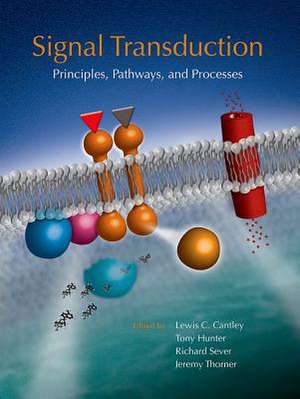
Signal Transduction: Principles, Pathways, and Processes
Editat de Lewis Cantley, Tony Hunter, Richard Sever, Jeremy Thorneren Limba Engleză Paperback – 31 oct 2013
This textbook provides a comprehensive view of signal transduction, covering both the fundamental mechanisms involved and their roles in key biological processes. Taking a novel approach, it first lays out the basic principles of signal transduction, explaining how different receptors receive information and transmit it via signaling proteins, ions, and second messengers. It then surveys the major signaling pathways that operate in cells, before examining in detail how these function in processes such as cell growth and division, cell movement, metabolism, development, reproduction, the nervous system, and immune function.
The book is essential reading for students learning about signal transduction for the first time. It will also be a vital reference for all cell, molecular, and developmental biologists and pharmacologists, neurobiologists, and immunologists studying processes regulated by cell signaling.
Preț: 501.61 lei
Preț vechi: 545.23 lei
-8%
Carte disponibilă
Livrare economică 09-23 noiembrie
Specificații
ISBN-10: 1621821811
Pagini: 452
Dimensiuni: 216 x 276 x 25 mm
Greutate: 1.15 kg
Editura: Cold Spring Harbor Laboratory Press
V-ar putea interesa
-
 Evolution: From Molecules to EcosystemsAndres Moya-33%Preț: 525.12 lei783.54 lei
 -
 Bioinformatics for DummiesJean-Michel ClaveriePreț: 204.30 lei
 -
 Molecular Machines in BiologyJoachim Frank-14%Preț: 746.82 lei868.40 lei
 -
 Biology of DiseaseNessar Ahmed-15%Preț: 435.65 lei512.53 lei
 -
 Fluorescent Analogs of Biomolecular Building BlocksMarcus Wilhelmsson-9%Preț: 1103.81 lei1212.97 lei
 -
 The Manga Guide to Molecular BiologyMasaharu Takemura-18%Preț: 129.35 lei158.62 lei
Descriere
Cells must respond to a wide variety of signals. These include hormones, growth factors, morphogens, and environmental stress, as well as signals from internal regulators and checkpoints. A complex network of signal transduction pathways within the cell ensures that these signals are relayed to the correct molecular targets and that the cell responds appropriately.
This textbook provides a comprehensive view of signal transduction, covering both the fundamental mechanisms involved and their roles in key biological processes. Taking a novel approach, it first lays out the basic principles of signal transduction, explaining how different receptors receive information and transmit it via signaling proteins, ions, and second messengers. It then surveys the major signaling pathways that operate in cells, before examining in detail how these function in processes such as cell growth and division, cell movement, metabolism, development, reproduction, the nervous system, and immune function.
The book is essential reading for students learning about signal transduction for the first time. It will also be a vital reference for all cell, molecular, and developmental biologists and pharmacologists, neurobiologists, and immunologists studying processes regulated by cell signaling.