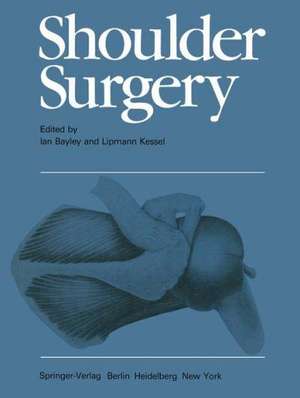
Shoulder Surgery
Editat de I. Bayley Prefață de H. Osmond-Clarke Editat de L. Kesselen Limba Engleză Paperback – 16 ian 2012
Preț: 693.55 lei
Preț vechi: 730.06 lei
-5%
Puncte Express: 1040
Carte tipărită la comandă
Livrare economică 27 noiembrie-11 decembrie
Livrare prin curier în România Termenul estimat este afișat lângă disponibilitate.
Transport gratuit pentru acest produs Plată online sau ramburs, în funcție de opțiunile comenzii.
Retur gratuit în 14 zile Comandă securizată și suport în română.
Specificații
ISBN-13: 9781447113164
ISBN-10: 1447113160
Pagini: 244
Ilustrații: XVI, 224 p. 252 illus.
Dimensiuni: 210 x 279 x 13 mm
Greutate: 0.56 kg
Ediția:1982
Editura: SPRINGER LONDON
Colecția Springer
Locul publicării:London, United Kingdom
ISBN-10: 1447113160
Pagini: 244
Ilustrații: XVI, 224 p. 252 illus.
Dimensiuni: 210 x 279 x 13 mm
Greutate: 0.56 kg
Ediția:1982
Editura: SPRINGER LONDON
Colecția Springer
Locul publicării:London, United Kingdom
V-ar putea interesa
-
 Intramedullary NailingPol M. Rommens-5%Preț: 1390.45 lei1463.63 lei
 -
 Total Knee ArthroplastyTheofilos Karachalios-5%Preț: 949.98 lei999.98 lei
 -
 Clinical Trials in OsteoporosisDerek Pearson-5%Preț: 746.94 lei786.26 lei
 -
 PsychoprostheticsPamela Gallagher-5%Preț: 740.34 lei779.30 lei
 -
 Rapid Orthopedic DiagnosisSeyed Behrooz Mostofi-5%Preț: 385.36 lei405.64 lei
 -
 -5%Preț: 1409.27 lei1483.44 lei
 -
 -5%Preț: 356.31 lei375.07 lei
 -
 Who's Who in OrthopedicsSeyed B. Mostofi-5%Preț: 1475.03 lei1552.67 lei
 -
 Engineering of Functional Skeletal TissuesFelix Bronner-5%Preț: 1467.62 lei1544.86 lei
 -
 Musculoskeletal Medicine in Clinical PracticeJohn K. Paterson-5%Preț: 358.64 lei377.52 lei
 -
 Sports Injuries of the Hand and WristMike Hayton-5%Preț: 699.87 lei736.70 lei
 -
 General Orthopaedics and Basic ScienceNikolaos K. Paschos-5%Preț: 683.46 lei719.44 lei
 -
 Partial Knee ArthroplastyJean-Noël A. Argenson-5%Preț: 680.75 lei716.58 lei
 -
 Acetabular Revision Surgery in Major Bone DefectsEduardo García-Rey-5%Preț: 746.23 lei785.50 lei
 -
 Robotik in der MedizinClemens Winter-8%Preț: 644.06 lei700.07 lei
 -
 Sacroiliac Joint DisorderEiichi Murakami-5%Preț: 1019.50 lei1073.16 lei
Public țintă
ResearchCuprins
Codman — His Influence on the Development of Surgery of the Shoulder.- Section I. Painful Arc Syndromes.- 1.1. Classification of the Painful Arc Syndromes.- 1.2. The Role of Coracoacromial Arch Impingement as a Cause of Attrition of the Rotator Cuff.- 1.3. Decompression of the Subacromial Space: An Anatomical Study.- 1.4. The Surgical Treatment of Rotator Cuff Impingement.- 1.5. Acromioplasty in the Treatment of Rotator Cuff Impingement: A Preliminary Report.- 1.6. Re-alignment of the Acromion in the Treatment of Chronic Rotator Cuff Ruptures.- References.- Section II. Rotator Cuff Rupture.- II. 1. The Correlation of Clinical Evaluation with Operative Findings and Prognosis in Rotator Cuff Rupture.- II.2. The Transacromial Approach for Rotator Cuff Rupture.- II.3. A Method for Reconstruction of the Rotator Cuff After Rupture.- II.4. Rotator Cuff Repair by Muscle Advancement.- II.5. Transfer of Subscapularis and Teres Minor for Massive Defects of the Rotator Cuff.- II.6. Long-Term Results of Rotator Cuff Repair.- References.- Section III. Recurrent Instability.- III. 1. Incidence and Prognosis of Shoulder Dislocation: A Preliminary Communication.- III.2. Conservative Treatment of Shoulder Dislocation in Young Males.- III.3. The Early Complications of Anterior Dislocation in the Middle Aged and Elderly Patient.- III.4. The Radiology of the Humeral Defect in Anterior Dislocation of the Shoulder — A Comparative Study.- III.5. Technical Aspects of the Bristow Repair for Recurrent Anterior Shoulder Instability.- III.6. Results of the Bristow Repair: Sports Participation After Surgery.- III.7. Posterior Glenoid Osteotomy for Posterior Dislocation of the Shoulder.- III.8. Anteversion of the Shoulder —A Rare Clinical Sign.- III.9. Reflections on Dislocation and RecurrentInstability of the Shoulder.- References.- Section IV. The Frozen Shoulder.- IV. 1. Pathomechanics of the Frozen Shoulder and the Effect of the Brisement Force.- IV.2. Immunological Studies in the Frozen Shoulder.- IV.3. Arthroscopic Examination of the Shoulder.- IV.4. Treatment of the Frozen Shoulder by Manipulation: A Pilot Study.- IV. 5. Distension Arthrography of the Shoulder Joint.- References.- Section V. Rheumatoid Arthritis and Prosthetic Replacement.- V.1. The Shoulder Joint in Rheumatoid Arthritis.- V.2. The Dynamic Study of Shoulder Movement.- V.3. Biomechanical Considerations in the Design of a Semi-constrained Total Shoulder Replacement.- V.4. The Trispherical Total Shoulder Replacement.- V.5. Neer Total Shoulder Arthroplasty.- V.6. The Kessel Total Shoulder Replacement.- V.7. Clinical Experience with the Liverpool Shoulder Replacement.- V.8. Taking Stock — Ten Years Experience of Shoulder Arthroplasty.- V.9. Double Osteotomy of the Shoulder.- References.- Section VI. The Acromioclavicular Joint.- VI.1. A Biomechanical Appraisal of the Acromioclavicular Joint.- VI.2. Post-traumatic Osteolysis of the Distal Clavicle.- VI.3. Disruption of the Acromioclavicular Joint: Surgical Anatomy and Biological Repair.- References.- Section VII. Some Fractures of the Proximal Humerus.- VII. 1. The Subdeltoid Approach to the Proximal Humerus.- VII.2. Displaced Proximal Humeral Fractures — Results of Non-Prosthetic Treatment.- VII.3. Prosthetic Replacement in the Treatment of Serious Fractures of the Proximal Humerus.- References.