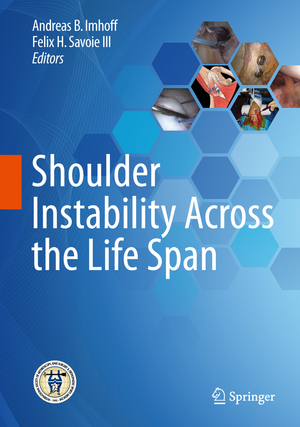
Shoulder Instability Across the Life Span
Editat de Andreas B. Imhoff, Felix H. Savoieen Limba Engleză Hardback – 4 iul 2017
Subliniem necesitatea unei abordări nuanțate în ortopedia modernă, unde managementul instabilității de umăr nu mai poate fi universal, ci trebuie adaptat profilului biologic al pacientului. Shoulder Instability Across the Life Span sintetizează consensul ISAKOS (International Society of Arthroscopy, Knee Surgery and Orthopaedic Sports Medicine), marcând o schimbare de paradigmă: trecerea de la proceduri standardizate la decizii clinice bazate pe vârstă și nivel de activitate. Notăm cu interes modul în care ghidurile actuale prioritizează identificarea precoce a hiperlaxității la pacienții tineri, în timp ce pentru segmentul de vârstă 25-50 de ani, accentul cade pe patologii complexe precum leziunile SLAP sau rupturile de subscapular. Structura volumului reflectă această progresie fiziologică, fiind organizată cronologic. Considerăm că această segmentare este esențială, deoarece mecanismele instabilității evoluează: dacă la sportivul tânăr domină instabilitatea combinată cu hiperlaxitatea, la pacientul matur, defectele osoase ale glenoidului și humerusului devin factori critici în decizia chirurgicală. Clinicienii care folosesc Surgery of Shoulder Instability de Stephen F. Brockmeier ca referință vor găsi aici o extensie necesară, acest volum oferind detalii mult mai aprofundate despre managementul conservator și protocoalele de reabilitare specifice fiecărei decade de viață. Această lucrare continuă direcția editorială stabilită de Andreas B. Imhoff în Rotator Cuff Across the Life Span, păstrând rigoarea clinică și claritatea algoritmică. Față de Surgical Atlas of Sports Orthopaedics and Sports Traumatology, volumul de față este mai puțin un manual tehnic și mai mult un ghid de luare a deciziilor, oferind contextul fiziopatologic necesar pentru a alege între reparația artroscopică de părți moi și tehnicile de bloc osos.
Preț: 862.64 lei
Preț vechi: 908.04 lei
-5%
Carte disponibilă
Livrare economică 23 octombrie-06 noiembrie
Specificații
ISBN-10: 3662540762
Pagini: 273
Ilustrații: 150 schwarz-weiße und 70 farbige Abbildungen, Bibliographie
Dimensiuni: 183 x 260 x 22 mm
Greutate: 0.87 kg
Ediția:1st ed. 2017
Editura: Springer
Locul publicării:Berlin, Heidelberg, Germany
V-ar putea interesa
-
 Rockwood and Matsen's The ShoulderFrederick A. Matsen-28%Preț: 1673.16 lei2316.68 lei
 -
 -28%Preț: 1473.09 lei2050.87 lei
 -
 Current Practice in Hand SurgeryJin Bo Tang-28%Preț: 1540.10 lei2141.28 lei
 -
 -24%Preț: 1770.85 lei2325.88 lei
 -
 Shoulder ArthroscopyStephen J. Snyder MD-24%Preț: 2092.22 lei2767.97 lei
 -
 -29%Preț: 1044.70 lei1470.85 lei
 -
 Stoller’s Orthopaedics and Sports Medicine: The ShoulderDavid W. Stoller MD, FACR-21%Preț: 2003.98 lei2543.05 lei
 -
 Reverse Shoulder ArthroplastyDavid M Dines-5%Preț: 1248.23 lei1313.93 lei
 -
 Advanced Reconstruction: Shoulder 2: Print + Ebook with MultimediaJeffrey S. Abrams M.D.-24%Preț: 1829.81 lei2408.27 lei
 -
 -22%Preț: 1611.82 lei2061.09 lei
 -
 Advanced Techniques in Shoulder ArthroscopyPeter J. Millett-5%Preț: 642.27 lei676.07 lei
 -
 Hip DysplasiaPaul E. Beaulé-5%Preț: 615.01 lei647.37 lei
 -
 Glenohumeral Osteoarthritis in the Young PatientBrian M. Grawe-5%Preț: 714.20 lei751.78 lei
 -
 Arthroscopy and Sport InjuriesPiero Volpi-5%Preț: 734.53 lei773.19 lei
 -
 Textbook of Shoulder SurgeryIan A. Trail-5%Preț: 1284.21 lei1351.80 lei
 -
 Normal and Pathological Anatomy of the ShoulderGregory I. Bain-5%Preț: 1315.38 lei1384.61 lei
 -
 Management of Failed Shoulder SurgeryGiuseppe Milano-5%Preț: 731.77 lei770.28 lei
 -
 Rotator Cuff Across the Life Span: ISAKOS Consensus BookAndreas B. Imhoff-5%Preț: 1154.20 lei1214.95 lei
 -
 360° Around Shoulder InstabilityRoman Brzóska-5%Preț: 860.73 lei906.03 lei
 -
 Shoulder InstabilityGiovanni Di Giacomo-5%Preț: 1132.91 lei1192.54 lei
De ce să citești această carte
Recomandăm această lucrare chirurgilor ortopezi și rezidenților care doresc să stăpânească algoritmii de decizie ISAKOS. Cititorul câștigă o înțelegere clară a modului în care patologia umărului se transformă odată cu vârsta, primind indicații precise pentru tehnici precum Bankart, remplissage sau stabilizarea deschisă. Este un instrument esențial pentru personalizarea tratamentului, asigurând un echilibru între intervenția chirurgicală și recuperarea funcțională.
Despre autor
Andreas B. Imhoff este un reputat specialist în ortopedie și traumatologie sportivă, recunoscut la nivel internațional pentru contribuțiile sale în chirurgia artroscopică. În calitate de editor pentru Springer, a coordonat numeroase volume de referință care definesc standardele actuale în medicina sportivă. Lucrările sale, precum Checkliste Orthopädie, sunt fundamentale pentru practica clinică zilnică, oferind algoritmi preciși de diagnostic. Expertiza sa în cadrul ISAKOS garantează că informațiile prezentate în acest volum reflectă cele mai noi dovezi științifice și consensuri medicale globale.