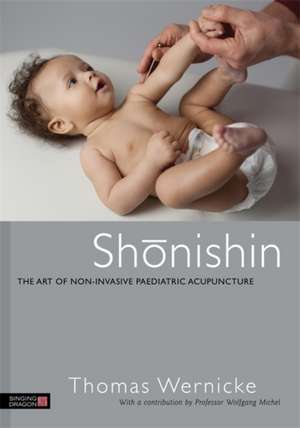
Shonishin: The Art of Non-Invasive Paediatric Acupuncture
Traducere de Anne Oppenheimer Autor Thomas Wernicke Contribuţii de Wolfgang Michelen Limba Engleză Paperback – 21 mai 2014
Covering the history, theory and clinical practice, Wernicke explores how Shonishin is used with young children, from babies and toddlers to school-age children, to treat a range of behavioural issues and physical conditions such as KISS syndrome, allergies and asthma. He also examines how the techniques can be adapted for use with adults and older people to provide an alternative, non-invasive treatment. With access to downloadable handouts that can be used with patients, and international case studies that demonstrate its effectiveness, his book provides a complete and practical handbook on Shonishin for existing practitioners. Written in an accessible style, it will also be of value to any therapist interested in learning more about the treatment, including practitioners of Chinese and Japanese medicine, traditional acupuncture and shiatsu, craniosacral and occupational therapists, and physiotherapists.
Preț: 224.80 lei
Preț vechi: 295.89 lei
-24%
Puncte Express: 337
Carte disponibilă
Livrare economică 16-30 noiembrie
Livrare prin curier în România Termenul estimat este afișat lângă disponibilitate.
Transport gratuit de la 400.00 lei Plată online sau ramburs, în funcție de opțiunile comenzii.
Retur gratuit în 14 zile Comandă securizată și suport în română.
Specificații
ISBN-13: 9781848191600
ISBN-10: 184819160X
Pagini: 288
Ilustrații: 128 full colour figures, 96 full colour photographs
Dimensiuni: 240 x 310 x 248 mm
Greutate: 0.87 kg
Editura: JESSICA KINGSLEY PUBLISHERS
Colecția Singing Dragon
Locul publicării:London, United Kingdom
ISBN-10: 184819160X
Pagini: 288
Ilustrații: 128 full colour figures, 96 full colour photographs
Dimensiuni: 240 x 310 x 248 mm
Greutate: 0.87 kg
Editura: JESSICA KINGSLEY PUBLISHERS
Colecția Singing Dragon
Locul publicării:London, United Kingdom
V-ar putea interesa
-
 Gua sha: A Traditional Technique for Modern PracticeArya Nielsen-30%Preț: 386.98 lei552.46 lei
 -
 Animal Acupressure Illustrated the Cat: The CatDeanna S SmithPreț: 133.91 lei
 -
 Trigger Point TherapySteve PlittPreț: 57.41 lei
 -
 -20%Preț: 144.82 lei181.55 lei
 -
 -20%Preț: 178.17 lei221.41 lei
 -
 Meridians and AcupointsBing Zhu-23%Preț: 191.08 lei249.55 lei
 -
 -20%Preț: 169.86 lei211.72 lei
 -
 Acupuncture TherapeuticsBing Zhu-21%Preț: 236.90 lei299.49 lei
 -
 Chair Yoga: Seated Exercises for Health and WellbeingEdeltraud Rohnfeld-19%Preț: 120.59 lei148.67 lei
 -
 Illustrated Chinese Moxibustion Techniques and MethodsXiaorong Chang-23%Preț: 268.54 lei350.06 lei
 -
 Preț: 210.49 lei
 -
 -21%Preț: 122.47 lei154.25 lei
 -
 Das Kribbel-Krabbel BuchKarin Kalbantner-WernickePreț: 169.57 lei
Cuprins
Preliminary Notes on Treating Children. Part I. Theoretical Principles. 1. Historical Background: Treating Children in Japan. 2. Introduction. 3. Diagnostic Principles. Part II. Practice. 4. Treatment Principles. 5. Treating Babies (From Birth to 12 Months). 6. Treating Small Children (from 2–3 Years). 7. Treating Pre-school Children (from 4-6 years). 8. Treating School-age Children (7-14 Years). 9. Treating Adults. 10. Treating the Elderly and People with Impaired Mobility. 11. Practical Use within the Home Setting. 12. Examples from Practice. 13. Epilogue (Feedback). Bibliography.