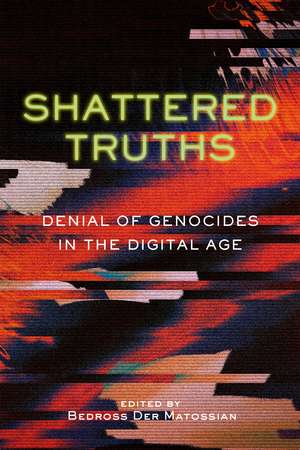
Shattered Truths: Denial of Genocides in the Digital Age
Editat de Bedross Der Matossianen Limba Engleză Hardback – 2027
Through a combination of theoretical frameworks and empirical research, Shattered Truths examines key questions at the intersection of technology, memory, and propaganda: How does genocide denial function in today’s interconnected digital environment? In what ways do various actors strategically employ online tools to disseminate falsehoods and falsify historical accounts of specific genocides? What types of websites and digital infrastructures are used to amplify these messages and expand their reach? The chapters also delve into how denialists capitalize on the viral dynamics of major social media platforms—including X (formerly Twitter), YouTube, Facebook, Instagram, Telegram, TikTok, Reddit, and Wikipedia—to inject denialist narratives into the public sphere.
Shattered Truths brings together leading scholars from across disciplines to add to the body of genocide scholarship that is challenged by denialist literature. By uncovering the mechanisms and strategies behind digital genocide denial, this volume offers critical insights into one of the most troubling dimensions of contemporary information warfare.
Preț: 457.66 lei
Preț vechi: 565.01 lei
-19% Precomandă
Puncte Express: 686
Carte nepublicată încă
Livrare prin curier în România Precomanda se expediază când titlul devine disponibil.
Transport gratuit pentru acest produs Plată online sau ramburs, în funcție de opțiunile comenzii.
Retur gratuit în 14 zile Comandă securizată și suport în română.
Doresc să fiu notificat când acest titlu va fi disponibil:
Se trimite...
Specificații
ISBN-13: 9781496244093
ISBN-10: 1496244095
Pagini: 324
Ilustrații: 13 illustrations, 1 table, index
Dimensiuni: 152 x 229 mm
Editura: Nebraska
Colecția University of Nebraska Press
Locul publicării:United States
ISBN-10: 1496244095
Pagini: 324
Ilustrații: 13 illustrations, 1 table, index
Dimensiuni: 152 x 229 mm
Editura: Nebraska
Colecția University of Nebraska Press
Locul publicării:United States
Notă biografică
Bedross Der Matossian is the Elwood N. and Katherine Thompson Distinguished Professor of Modern World History at the University of Nebraska–Lincoln. He is the author, editor, or coeditor of nine books dealing with political history and mass violence and its denial, including Denial of Genocides in the Twenty-First Century (Nebraska, 2026). Der Matossian was awarded a 2026 fellowship from the John Simon Guggenheim Memorial Foundation.
Cuprins
List of Illustrations
Introduction: Denial of Genocides in the Age of the Internet
Bedross Der Matossian
Denial of Genocides: Historical and Theoretical Background
1. The Evolution of Genocide Denial
Jeffrey S. Bachman
2. The Adaptation of Genocide Denial to the Technology and Commercial Architecture of Social Media
Akriti Gaur, Isabella Panico, and David Simon
3. Plausible Deniability: On Media Siege, Media Activists, and Epistemic Murk
Stefan Tarnowski
Denial of the Armenian Genocide
4. Denial of the Armenian Genocide in the Digital Age: Refashioning the “Events of 1915” on the Internet
Bedross Der Matossian
5. From Promise to Propaganda: Armenian Genocide Denial on Twitter
Michael Bobelian
6. Using YouTube as a Denialist Echo Chamber: How to Think About Armenians and the Armenian Genocide
Hakan Seckinelgin
Denial of Other Genocides
7. Denial of Genocides of Indigenous Peoples in the Digital Age: The Cases of Brazil and Zimbabwe
Robert K. Hitchcock and Bedross Der Matossian
8. History Under Attack: Holocaust Denial and Distortion on Social Media
Gerald J. Steinacher
9. Memory, Denial, and Distortion: The Khmer Rouge Genocide in the Digital Age
Eve M. Zucker
10. Denial of the Bosnian Genocide in the Digital Age
Hikmet Karčić and Richard Newell
11. The Denial of the Uyghur Genocide in the Digital Age
Samuel Totten
Acknowledgments
Contributors
Index
Introduction: Denial of Genocides in the Age of the Internet
Bedross Der Matossian
Denial of Genocides: Historical and Theoretical Background
1. The Evolution of Genocide Denial
Jeffrey S. Bachman
2. The Adaptation of Genocide Denial to the Technology and Commercial Architecture of Social Media
Akriti Gaur, Isabella Panico, and David Simon
3. Plausible Deniability: On Media Siege, Media Activists, and Epistemic Murk
Stefan Tarnowski
Denial of the Armenian Genocide
4. Denial of the Armenian Genocide in the Digital Age: Refashioning the “Events of 1915” on the Internet
Bedross Der Matossian
5. From Promise to Propaganda: Armenian Genocide Denial on Twitter
Michael Bobelian
6. Using YouTube as a Denialist Echo Chamber: How to Think About Armenians and the Armenian Genocide
Hakan Seckinelgin
Denial of Other Genocides
7. Denial of Genocides of Indigenous Peoples in the Digital Age: The Cases of Brazil and Zimbabwe
Robert K. Hitchcock and Bedross Der Matossian
8. History Under Attack: Holocaust Denial and Distortion on Social Media
Gerald J. Steinacher
9. Memory, Denial, and Distortion: The Khmer Rouge Genocide in the Digital Age
Eve M. Zucker
10. Denial of the Bosnian Genocide in the Digital Age
Hikmet Karčić and Richard Newell
11. The Denial of the Uyghur Genocide in the Digital Age
Samuel Totten
Acknowledgments
Contributors
Index
Recenzii
“Of all the atrocities that hide beneath the political subordination of reality, there is none more odious than genocide. With today’s digital post-truth tactics, genocide deniers have found not just another tool for their toolbelt—they have found a flamethrower. Bedross Der Matossian’s Shattered Truths is a monumental achievement, bringing these tactics to light and, one hopes, helping others to recognize that the slaughter of innocents often walks hand in hand with the death of truth.”—Lee McIntyre, author of Post-Truth
“The subject of Shattered Truths is of critical urgency as the problem of genocide denial on digital platforms is increasing exponentially. The rise of the internet and digital platforms have contributed to the unprecedented speed and proliferation of denial. The lack of regulation of the digital space allows denial to spread with no consequence, and the implications of this are profound. The collection is diverse in its approaches, and it covers significant ground.”—Jelena Subotić, author of Yellow Star, Red Star: Holocaust Remembrance after Communism
“The subject of Shattered Truths is of critical urgency as the problem of genocide denial on digital platforms is increasing exponentially. The rise of the internet and digital platforms have contributed to the unprecedented speed and proliferation of denial. The lack of regulation of the digital space allows denial to spread with no consequence, and the implications of this are profound. The collection is diverse in its approaches, and it covers significant ground.”—Jelena Subotić, author of Yellow Star, Red Star: Holocaust Remembrance after Communism
Descriere
This volume brings together leading scholars from across disciplines to discuss genocide denial in the twenty-first century, concentrating on communication, social networks, and public spheres of daily life.