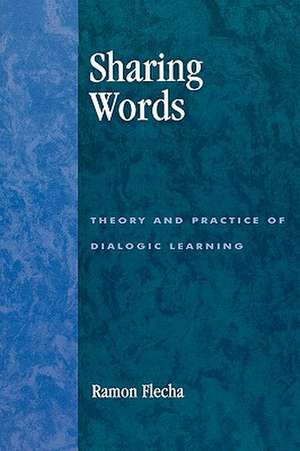
Sharing Words: Theory and Practice of Dialogic Learning: Critical Perspectives Series: A Book Series Dedicated to Paulo Freire
Autor Ramón Flechaen Limba Engleză Paperback – 22 feb 2000
Această monografie, semnată de Ramón Flecha, reprezintă un hibrid metodologic valoros pentru domeniul pedagogiei critice, fiind publicată în cadrul Critical Perspectives Series: A Book Series Dedicated to Paulo Freire. Notăm cu interes modul în care autorul reușește să traducă concepte sociologice complexe într-o formă narativă accesibilă, structurând volumul între rigoarea teoretică a principiilor învățării dialogice și experiența umană directă. Remarcăm faptul că primele capitole stabilesc fundamentul conceptual, în timp ce restul lucrării este dedicat unor portrete vii — precum cele ale lui Manuel, Lola sau Juan — care ilustrează lupta împotriva inegalităților culturale și procesul de decolonizare a cotidianului prin educație. Cartea completează perspectiva teoretică oferită de Dialogue and Boundary Learning de Peter Rule, adăugând o dimensiune practică, ancorată în biografii reale, care demonstrează cum teoria dialogică poate transforma subiecți considerați anterior „analfabeți” în creatori de cercuri literare. Spre deosebire de textele pur academice, Sharing Words utilizează investigația dialogică pentru a analiza contribuția comunităților marginalizate, precum cea rromă, la dialogul educațional global. Stilul de scriere invită la o lectură reflexivă, transformând teoria educațională într-o experiență de împărtășire între colegi și studenți, facilitând înțelegerea modului în care dialogul poate servi drept instrument de emancipare socială.

Preț: 316.59 lei
Preț vechi: 397.25 lei
-20%
Carte tipărită la comandă
Livrare economică 17 noiembrie-01 decembrie
Specificații
ISBN-10: 0847695964
Pagini: 144
Dimensiuni: 148 x 226 x 8 mm
Greutate: 0.24 kg
Ediția:0144
Editura: Bloomsbury Publishing
Colecția Rowman & Littlefield
Seria Critical Perspectives Series: A Book Series Dedicated to Paulo Freire
Locul publicării:New York, United States
V-ar putea interesa
-
 McCoubrey & White's Textbook on JurisprudenceJames Penner-21%Preț: 399.93 lei507.71 lei
 -
 -12%Preț: 289.71 lei330.96 lei
 -
 Social Economies of Fear and DesireV. NicolPreț: 401.84 lei
 -
 -18%Preț: 1126.18 lei1373.39 lei
 -
 Real Social ScienceBent FlyvbjergPreț: 283.85 lei
 -
 Preț: 270.88 lei
 -
 Networks in Social Policy ProblemsBal Zs Vedres-11%Preț: 681.51 lei765.73 lei
 -
 The Reflexive Imperative in Late ModernityMargaret S. ArcherPreț: 334.96 lei
 -
 -18%Preț: 1248.98 lei1523.15 lei
 -
 Postmodern GeographiesEdward W SojaPreț: 91.85 lei
 -
 ViolenceSlavoj Zizek-20%Preț: 68.05 lei85.23 lei
 -
 Social theory for beginnersPaul RansomePreț: 263.15 lei
 -
 Preț: 280.56 lei
 -
 The Project SocietyAnders Fogh JensenPreț: 136.85 lei
De ce să citești această carte
Recomandăm această carte educatorilor și sociologilor interesați de aplicarea practică a principiilor lui Paulo Freire. Cititorul câștigă o înțelegere profundă a învățării dialogice prin studii de caz concrete, care demonstrează cum transformarea personală și socială este posibilă în medii defavorizate. Este o resursă esențială pentru cei care doresc să implementeze strategii educaționale inclusive și să combată inegalitățile prin dialog autentic.
Descriere
Cuprins
Chapter 2 Introduction: Priciples of Dialogic Learning
Chapter 3 1. Manuel: A Life Spent Struggling against Cultural Inequalities
Chapter 4 2. Lola: From "Illiterate" to Creator of a Literary Circle
Chapter 5 3. Chelo: Subject of Her Own Transformation
Chapter 6 4. Rocío: Overcoming Agism
Chapter 7 5. Juan: Decolonizing Everyday Life
Chapter 8 6. Rosalía: Dialogic Investigation
Chapter 9 7. Antonio: Gypsy Contribution to the Dialogue
Chapter 10 Index
Chapter 11 About the Author
Recenzii
Knowledge is not always disseminated from the top down to students or consumers. Sometimes, as Ramón Flecha here demonstrates, knowledge flows from the bottom up, when individuals with no degree or academic background 'produce' and 'invent' cultural analyses on the basis of their own experience, their thought, and the exchange with other inventors of their own culture. This book successfully takes a close look at this alternative educational process.
Sharing Words may be an example of a new way of writing about educational theory and practice, one that results in a captivating and enjoyable experience that invites the reader to share and comment with colleagues, students, and friends.
In Sharing Words: Theory and Practice of Dialogic Learning, Ramón Flecha provides a unique example of the theory and practice of dialogic learning. By mixing educational and social theory with literature, life narratives, and personal accounts, Flecha creatively narrates the practice of dialogic learning in a seemingly utopian reality: a literary circle in which low-literacy adults enjoy reading books by authors like Kafka, Dostoyevsky, and García Lorca. The book highlights both theory and practice; it is both expository and narrative; and it refers as much to educational and social science works as to classical literature. In this way , Sharing Words may be an example of a new way of writing about educational theory and practice, one that results in a captivating and enjoyable experience that invites the reader to share and comment with colleagues, students, and friends.