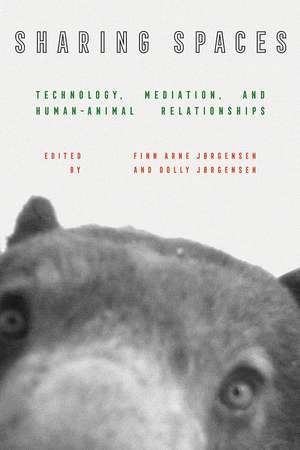
Sharing Spaces: Technology, Mediation, and Human-Animal Relationships: INTERSECTIONS: Histories of Environment
Editat de Finn Arne Jørgensen, Dolly Jorgensenen Limba Engleză Hardback – 29 oct 2024
În literatura academică dedicată mediului, intersecția dintre tehnologie și viața animală a fost adesea tratată tangențial, lăsând o lacună în înțelegerea modului în care instrumentele create de om definesc spațiile comune. Volumul Sharing Spaces, editat de Finn Arne Jørgensen și Dolly Jorgensen, vine să umple acest gol, propunând o analiză riguroasă a modului în care tehnologia acționează ca un conector și, în același timp, ca un mediator între specii. Considerăm că această lucrare reîncadrează discuția despre „naturecultures”, demonstrând că tehnologia nu este doar un factor extern, ci elementul care structurează modul în care măsurăm, conservăm sau chiar conviețuim cu animalele.
Cititorii familiarizați cu Animal Places de Jacob Bull vor aprecia modul în care Sharing Spaces aduce un strat suplimentar de complexitate prin focusul pe materialitate. În timp ce volumul lui Bull se concentrează pe spațiile geografice și sociale, această nouă apariție din seria INTERSECTIONS: Histories of Environment subliniază că aceste spații sunt produse tehnologic. De la utilizarea dispozitivelor de monitorizare până la infrastructura urbană care facilitează sau blochează mișcarea speciilor sălbatice, volumul oferă o perspectivă tehnică indispensabilă.
Această abordare continuă direcția începută de Finn Arne Jørgensen în lucrări anterioare precum New Natures, unde explora dialogul dintre istoria mediului și studiile STS. Dacă în Recycling autorul analiza procesele materiale ale deșeurilor, aici își extinde viziunea asupra întregului spectru de interacțiuni multispecii. Tonul volumului este unul academic precis, evitând speculațiile și ancorându-se în studii de caz care transformă viziunea noastră asupra animalelor din simple resurse în actori prinși într-o rețea tehnologică complexă.









Preț: 446.55 lei
Preț vechi: 551.30 lei
-19%
Carte disponibilă
Livrare economică 17 noiembrie-01 decembrie
Livrare express 03-07 noiembrie pentru 35.19 lei
Specificații
ISBN-10: 0822948303
Pagini: 296
Dimensiuni: 152 x 229 x 29 mm
Greutate: 0.59 kg
Editura: University of Pittsburgh Press
Colecția University of Pittsburgh Press
Seria INTERSECTIONS: Histories of Environment
V-ar putea interesa
-
 Preț: 168.33 lei
 -
 How Animals Heal UsJay GriffithsPreț: 168.40 lei
 -
 Shared WisdomAlex PentlandPreț: 153.35 lei
 -
 Against the MachinePaul KingsnorthPreț: 193.57 lei
 -
 The Lion's Historian: Africa's Animal PastSandra SwartPreț: 151.57 lei
 -
 Writing Animal HistoryTimm Schönfelder-26%Preț: 521.63 lei700.23 lei
 -
 Designing the Domestic PosthumanColbey Emmerson Reid-21%Preț: 184.85 lei235.43 lei
 -
 Animal Studies and PhilosophyRebekah HumphreysPreț: 168.80 lei
 -
 Preț: 138.86 lei
 -
 The Space of the WorldNick CouldryPreț: 157.50 lei
 -
 The Care of ThingsJerome DenisPreț: 237.50 lei
 -
 Power and TechnologyJan Van DijkPreț: 184.68 lei
 -
 Solidarity Between SpeciesFrédéric KeckPreț: 167.77 lei
 -
 Wise AnimalsTom Chatfield-39%Preț: 48.40 lei79.29 lei
 -
 Natural ConnectionJoycelyn LongdonPreț: 137.51 lei
 -
 -18%Preț: 88.10 lei107.57 lei
 -
 BeastlyKeggie CarewPreț: 79.75 lei
 -
 The Information AnimalAlicia WanlessPreț: 242.32 lei
 -
 Pets and Their PeopleCharles FosterPreț: 207.85 lei
 -
 Preț: 376.57 lei
De ce să citești această carte
Recomandăm acest volum cercetătorilor și studenților din domeniile științelor umaniste de mediu și studiilor multispecii. Cititorul câștigă o înțelegere profundă a modului în care tehnologia — de la banala îmbrăcăminte la algoritmi complecși — ne modelează interacțiunea cu lumea non-umană. Este o lectură esențială pentru a descifra complexitatea „Antropocenului”, oferind un cadru teoretic solid pentru a regândi coexistența noastră cu animalele ca parteneri, hrană sau companioni.
Despre autor
Finn Arne Jørgensen este un cercetător consacrat în istoria mediului și a tehnologiei, cunoscut pentru abordările sale interdisciplinare care leagă studiile de conservare de materialitatea cotidiană. Activitatea sa editorială și de autor, reflectată în titluri precum Recycling (publicat în seria MIT Press Essential Knowledge) și New Natures, demonstrează un interes constant pentru modul în care intervenția umană transformă conceptele de natură. Împreună cu Dolly Jorgensen, acesta coordonează proiecte care plasează istoria mediului într-un dialog fertil cu știința și tehnologia, oferind perspective critice asupra modului în care societatea modernă gestionează resursele și relațiile cu alte specii.
Descriere scurtă
Recenzii
—Tina Loo, University of British Columbia
“This rich collection chronicles some of the ways technologies shape human relationships with animals. While some of these relationships are exploitative, here also are chronicled relations of care and symbiotic partnerships. The case studies are fascinating, the analysis consistently attuned to the complexities of these entanglements.”
—Emma Marris, author of Wild Souls: Freedom and Flourishing in the Non-human World
“Sharing Spaces offers a highly sophisticated and much welcome contribution to the fields of environmental studies, human-animal studies, and science and technology studies. It serves as an excellent example of how these three fields can be brought into a very fruitful conversation.”
—Dorothee Brantz, Technische Universität Berlin
Notă biografică
Dolly Jørgensen is professor of history at University of Stavanger, Norway. She is the author of Recovering Lost Species in the Modern Age: Histories of Longing and Belonging and The Medieval Pig. She is coeditor-in-chief of the journal Environmental Humanities and codirects, with Finn Arne Jørgensen, the Greenhouse Center for Environmental Humanities at University of Stavanger.