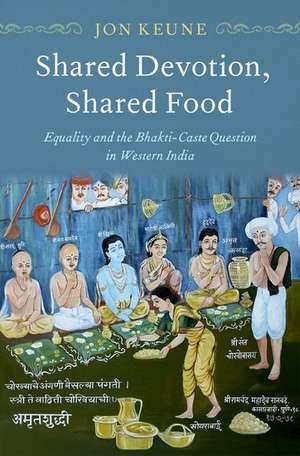
Shared Devotion, Shared Food: Equality and the Bhakti-Caste Question in Western India
Autor Jon Keuneen Limba Engleză Hardback – 30 sep 2021
Preț: 665.26 lei
Preț vechi: 962.74 lei
-31%
Puncte Express: 998
Carte tipărită la comandă
Livrare economică 04-09 decembrie
Livrare prin curier în România Termenul estimat este afișat lângă disponibilitate.
Transport gratuit pentru acest produs Plată online sau ramburs, în funcție de opțiunile comenzii.
Retur gratuit în 14 zile Comandă securizată și suport în română.
Specificații
ISBN-13: 9780197574836
ISBN-10: 0197574831
Pagini: 328
Dimensiuni: 241 x 160 x 28 mm
Greutate: 0.68 kg
Editura: Oxford University Press
Colecția OUP USA
Locul publicării:New York, United States
ISBN-10: 0197574831
Pagini: 328
Dimensiuni: 241 x 160 x 28 mm
Greutate: 0.68 kg
Editura: Oxford University Press
Colecția OUP USA
Locul publicării:New York, United States
Recenzii
Through a detailed study of commensality practices, Keune offers a brilliant historical analysis of the relationship between bhakti traditions and the reality of caste hierarchies.
This gem of a book explores the relationship between inclusive religious imagery and the hard realities of social hierarchy. In a tour de force of textual analysis, Jon Keune critically and meticulously compares multiple versions of stories about Eknath, a 16th-century bhakti saint, in plays and movies as well as in traditional texts. Using the narratives as a prism, Keune examines an astonishingly broad spectrum of topics: from the social significance of sharing food to the modern intellectual history of Eknath's region, trends in scholarship on bhakti, and even the very notion of equality itself.
Keune brings insight and humor to this study of how sharing food across religious spaces in sacred biographies and devotional texts reveals important considerations about social equality and caste, which he evocatively calls 'the bhakti-caste question'. Spanning archives, literature, manuscripts, visual culture, and ethnography, Keune delves deeply into the possible ethics of devotionalism in India over several centuries, and this book should be of interest to anyone who cares about the politics of power at the intersections of religion, food, and society.
It is a useful tool in the classroom to think about the nuances of representation and authorial intention in religious narratives.
This volume is a master class in the study of hagiographical literature. Hagiographical analysis usually focuses on written text and views a single rendition of a story as a "self-contained snapshot," but Keune shows the value in approaching each story as "one scene in a sequence of film frames" to take account of "the effects of time and changing context on how a story gets told". With his "hagiography in 4D" approach, one can attend to the vitality and dynamism of stories as they move, over generations, across many media forms, always serving as points of orientation for living traditions.
This gem of a book explores the relationship between inclusive religious imagery and the hard realities of social hierarchy. In a tour de force of textual analysis, Jon Keune critically and meticulously compares multiple versions of stories about Eknath, a 16th-century bhakti saint, in plays and movies as well as in traditional texts. Using the narratives as a prism, Keune examines an astonishingly broad spectrum of topics: from the social significance of sharing food to the modern intellectual history of Eknath's region, trends in scholarship on bhakti, and even the very notion of equality itself.
Keune brings insight and humor to this study of how sharing food across religious spaces in sacred biographies and devotional texts reveals important considerations about social equality and caste, which he evocatively calls 'the bhakti-caste question'. Spanning archives, literature, manuscripts, visual culture, and ethnography, Keune delves deeply into the possible ethics of devotionalism in India over several centuries, and this book should be of interest to anyone who cares about the politics of power at the intersections of religion, food, and society.
It is a useful tool in the classroom to think about the nuances of representation and authorial intention in religious narratives.
This volume is a master class in the study of hagiographical literature. Hagiographical analysis usually focuses on written text and views a single rendition of a story as a "self-contained snapshot," but Keune shows the value in approaching each story as "one scene in a sequence of film frames" to take account of "the effects of time and changing context on how a story gets told". With his "hagiography in 4D" approach, one can attend to the vitality and dynamism of stories as they move, over generations, across many media forms, always serving as points of orientation for living traditions.
Notă biografică
Jon Keune is Assistant Professor of Religious Studies at Michigan State University. He held postdoctoral fellowships in Houston and Göttingen, and he earned a PhD from Columbia University. His research focuses on religion, society, and history in India and with a comparative eye to central Europe and East Asia. As co-founder of the Regional Bhakti Scholars Network in 2013, he is also deeply involved in collaborative research.