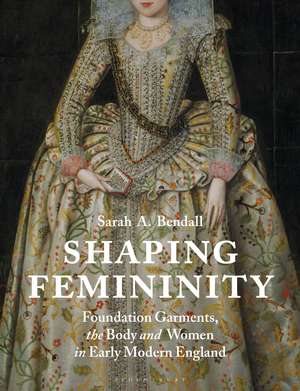
Shaping Femininity: Foundation Garments, the Body and Women in Early Modern England
Autor Sarah A. Bendallen Limba Engleză Paperback – 4 noi 2021
Suntem de părere că Shaping Femininity reprezintă o contribuție esențială în istoria modei, oferind o perspectivă rară prin intermediul resurselor vizuale și tehnice detaliate. Cu 150 de ilustrații color și alb-negru, lucrarea documentează metodic cum vestimentația de bază a încetat să fie un simplu accesoriu utilitar, devenind un instrument de definire a feminității, statutului social și moralității în Anglia secolelor XVI și XVII. Notăm cu interes modul în care Sarah A. Bendall utilizează o metodologie transdisciplinară, combinând analiza textelor de epocă cu reconstrucția fizică a pieselor vestimentare pentru a înțelege experiența trăită a corpului.
Structura volumului urmărește o progresie logică, de la 'corpul artificial' al curtenilor la consumul acestor piese de către femeile din clasa de mijloc, explorând totodată aspectele erotice și de control social. Putem afirma că această abordare completează excelent titlul Materializing Gender in Early Modern English Literature and Culture prin accentul pus pe materialitatea specifică a lenjeriei de corp, adăugând o dimensiune practică studiului identității de gen. De asemenea, lucrarea se raportează direct la Corsets and Crinolines, însă aduce un plus de profunzime sociologică, investigând nu doar cum s-a schimbat moda, ci și cine au fost 'făcătorii de corpuri' (body makers) care au creat aceste structuri.
Această cercetare se înscrie natural în parcursul academic al autoarei, continuând temele explorate în The Women Who Clothed the Stuart Queens și Embodied Experiences of Making in Early Modern Europe. Dacă în lucrările anterioare s-a concentrat pe rolul femeilor în producția vestimentară și pe conexiunea dintre minte și obiect, în Shaping Femininity Bendall reușește să recupereze vocile pierdute ale femeilor din diverse straturi sociale, demonstrând cum idealul corporal feminin a fost negociat prin intermediul balenelor de bumbac și al structurilor rigide.
Preț: 226.04 lei
Preț vechi: 289.02 lei
-22%
Carte disponibilă
Livrare economică 09-23 noiembrie
Livrare express 23-29 octombrie pentru 122.91 lei
Specificații
ISBN-10: 1350164100
Pagini: 352
Ilustrații: 150 color and bw illus
Dimensiuni: 188 x 244 x 22 mm
Greutate: 1 kg
Editura: Bloomsbury Publishing
Colecția Bloomsbury Visual Arts
Locul publicării:London, United Kingdom
V-ar putea interesa
-
 The Mode in Furs: A Historical Survey with 680 IllustrationsR. Turner WilcoxPreț: 93.10 lei
 -
 ShoesRaissa BretañaPreț: 76.68 lei
 -
 Out of the BoxElizabeth SemmelhackPreț: 326.61 lei
 -
 HatsProfessor Clair Hughes-41%Preț: 145.20 lei244.11 lei
 -
 Hair: An Illustrated HistorySusan J. Vincent-37%Preț: 152.65 lei240.79 lei
 -
 Fashioning the Victorians: A Critical SourcebookProfessor Rebecca Mitchell-23%Preț: 208.70 lei272.56 lei
 -
 The Dangers of Fashion: Towards Ethical and Sustainable SolutionsSara B. Marcketti-33%Preț: 584.27 lei873.71 lei
 -
 -21%Preț: 220.00 lei278.17 lei
 -
 The Business of Beauty: Gender and the Body in Modern LondonJessica P. Clark-18%Preț: 192.49 lei233.59 lei
 -
 Rei Kawakubo: For and Against FashionDr Rex Butler-36%Preț: 556.30 lei870.04 lei
 -
 A Cultural History of Dress and Fashion in the Modern AgeProfessor Alexandra Palmer-24%Preț: 204.53 lei270.02 lei
 -
 A Cultural History of Dress and Fashion in the RenaissanceElizabeth Currie-24%Preț: 204.31 lei269.75 lei
 -
 A Cultural History of Dress and Fashion in the Medieval AgeProfessor Sarah-Grace Heller-18%Preț: 206.60 lei252.91 lei
 -
 The Hidden History of the Smock FrockAlison Toplis-18%Preț: 194.02 lei238.03 lei
 -
 Danger in the Path of Chic: Violence in Fashion between the WarsLucy Moyse Ferreira-26%Preț: 206.77 lei278.57 lei
 -
 The Way We WoreDaphne Selfe-24%Preț: 87.40 lei114.64 lei
 -
 Fabric of Vision: Dress and Drapery in PaintingAnne Hollander-34%Preț: 183.12 lei278.04 lei
 -
 The Sports Shoe: A History from Field to FashionThomas Turner-51%Preț: 184.14 lei377.54 lei
 -
 Fashion on the Ration: Style in the Second World WarJulie Summers-20%Preț: 62.17 lei77.36 lei
 -
 -15%Preț: 299.00 lei353.21 lei
De ce să citești această carte
Recomandăm această carte studenților și cercetătorilor interesați de istoria genului și a corpului, dar și curatorilor de costume. Cititorul câștigă o înțelegere profundă a modului în care vestimentația a modelat nu doar corpul fizic, ci și percepția socială asupra feminității. Este o resursă valoroasă datorită aparatului critic bogat și a ilustrațiilor care fac din studiul culturii materiale o experiență vizuală captivantă, explicând rădăcinile idealurilor estetice occidentale moderne.
Descriere
In sixteenth and seventeenth-century England, the female silhouette underwent a dramatic change. This very structured form, created using garments called bodies and farthingales, existed in various extremes in Western Europe and beyond, in the form of stays, corsets, hoop petticoats and crinolines, right up until the twentieth century. With a nuanced approach that incorporates a stunning array of visual and written sources and drawing on transdisciplinary methodologies, Shaping Femininity explores the relationship between material culture and femininity by examining the lives of a wide range of women, from queens to courtiers, farmer's wives and servants, uncovering their lost voices and experiences. It reorients discussions about female foundation garments in English and wider European history, arguing that these objects of material culture began to shape and define changing notions of the feminine bodily ideal, social status, sexuality and modesty in the early modern period, influencing enduring Western notions of femininity.
Beautifully illustrated in full colour throughout, Shaping Femininity is the first large-scale exploration of the materiality, production, consumption and meanings of women's foundation garments in sixteenth and seventeenth-century England. It offers a fascinating insight into dress and fashion in the early modern period, and offers much of value to all those interested in the history of early modern women and gender, material culture and consumption, and the history of the body, as well as curators and reconstructors.
Cuprins
Notes to the Reader
Abbreviations
Introduction
1. The foundations of the body: foundation garments and the early modern female silhouette
2. The artificial body: courtiers, gentlewomen and disputed visions of femininity, 1560-1650
3. The socially mobile body: consumption of foundation garments by middling and common women, 1560 - 1650
4. The body makers: making and buying foundation garments in early modern England
5. The everyday body: assumptions, tropes and the lived experience
6. The sexual body: eroticism, reproduction and control
7. The respectable body: rising consumption and the changing sensibilities of late seventeenth-and early eighteenth-century England
Conclusion: legacies and misconceptions
Glossary
Notes
Selected Bibliography
List of Illustrations
Index
Recenzii
Sarah Bendall's fascinating exploration of women's foundation garments in Early Modern England shows not just how artisans made clothes, but how clothes made their wearers. Richly researched and beautifully illustrated, Shaping Femininity is both scholarly and accessible, and its innovative use of historical reconstruction ensures that it will become the essential study of female silhouettes before the Victorian corset.
Body shaping garments determined the social spaces females claimed, an embodied assertion, always political. Sarah Bendall's original and important interdisciplinary study reveals the gendered meanings of shaping garments, in elite and everyday life. History is enriched through her findings.
Shaping Femininity provides fascinating insight into female foundation garments in early modern England - their makers and wearers, their materiality and their meanings. With a richly evocative contextual background that takes in a wide range of texts, images, garments and objects, Bendall deftly shows how female bodies were a site of agency and contest, power and beauty. A powerful voice of the role of experiential learning, Bendall charts her own reconstructions of garments. The vital importance of making and experience is at the heart of this book, which insists that we take foundation garments - and the women who wore them - seriously.
Bold, innovative (and entertaining) scholarship.