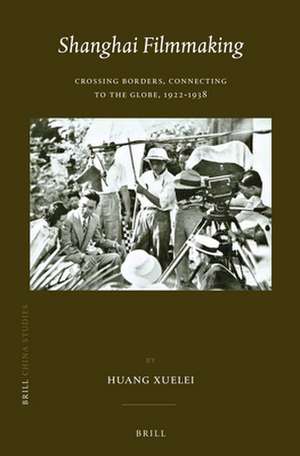
Shanghai Filmmaking: Shanghai Filmmaking, cartea 29
Autor Huang Xueleien Limba Engleză Hardback – 12 aug 2014
Shanghai filmmaking developed in a matrix of global cultural production and distribution, and interacted closely with print culture and theatre. People from allegedly antagonistic political groupings worked closely with each other to bring a new form of visual culture and a new body of knowledge to an audience in and outside China. By exploring various border crossings, this book sheds new light on the power of popular cultural production during China’s modern transformation.
Preț: 1235.11 lei
Preț vechi: 1604.04 lei
-23%
Puncte Express: 1853
Carte tipărită la comandă
Livrare economică 23 noiembrie-07 decembrie
Livrare prin curier în România Termenul estimat este afișat lângă disponibilitate.
Transport gratuit pentru acest produs Plată online sau ramburs, în funcție de opțiunile comenzii.
Retur gratuit în 14 zile Comandă securizată și suport în română.
Specificații
ISBN-13: 9789004279339
ISBN-10: 9004279334
Pagini: 398
Dimensiuni: 155 x 234 x 22 mm
Greutate: 0.73 kg
Ediția:New.
Editura: Koninklijke Brill Bv
Colecția Shanghai Filmmaking
Seriile Shanghai Filmmaking, Brill
ISBN-10: 9004279334
Pagini: 398
Dimensiuni: 155 x 234 x 22 mm
Greutate: 0.73 kg
Ediția:New.
Editura: Koninklijke Brill Bv
Colecția Shanghai Filmmaking
Seriile Shanghai Filmmaking, Brill
V-ar putea interesa
-
 The Rational OptimistMatt RidleyPreț: 80.42 lei
 -
 Empires of FoodAndrew RimasPreț: 92.98 lei
 -
 Brief LivesPaul JohnsonPreț: 110.07 lei
 -
 Cultural History: A Concise IntroductionAlessandro ArcangeliPreț: 383.23 lei
 -
 How Food Made HistoryB W HigmanPreț: 253.89 lei
 -
 The National Theatre StoryDr Daniel Rosenthal-15%Preț: 376.65 lei444.65 lei
 -
 Cambridge GhostsRobert HallidayPreț: 115.54 lei
 -
 Tindall, G: Fields BeneathGillian Tindall-19%Preț: 86.59 lei106.55 lei
 -
 When Miss Emmie as in RussiaHarvey Pitcher-19%Preț: 87.42 lei107.45 leiNou
Notă biografică
Huang Xuelei, Ph.D. (2009), University of Heidelberg, is Chancellor’s Research Fellow in Chinese Studies at the University of Edinburgh. She has published on Chinese cinema, print culture and the social history of modern China.
Cuprins
Figures, Charts, and Tables
Conventions and Abbreviations
Acknowledgements
Foreword
Paul G. Pickowicz
INTRODUCTION: Shanghai Filmmaking: Border-crossing Practices
PART I PRODUCTION
1. The Business
2. Players in the 1920s: Interconnecting, Mediating
3. Players in the 1930s: Contestation? Collaboration?
PART II PRODUCT
4. The Medium: Inside Glocal Mediascapes
5. The Narrative (I): Melodrama as a Social Form
6. The Narrative (II): Melodramas Fit for All
7. The Meaning: Toward a Sentimental Education
EPILOGUE: Toward a Glocal Viewing Public
Appendix I: Filmography
Appendix II: Mingxing Personnel
Bibliography
Conventions and Abbreviations
Acknowledgements
Foreword
Paul G. Pickowicz
INTRODUCTION: Shanghai Filmmaking: Border-crossing Practices
PART I PRODUCTION
1. The Business
2. Players in the 1920s: Interconnecting, Mediating
3. Players in the 1930s: Contestation? Collaboration?
PART II PRODUCT
4. The Medium: Inside Glocal Mediascapes
5. The Narrative (I): Melodrama as a Social Form
6. The Narrative (II): Melodramas Fit for All
7. The Meaning: Toward a Sentimental Education
EPILOGUE: Toward a Glocal Viewing Public
Appendix I: Filmography
Appendix II: Mingxing Personnel
Bibliography
Recenzii
“Huang Xuelei invites readers to go on a delightful tour that will familiarize them with the unforgettable personalities and practices responsible for the remarkable Mingxing story. When this special tour is over, readers will know much more about the complex origins of Chinese filmmaking and how these origins help us better understand the complicated world of Chinese filmmaking today.”
Paul G. Pickowicz, University of California, San Diego
"[Huang]'s interdisciplinary approach ultimately adds richness to our understanding of Mingxing, and the historiographical method of multiple strands provides us with a comprehensive and palimpsestic picture. [Huang] argues that melodrama is the social form and the narrative mode favored by all, thereby explaining its dominance in Mingxing production. [Huang], like some scholars of Chinese cinema, has traced the cross-cultural influence of melodrama in, for instance, transnational remakes or adaptation while noting the multiplicity of genres produced by Mingxing."
Xiangyang Cindy Chen, independent scholar, China Review International, Vol. 21, No. 1, 2014.
"Shanghai Filmmaking [is] a key volume in the rapidly expanding library of books on Chinese cinema of the Republican era, and one which will have lasting value for scholars for years to come."
-Chris Berry, The China Quarterly, Volume 221, March 2015, pp 279-280.
Paul G. Pickowicz, University of California, San Diego
"[Huang]'s interdisciplinary approach ultimately adds richness to our understanding of Mingxing, and the historiographical method of multiple strands provides us with a comprehensive and palimpsestic picture. [Huang] argues that melodrama is the social form and the narrative mode favored by all, thereby explaining its dominance in Mingxing production. [Huang], like some scholars of Chinese cinema, has traced the cross-cultural influence of melodrama in, for instance, transnational remakes or adaptation while noting the multiplicity of genres produced by Mingxing."
Xiangyang Cindy Chen, independent scholar, China Review International, Vol. 21, No. 1, 2014.
"Shanghai Filmmaking [is] a key volume in the rapidly expanding library of books on Chinese cinema of the Republican era, and one which will have lasting value for scholars for years to come."
-Chris Berry, The China Quarterly, Volume 221, March 2015, pp 279-280.