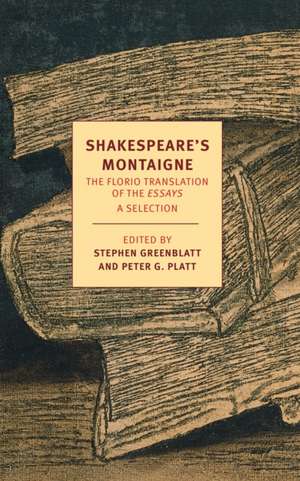
Shakespeare's Montaigne
Autor Michel De Montaigneen Limba Engleză Paperback – 8 apr 2014
Această ediție publicată de NEW YORK REVIEW OF BOOKS sub îngrijirea lui Stephen Greenblatt aduce o perspectivă proaspătă asupra uneia dintre cele mai fertile intersecții din istoria literaturii: dialogul dintre Michel De Montaigne și William Shakespeare. Ceea ce distinge acest volum este decizia editorială de a folosi și moderniza traducerea lui John Florio din 1603, textul prin care Shakespeare însuși a descoperit gândirea sceptică și umanistă a francezului. Ne-a atras atenția modul în care această ediție nu se limitează la a fi o simplă culegere de eseuri, ci devine un instrument critic ce demonstrează cum concepte din The Complete Essays au fost reconfigurate în piese fundamentale precum „Regele Lear” sau „Furtuna”. Găsim în această carte o structură tripartită care onorează nu doar sursa și destinatarul ideilor, ci și pe „maestrul limbajului”, Florio, a cărui proză barocă a contribuit activ la inventarea limbii engleze moderne. Comparabil cu Montaigne's English Journey de William M. Hamlin în rigurozitate, volumul de față este actualizat pentru studiile literare contemporane, oferind note de subsol care clarifică arhaismele fără a sacrifica muzicalitatea originală. În contextul operei lui Michel De Montaigne, acest volum extrage acele teme — de la natura canibalismului la fluiditatea eului — care au rezonat cel mai puternic cu dramaturgia elisabetană. Putem afirma că lucrarea reușește să transforme un text istoric într-o experiență de lectură vibrantă, subliniind tensiunile dintre viziunile celor doi titani asupra cunoașterii și identității.
Preț: 144.72 lei
Carte disponibilă
Livrare economică 18 mai-01 iunie
Livrare express 01-07 mai pentru 31.26 lei
Specificații
ISBN-10: 1590177223
Pagini: 480
Dimensiuni: 126 x 203 x 30 mm
Greutate: 0.48 kg
Ediția:Main
Editura: New York Review Books
V-ar putea interesa
-
 The Oxford Handbook of Shakespearean ComedyHeather Hirschfeld-20%Preț: 375.39 lei471.24 lei
 -
 -33%Preț: 572.83 lei857.03 lei
 -
 -34%Preț: 871.32 lei1318.46 lei
 -
 The Elizabethan Stage: Volume 2E. K. Chambers-37%Preț: 1013.17 lei1614.10 lei
 -
 How to do ShakespeareAdrian Noble-18%Preț: 1067.59 lei1301.93 lei
 -
 -29%Preț: 171.94 lei243.09 lei
 -
 Shakespeare and ForgettingPeter Holland-29%Preț: 198.39 lei279.44 lei
 -
 Women’s Labour and the History of the Book in Early Modern EnglandDr Valerie Wayne-29%Preț: 160.46 lei225.33 lei
 -
 Lockdown Shakespeare: New Evolutions in Performance and AdaptationGemma Kate Allred-27%Preț: 198.69 lei270.40 lei
 -
 White People in Shakespeare: Essays on Race, Culture and the EliteArthur L. Little, Jr.-22%Preț: 155.10 lei199.64 lei
 -
 Shakespeare’s House: A Window onto his Life and LegacyProfessor Richard Schoch-39%Preț: 123.41 lei203.05 lei
 -
 Shakespeare and the Denial of TerritoryPascale Drouet-19%Preț: 673.46 lei831.43 lei
 -
 Filthy ShakespearePauline KiernanPreț: 126.97 lei
 -
 Essays of Michel de Montaigne: The Power of the Coming RaceMichel de MontaignePreț: 162.42 lei
 -
 -23%Preț: 78.51 lei102.00 lei
 -
 Shakespeare on StageJulian CurryPreț: 107.47 lei
 -
 Preț: 210.49 lei
De ce să citești această carte
Recomandăm această ediție oricărui cititor pasionat de originile gândirii moderne și de mecanismele creației shakespeariene. Este o oportunitate rară de a citi Essays prin ochii și limba epocii lui Shakespeare, beneficiind în același timp de claritatea unei editări critice moderne. Veți câștiga o înțelegere profundă a modului în care eseul, ca formă literară, a modelat profunzimea psihologică a teatrului universal.
Despre autor
Michel De Montaigne (1533-1592) a fost un magistrat și filozof francez, recunoscut universal ca inventatorul eseului modern. Retras la castelul său pentru a studia „eul” în toată variabilitatea sa, a lăsat în urmă o operă care a influențat decisiv cursul literaturii europene. Stephen Greenblatt, editorul acestui volum, este un distins specialist în perioada Renașterii și unul dintre fondatorii Noului Istoricism, fiind autorul unor biografii de referință despre Shakespeare. Traducerea îi aparține lui John Florio, figură centrală a cercurilor literare elisabetane, a cărui măiestrie lingvistică a oferit publicului englez acces la filozofia continentală.
Notă biografică
John Florio (1553ߝ1625) was an Anglo-Italian linguist and lexicographer, a royal language tutor at the Court of James I, a possible friend and influence on Shakespeare, and the translator of Montaigne’s Essais into English.
Stephen Greenblatt is the Cogan University Professor of English and American Literature and Language at Harvard University. He lives in Cambridge, Massachusetts, and in Vermont. His most recent book, The Swerve: How the World Became Modern, won the National Book Award for Nonfiction.
Peter Platt is Professor of English at Barnard College, where he is also the department’s chair. He is the author of Shakespeare and the Culture of Paradox and Reason Diminished: Shakespeare and the Marvelous and the editor of Wonders, Marvels, and Monsters in Early Modern Culture.
Descriere scurtă
Shakespeare, Nietzsche once wrote, was Montaigne’s best reader. It is a typically brilliant Nietzschean insight, capturing the intimate relationship between the ever-changing record of the mutable self constituted by Montaigne’s Essays and Shakespeare’s kaleidoscopic register of human character. For all that, how much Shakespeare actually read Montaigne remains a matter of uncertainty and debate to this day. That he read him there is no doubt. Passages from Montaigne are evidently reworked in both King Lear and The Tempest, and there are possible echoes elsewhere in the plays. But however closely Shakespeare himself may have pored over the Essays, he lived in a milieu in which Montaigne was widely known, oft cited, and both disputed and respected. This in turn was thanks to the inspired and dazzling translation of his work by a man who was a fascinating polymath, man-about-town, and master of language himself, Sir John Florio.
Shakespeare’s Montaigne offers modern readers a new, adroitly modernized edition of Florio’s translation of the Essays, a still-resonant reading of Montaigne that is also a masterpiece of English prose. Florio’s translation, like Sir Robert Burton’s Anatomy of Melancholy and the works of Sir Thomas Browne, is notable not only for its stylistic range and felicity and the deep and lingering music of many passages, but also for having helped to invent the English language as we know it today, supplying it, very much as Shakespeare also did, with new words and enduring turns of phrase. Stephen Greenblatt’s introduction also explores the echoes and significant tensions between Shakespeare’s and Montaigne’s world visions, while Peter Platt introduces readers to the life and times of Sir John Florio. Altogether, this book provides a remarkable new experience of not just two but three great writers who ushered in the modern world.
Recenzii
“That such a man wrote has truly augmented the joy of living on Earth.” —Friedrich Nietzsche
“Montaigne is the frankest and honestest of all writers.” —Ralph Waldo Emerson
“I defy any reader of Montaigne not to put down the book at some point and say with incredulity: ‘How did he know all that about me?’ ” —Bernard Levin, The Times (London)
“So much have I made him my own, that it seems he is my very self.” —André Gide
“Here is a ‘you’ in which ‘I’ is reflected; here is where all distance is abolished.” —Stefan Zweig
“Don’t read him as children do, for amusement, nor as the ambitious do, to be instructed. No, read him in order to live.” —Gustave Flaubert
“It is not in Montaigne but in myself that I find everything I see there.” —Blaise Pascal
“Upon his version of Montaigne’s Essays [Florio] exhausted his gifts and lavished his temperament. ...Turn where you will in his translation, and you will find flowers of speech.” —The Cambridge History of English and American Literature
“Like Montaigne, [Florio] wrote by exuding ever more complex thoughts as a spider exudes silk. But while Montaigne always moves forward, Florio winds back on himself and scrunches his sentences in a puff of syntax. The real magic happens when the two writers meet. Montaigne’s earthiness holds Florio’s convolutions in check, while Florio gives Montaigne an Elizabethan English quality, as well as a lot of sheer fun.” —Sara Bakewell, How to Live, or, A Life of Montaigne