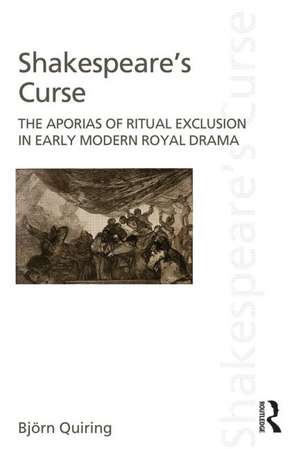
Shakespeare's Curse: The Aporias of Ritual Exclusion in Early Modern Royal Drama
Autor Björn Quiringen Limba Engleză Hardback – 30 oct 2013
A fascinating interdisciplinary study, this book will interest students and scholars of Law, Literature, and History.
Preț: 1203.54 lei
Preț vechi: 1595.14 lei
-25%
Puncte Express: 1805
Carte indisponibilă temporar
Doresc să fiu notificat când acest titlu va fi disponibil:
Se trimite...
Specificații
ISBN-13: 9780415517560
ISBN-10: 0415517567
Pagini: 280
Dimensiuni: 156 x 234 x 23 mm
Greutate: 0.6 kg
Ediția:1
Editura: Taylor & Francis
Colecția Routledge
Locul publicării:Oxford, United Kingdom
ISBN-10: 0415517567
Pagini: 280
Dimensiuni: 156 x 234 x 23 mm
Greutate: 0.6 kg
Ediția:1
Editura: Taylor & Francis
Colecția Routledge
Locul publicării:Oxford, United Kingdom
V-ar putea interesa
-
 -15%Preț: 468.38 lei551.03 lei
 -
 -15%Preț: 467.14 lei549.58 lei
 -
 -15%Preț: 493.73 lei580.85 lei
 -
 Preț: 158.37 lei
 -
 Preț: 307.55 lei
 -
 Reach - Mustervertrage Fur Konsortien: Und Andere Formen Der DatenteilungHorst von HollebenPreț: 452.78 lei
Public țintă
General, Postgraduate, and UndergraduateCuprins
Acknowledgements Introduction 1. Richard III and the Ostracized Heritage of Theater 1.1 Anne and the Supplement of the Eucharist 1.2 Margaret and the Excommunication of the Old Liturgy 1.3 Edward IV, the Oath and the Performance of the Social Contract 1.4 Hastings and the Fateful Prophecy 1.5 Henry VI and the Standing Army of the Dead 1.6 Clarence and the Diabolical Allegory 1.7 Buckingham and the Grounds of Theater 2. King John and the Ordeal of the Bastard Commodity 3. King Lear and the Naturalized State of Exception 3.1 Cordelia and the Problem of Equity 3.2 Goneril and Regan within the Liberties of Nature 3.3 Kent in Internal Banishment 3.4 Edgar and the benedictio vacui 3.5 The Fool and the Bonds of Fate 3.6 Storm still and the Perpetual Downfall of the Last Judgment
Recenzii
"Shakespeare’s Curse is a compelling and original study of the terrible force of words in King Lear and the history plays. Written by one of Germany’s most brilliant young Shakespeare scholars, this book demonstrates the dramatic yoking of affect and order, act and expression, and sovereignty and ban within the primitive arc of the curse. Quiring combines deep juridical, philosophical and biblical knowledge with a compassionate and generous attention to the pathos of power in Shakespearean drama." - Julia Reinhard Lupton, author of Thinking with Shakespeare: Essays on Politics and Life
"A damn good book." - Roger Lüdeke, Shakespeare Jahrbuch
"Björn Quiring's study 'Shakspeare's Curse' is quite remarkable. With notable thoroughness, it explains the presence and history of cursing as an act of violence within the making of legal codes and lawmaking moments." - Nigel Smith, Princeton University
"Shakespeare’s Curse is well-written and delivers an exciting argument that makes possible a wide range of subsequent studies." - Matthew Vadnais for Theatre Journal (Vol. 67, No. 1, Mar 2015)
"Shakespeare’s Curse is a compelling and original study of the terrible force of words in King Lear and the history plays. Written by one of Germany’s most brilliant young Shakespeare scholars, this book demonstrates the dramatic yoking of affect and order, act and expression, and sovereignty and ban within the primitive arc of the curse. Quiring combines deep juridical, philosophical and biblical knowledge with a compassionate and generous attention to the pathos of power in Shakespearean drama."
Julia Reinhard Lupton, author of Thinking with Shakespeare: Essays on Politics and Life
"A damn good book."
Roger Lüdeke, Shakespeare Jahrbuch
"Björn Quiring's study 'Shakspeare's Curse' is quite remarkable. With notable thoroughness, it explains the presence and history of cursing as an act of violence within the making of legal codes and lawmaking moments.
In Shakespeare's history plays, and that of the best of his contemporaries, that act of verbal violence remains at work, but divorced from its original sites of operation. The curse in drama becomes a uniquely powerful, disarming force, crucial in the formation of the modern subject. Shakespeare's understanding of the meaning of the curse sets him apart and makes his plays an unusually highly attuned witness to the continuing role of the curse, even as secularization took hold. This study is compelling and exciting, and as high-powered and original a reading of Shakespeare as you could hope to find. It is wholly deserved and a great relief to have this study now translated into English."
Nigel Smith, Princeton University
"A damn good book." - Roger Lüdeke, Shakespeare Jahrbuch
"Björn Quiring's study 'Shakspeare's Curse' is quite remarkable. With notable thoroughness, it explains the presence and history of cursing as an act of violence within the making of legal codes and lawmaking moments." - Nigel Smith, Princeton University
"Shakespeare’s Curse is well-written and delivers an exciting argument that makes possible a wide range of subsequent studies." - Matthew Vadnais for Theatre Journal (Vol. 67, No. 1, Mar 2015)
"Shakespeare’s Curse is a compelling and original study of the terrible force of words in King Lear and the history plays. Written by one of Germany’s most brilliant young Shakespeare scholars, this book demonstrates the dramatic yoking of affect and order, act and expression, and sovereignty and ban within the primitive arc of the curse. Quiring combines deep juridical, philosophical and biblical knowledge with a compassionate and generous attention to the pathos of power in Shakespearean drama."
Julia Reinhard Lupton, author of Thinking with Shakespeare: Essays on Politics and Life
"A damn good book."
Roger Lüdeke, Shakespeare Jahrbuch
"Björn Quiring's study 'Shakspeare's Curse' is quite remarkable. With notable thoroughness, it explains the presence and history of cursing as an act of violence within the making of legal codes and lawmaking moments.
In Shakespeare's history plays, and that of the best of his contemporaries, that act of verbal violence remains at work, but divorced from its original sites of operation. The curse in drama becomes a uniquely powerful, disarming force, crucial in the formation of the modern subject. Shakespeare's understanding of the meaning of the curse sets him apart and makes his plays an unusually highly attuned witness to the continuing role of the curse, even as secularization took hold. This study is compelling and exciting, and as high-powered and original a reading of Shakespeare as you could hope to find. It is wholly deserved and a great relief to have this study now translated into English."
Nigel Smith, Princeton University
Descriere
Conceptualizing the curse as the representation of a foundational, mythical violence embedded within juridical discourse, Shakespeare’s Curse provides a fresh perspective on Shakespeare’s plays Richard III, King John, and King Lear, and an original insight into early modern legal developments. Drawing on the work of Derrida, Lacan, Walter Benjamin and Giorgio Agamben, among others, Quiring analyses the performativity of the curse, and tracks its power through the juristic themes that are pursued within the plays – such as sovereignty, legitimacy, obligation, exception, and natural law. A fascinating interdisciplinary book of interest to students and scholars of Law, Literature, and History.