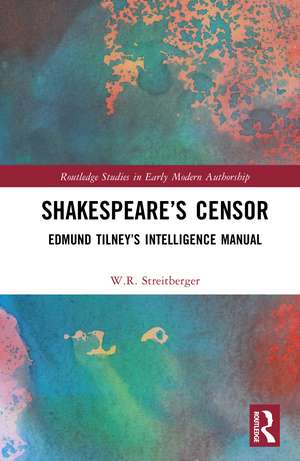
Shakespeare’s Censor: Edmund Tilney’s Intelligence Manual: Routledge Studies in Early Modern Authorship
Autor W.R. Streitbergeren Limba Engleză Hardback – 11 feb 2026
The study focuses on those subjects by placing them in the broader context of a European culture that came increasingly to believe that the effective analysis and deployment of historical evidence would establish a reliable version of the past that could be used to resolve contemporary problems. But the new humanist methods of historical analysis and argument exacerbated rather than resolved disputes. The techniques developed to analyse evidence and argue causality themselves were used to challenge the intellectual, political, and religious establishments they were originally devised to strengthen. As both Protestant and Catholic reformers throughout Europe became more assertive in using historical arguments to defend their confessional beliefs and to apply political pressure on governments to act on their behalf, politics and religion became inseparably intertwined. The polarization that developed from the impasse in debate eventually took the form of political and military alliances, plunging Northern Europe into a period of almost unceasing religious, political, and military conflict. Tilney’s manual reflects the tension produced by that conflict. He attempted to defend the interests of England, Elizabeth I, and the Reformed Religion that she patronized in historical arguments in which politics, religion, and military action reinforced one another. Tilney’s manual provides valuable insights into his understanding of some of the key political and religious issues of the period. Since he was a client of his more famous relative, Lord Admiral Charles Howard, the manual also provides insights into the politico-religious ideas acceptable within the network of one of Elizabeth I’s more prominent privy councillors. While it does not provide a blueprint for the conduct of Tilney’s duties as censor, the manual does provide insights into the humanist outlook he brought to his duties as licenser of plays for public performance and as producer of plays for the court. It also suggests how these ideas were disseminated and became part of the social fabric of English culture.

Preț: 1115.17 lei
Preț vechi: 1359.96 lei
-18%
Puncte Express: 1673
Carte tipărită la comandă
Livrare economică 02-16 decembrie
Livrare prin curier în România Termenul estimat este afișat lângă disponibilitate.
Transport gratuit pentru acest produs Plată online sau ramburs, în funcție de opțiunile comenzii.
Retur gratuit în 14 zile Comandă securizată și suport în română.
Specificații
ISBN-13: 9781041099802
ISBN-10: 1041099800
Pagini: 202
Ilustrații: 12
Dimensiuni: 152 x 229 mm
Greutate: 0.53 kg
Ediția:1
Editura: Taylor & Francis
Colecția Routledge
Seria Routledge Studies in Early Modern Authorship
Locul publicării:Oxford, United Kingdom
ISBN-10: 1041099800
Pagini: 202
Ilustrații: 12
Dimensiuni: 152 x 229 mm
Greutate: 0.53 kg
Ediția:1
Editura: Taylor & Francis
Colecția Routledge
Seria Routledge Studies in Early Modern Authorship
Locul publicării:Oxford, United Kingdom
Public țintă
PostgraduateCuprins
Introduction, Chapter 1. Authorship, Genre, Sources, Chapter 2. History, Chronologies, Regiments, Chapter 3. Legend and History, Chapter 4. Religion and Politics, Chapter 5. Licensing and Censorship: the Oldcastle/Falstaff Controversy and the book of Sir Thomas More, Chapter 6. PrProducing Shakespeare at Court, Conclusion, Index
Recenzii
"Streitberger takes you into the mind which licensed most of Shakespeare’s plays and reveals a surprising place, deeply absorbed in European theology, history and diplomacy while engaged in supplying suitable entertainment for his monarch. We will never get closer to what sophisticated Elizabethans saw when they read a Shakespeare play."
- Richard Dutton, Ohio State University (Emeritus)
"Streitberger offers the first in-depth analysis of Edmund Tilney’s life’s work, ‘Topographical Descriptions’, a fascinating example of diplomatic literature that combined political information gathering with humanist historiography. Streitberger’s meticulous research fills an important gap in our understanding, providing insight into the knowledge and sensibilities of this significant figure of Elizabethan theatre."
- Elizabeth R. Williamson, University of Exeter
"This book is a significant addition to existing scholarship on censorship and state control of the Elizabethan stage. Streitberger strengthens the view that Edmund Tilney was no mere censorious bureaucrat, but an enabler of the drama; brings to light the contents of Tilney's ‘intelligence manual’, as yet buried in the archives; and throws light on the regulatory, licensing and censorship practices of the Elizabethan and Jacobean state in the context of a wider consideration of humanist culture."
- Graham Holderness, University of Hertfordshire (Emeritus)
- Richard Dutton, Ohio State University (Emeritus)
"Streitberger offers the first in-depth analysis of Edmund Tilney’s life’s work, ‘Topographical Descriptions’, a fascinating example of diplomatic literature that combined political information gathering with humanist historiography. Streitberger’s meticulous research fills an important gap in our understanding, providing insight into the knowledge and sensibilities of this significant figure of Elizabethan theatre."
- Elizabeth R. Williamson, University of Exeter
"This book is a significant addition to existing scholarship on censorship and state control of the Elizabethan stage. Streitberger strengthens the view that Edmund Tilney was no mere censorious bureaucrat, but an enabler of the drama; brings to light the contents of Tilney's ‘intelligence manual’, as yet buried in the archives; and throws light on the regulatory, licensing and censorship practices of the Elizabethan and Jacobean state in the context of a wider consideration of humanist culture."
- Graham Holderness, University of Hertfordshire (Emeritus)
Notă biografică
W.R. Streitberger is Professor of English and a faculty member in the Interdisciplinary Textual Studies Program at the University of Washington, Seattle. He has dedicated an entire scholarly career to the study of the early modern English court and its management of entertainments and is recognized as the leading modern authority on the subject. Some of his more important earlier books include Tudor Court Revels, 1485-1559 (Toronto, 1994), Jacobean and Caroline Revels Accounts (Malone Society Collections XIII, 1986), and the David Bevington Prize winner The Masters of the Revels and Elizabeth I’s Court Theatre (Oxford, 2016).
Descriere
This book situates Tilney’s intelligence manual in the emerging genre that developed around intelligence gathering in the late sixteenth century and attempts to explain how he reconciled the tension between his admiration for the aims of humanist history with his political and religious beliefs.