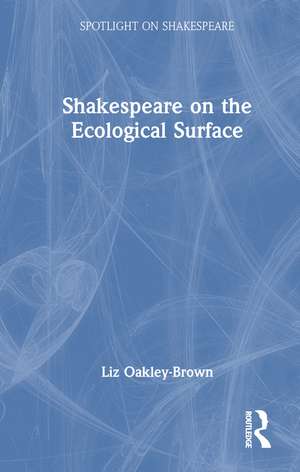
Shakespeare on the Ecological Surface: Spotlight on Shakespeare
Autor Liz Oakley-Brownen Limba Engleză Hardback – 31 ian 2024
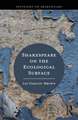
While the word ‘surface’ was never used in Shakespeare’s works, Liz Oakley-Brown shows how thinking about Shakespearean surfaces helps readers explore the politics of Elizabethan and Jacobean culture. She also draws surprising parallels with our current political and ecological concerns. The book explores how Shakespeare uses ecological surfaces to help understand other types of surfaces in his plays and poems: characters’ public-facing selves; contact zones between characters and the natural world; surfaces upon which words are written; and physical surfaces upon which plays are staged.
This book will be an illuminating read for anyone studying Shakespeare, early modern culture, ecocriticism, performance and activism.
Din seria Spotlight on Shakespeare
-
 Preț: 230.78 lei
 -
 Preț: 173.44 lei
 -
 Preț: 204.00 lei
 -
 Preț: 196.37 lei
 -
 Preț: 194.06 lei
 -
 Preț: 194.58 lei
 -
 Preț: 241.90 lei
 -
 Preț: 234.65 lei
 -
 Preț: 288.78 lei
 -
 Preț: 287.73 lei
 - nou
 Preț: 212.14 lei
Preț: 898.69 lei
Preț vechi: 1273.03 lei
-29%
Puncte Express: 1348
Preț estimativ în valută:
159.08€ • 184.78$ • 137.82£
159.08€ • 184.78$ • 137.82£
Carte indisponibilă temporar
Doresc să fiu notificat când acest titlu va fi disponibil:
Se trimite...
Preluare comenzi: 021 569.72.76
Specificații
ISBN-13: 9780367345914
ISBN-10: 0367345919
Pagini: 264
Dimensiuni: 129 x 198 mm
Greutate: 0.36 kg
Ediția:1
Editura: Taylor & Francis
Colecția Routledge
Seria Spotlight on Shakespeare
Locul publicării:Oxford, United Kingdom
ISBN-10: 0367345919
Pagini: 264
Dimensiuni: 129 x 198 mm
Greutate: 0.36 kg
Ediția:1
Editura: Taylor & Francis
Colecția Routledge
Seria Spotlight on Shakespeare
Locul publicării:Oxford, United Kingdom
Public țintă
Postgraduate and UndergraduateCuprins
1. Slick: Art for What’s Sake? 2. Smoke: London’s Burning 3. Sky: Unfirming the Firmament 4. Steam: Under Pressure 5. Soil: Down to Earth 6. Slime: Sensory Plays 7. Snail: Finding Our Place 8. Silk: Textile Production 9. Skin: Curating Complexion 10. Stage: Disposable Globes
Notă biografică
Liz Oakley-Brown is Senior Lecturer in the Department of English Literature and Creative Writing at Lancaster University, UK. Her publications include The Rituals and Rhetoric of Queenship: Medieval to Early Modern (co-edited with Louise J. Wilkinson; 2009), Shakespeare and the Translation of Identity in Early Modern England (2011) and Twelfth Night: A Critical Reader (co-edited with Alison Findlay; 2014).
Recenzii
‘It carries a political appeal to “act” as if “our collective non-human and human existence depend[ed] upon it”. For taking the discipline of ecocriticism in a new direction, its bravery and radicalism should be welcomed.’ Alice Leonard, TLS
'The book advances an original and canny argument that the absence of the word surface from Shakespeare’s lexicon constitutes negative evidence that he and his culture had a much more immersive, inter-connected understanding of the world that did not draw such sharp divides– physical or taxonomic–between things. . . . [It] makes an important contribution to ecocriticism and Shakespeare Studies, while illustrating how eco-theory might influence theatre practitioners and vice-versa. . . . Since Oakley-Brown spends many sentences thanking the critics who have taught her to see Shakespeare and the world anew, it seems only fitting that a reviewer return the favour and thank the author for spotlighting the surfaces of Shakespeare’s world, revealing how much can still be glimpsed in them and through them if we look closely enough and through the eyes of such a keen-sighted guide' Todd Borlik, Shakespeare
‘Shakespeare on the Ecological Surface is a handy and absorbing study. As well as early modern ecocritics, the book will be useful to anyone working in the wider fields of surface studies or geo-humoralism. As an invitation to shift perceptions on the individual ‘surfaces’ described in the book, both in Shakespeare’s plays and in the modern experience, the book undoubtedly succeeds. The research opens up many potential further avenues of exploration.’ Elizabeth Freestone, Green Letters: Studies in Ecocriticism
‘The strengths of Oakley-Brown’s project are several. . . . [Oakley-Brown’s] brand of presentism demonstrates that Shakespearean scholarship can change as rapidly as our technology, our pathogens, and our ecology during times of environmental and anthropogenic crises. The book is a powerful reminder of how Covid-19 has shaped a cultural and critical landscape full of surfaces that must be acknowledged, wiped off, bleached, breathed on, breathed through, and studied. As a timely product of the pandemic, her book still manages to provide a strong defence of the humanities in the fight for climate justice’. Will Steffen, Cahiers Élisabéthains: A Journal of English Renaissance Studies
'The book advances an original and canny argument that the absence of the word surface from Shakespeare’s lexicon constitutes negative evidence that he and his culture had a much more immersive, inter-connected understanding of the world that did not draw such sharp divides– physical or taxonomic–between things. . . . [It] makes an important contribution to ecocriticism and Shakespeare Studies, while illustrating how eco-theory might influence theatre practitioners and vice-versa. . . . Since Oakley-Brown spends many sentences thanking the critics who have taught her to see Shakespeare and the world anew, it seems only fitting that a reviewer return the favour and thank the author for spotlighting the surfaces of Shakespeare’s world, revealing how much can still be glimpsed in them and through them if we look closely enough and through the eyes of such a keen-sighted guide' Todd Borlik, Shakespeare
‘Shakespeare on the Ecological Surface is a handy and absorbing study. As well as early modern ecocritics, the book will be useful to anyone working in the wider fields of surface studies or geo-humoralism. As an invitation to shift perceptions on the individual ‘surfaces’ described in the book, both in Shakespeare’s plays and in the modern experience, the book undoubtedly succeeds. The research opens up many potential further avenues of exploration.’ Elizabeth Freestone, Green Letters: Studies in Ecocriticism
‘The strengths of Oakley-Brown’s project are several. . . . [Oakley-Brown’s] brand of presentism demonstrates that Shakespearean scholarship can change as rapidly as our technology, our pathogens, and our ecology during times of environmental and anthropogenic crises. The book is a powerful reminder of how Covid-19 has shaped a cultural and critical landscape full of surfaces that must be acknowledged, wiped off, bleached, breathed on, breathed through, and studied. As a timely product of the pandemic, her book still manages to provide a strong defence of the humanities in the fight for climate justice’. Will Steffen, Cahiers Élisabéthains: A Journal of English Renaissance Studies
Descriere
Shakespeare on the Ecological Surface uses the concept of the ‘surface’ to examine the relationship between contemporary performance and ecocriticism.