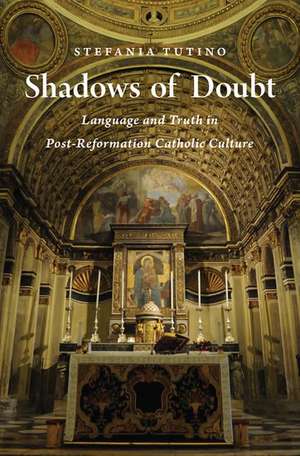
Shadows of Doubt: Language and Truth in Post-Reformation Catholic Culture
Autor Stefania Tutinoen Limba Engleză Hardback – 30 ian 2014
Preț: 694.17 lei
Preț vechi: 1011.17 lei
-31%
Puncte Express: 1041
Carte tipărită la comandă
Livrare economică 27 noiembrie-08 decembrie
Livrare prin curier în România Termenul estimat este afișat lângă disponibilitate.
Transport gratuit pentru acest produs Plată online sau ramburs, în funcție de opțiunile comenzii.
Retur gratuit în 14 zile Comandă securizată și suport în română.
Specificații
ISBN-13: 9780199324989
ISBN-10: 0199324980
Pagini: 304
Dimensiuni: 160 x 236 x 28 mm
Greutate: 0.54 kg
Editura: Oxford University Press
Colecția OUP USA
Locul publicării:New York, United States
ISBN-10: 0199324980
Pagini: 304
Dimensiuni: 160 x 236 x 28 mm
Greutate: 0.54 kg
Editura: Oxford University Press
Colecția OUP USA
Locul publicării:New York, United States
V-ar putea interesa
-
 Opus DeiJohn L. AllenPreț: 117.18 lei
 -
 -20%Preț: 514.07 lei643.44 lei
 -
 -30%Preț: 401.73 lei570.86 lei
 -
 -10%Preț: 394.18 lei436.26 lei
 -
 -31%Preț: 777.08 lei1129.70 lei
 -
 -23%Preț: 246.18 lei318.86 lei
 -
 -23%Preț: 294.03 lei383.73 lei
 -
 The Spirit's Tether: Family, Work, and Religion among American CatholicsMary Ellen Konieczny-13%Preț: 273.48 lei313.33 lei
 -
 The Last Years of Saint Therese: Doubt and Darkness, 1895-1897Thomas R. Nevin-28%Preț: 377.51 lei521.00 lei
 -
 The Disarmament of HatredG. Barry-15%Preț: 647.80 lei762.11 lei
 -
 That They May All Be OneWalter Kasper-41%Preț: 100.84 lei172.02 lei
 -
 -14%Preț: 235.01 lei273.32 lei
 -
 Catholic Book of PrayersMaurus FitzgeraldPreț: 73.57 lei
 -
 A Pocket Guide to the BibleScott HahnPreț: 64.52 lei
 -
 29 Things to Know about CatholicismSue Marquette PorembaPreț: 61.19 lei
Recenzii
It is impossible not to be impressed with the author's erudition. Tutinoâs mastery of the Roman and Vatican archives is unrivalled. She throws light on the vibrancy of early modern Catholic intellectual culture in a way that has rarely, if ever, been done before.
This highly original and brilliantly argued study of the way in which truth claims were made and debated in post-Reformation Catholic culture is the work of a world-class scholar at the very top of her game. Tutino has not only made an indispensable contribution to the history of early modern skepticism and doubt, but has also recovered for attention the early modern origins of 'post-modern' awareness of the fragile relationship between truth and language. As such, her book will be required reading not only for historians of early modern Roman Catholicism but also for students of literature and philosophy of language more generally.
This highly original and brilliantly argued study of the way in which truth claims were made and debated in post-Reformation Catholic culture is the work of a world-class scholar at the very top of her game. Tutino has not only made an indispensable contribution to the history of early modern skepticism and doubt, but has also recovered for attention the early modern origins of 'post-modern' awareness of the fragile relationship between truth and language. As such, her book will be required reading not only for historians of early modern Roman Catholicism but also for students of literature and philosophy of language more generally.
Notă biografică
Stefania Tutino is Professor of Early Modern History at UCLA