Cantitate/Preț
Produs

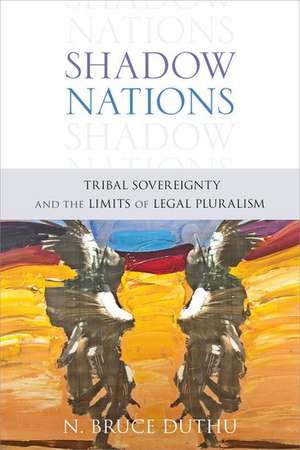
Shadow Nations: Tribal Sovereignty and the Limits of Legal Pluralism

Autor Bruce Duthu
en Limba Engleză Hardback – 18 iul 2013

Observăm un fapt istoric și juridic frapant: deși triburile de indieni americani au fost recunoscute de mult timp ca „națiuni domestice dependente”, puterea lor de autoguvernare a fost constant erodată de intervențiile Congresului și ale Curții Supreme. În Shadow Nations, Bruce Duthu analizează critic acest proces, identificând o tendință imperialistă care încearcă să elimine orice formă de autoritate politică ce ar putea concura cu statul. Subliniem faptul că volumul nu este doar o cronică a declinului, ci un manifest pentru recuperarea pluralismului juridic — ideea că mai multe națiuni și sisteme de legi pot coexista pașnic pe același teritoriu.

Descoperim aici o analiză riguroasă a două obstacole ideologice majore: centralismul juridic, care vede statul ca unică sursă de legitimitate, și liberalismul clasic, care pune individul mai presus de colectivitate. Bruce Duthu propune o schimbare de paradigmă, solicitând o arhitectură instituțională flexibilă, capabilă să integreze suveranitatea tribală fără a compromite valorile constituționale fundamentale. Cititorul care a aplicat ideile din Negotiated Sovereignty despre cooperarea dintre triburi și stat va găsi aici fundamentul teoretic necesar pentru a înțelege de ce simpla negociere este insuficientă fără o reformă a bazei filozofice a dreptului american. Notăm cu interes modul în care autorul echilibrează rigoarea academică cu o viziune umanistă, oferind o soluție concretă pentru o relație politică aflată în impas de decenii.

Citește tot Restrânge

Preț: 32955 lei

Preț vechi: 37027 lei
-11%

Puncte Express: 494

Carte tipărită la comandă

Livrare economică 18-24 iunie


Specificații

ISBN-13: 9780199735860
ISBN-10: 0199735867
Pagini: 248
Dimensiuni: 211 x 147 x 25 mm
Greutate: 0.39 kg
Editura: Oxford University Press
Colecția OUP USA
Locul publicării:New York, United States

De ce să citești această carte

Recomandăm această carte profesioniștilor din domeniul dreptului constituțional și cercetătorilor interesați de drepturile indigene. Cititorul va câștiga o înțelegere profundă a limitelor pluralismului juridic și va învăța cum pot fi restructurate instituțiile pentru a respecta suveranitatea colectivă. Este un instrument esențial pentru oricine dorește să exploreze alternative la centralismul de stat, oferind argumente solide pentru o conviețuire politică bazată pe respect reciproc și autonomie reală.


Despre autor

Bruce Duthu este un cercetător de renume în domeniul dreptului și al studiilor native americane, fiind recunoscut pentru expertiza sa în relația complexă dintre triburile indigene și guvernul federal al Statelor Unite. Activitatea sa academică se concentrează pe intersecția dintre suveranitate, drept constituțional și istorie legală. În calitate de autor publicat de Oxford University Press, Duthu aduce o perspectivă echilibrată și documentată asupra modului în care sistemele juridice pot evolua pentru a include voci marginalizate istoric, fiind o voce de autoritate în dezbaterile contemporane despre pluralism și guvernanță.


Descriere

American Indian tribes have long been recognized as "domestic, dependent nations" within the United States, with powers of self-government that operate within the tribes' sovereign territories. Yet over the years, Congress and the Supreme Court have steadily eroded these tribal powers. In some respects, the erosion of tribal powers reflects the legacy of an imperialist impulse to constrain or eliminate any political power that may compete with the state. These developments have moved the nation away from its early commitments to a legally plural society--in other words, the idea that multiple nations and their legal systems could co-exist peacefully in shared territories.Shadow Nations argues for redirecting the trajectory of tribal-federal relations to better reflect the formative ethos of legal pluralism that operated in the nation's earliest years. From an ideological standpoint, this means that we must reexamine several long-held commitments. One is to legal centralism, the view that the nation-state and its institutions are the only legitimate sources of law. Another is to liberalism, the dominant political philosophy that undergirds our democratic structures and situates the individual, not the group or a collective, as the bedrock moral unit of society. From a constitutional standpoint, establishing more robust expressions of tribal sovereignty will require that we take seriously the concerns of citizens, tribal and non-tribal alike, who demand that tribal governments operate consistently with basic constitutional values. From an institutional standpoint, these efforts will require a new, flexible and adaptable institutional architecture that is better suited to accommodating these competing interests.Argued with grace, humanity, and a peerless scholarly eye, Shadow Nations is a clarion call for a true and consequential rethinking of the legal and political relationship between Indigenous tribes and the United States government.

Notă biografică

N. Bruce Duthu is the Samson Occom Professor of Native American Studies at Dartmouth College. An internationally recognized scholar of Native American law and policy, Duthu is the author of American Indians and the Law (2008) and was a contributing author to Felix S. Cohen's Handbook of Federal Indian Law (2005), the leading treatise in the field. He previously served as professor of law at Vermont Law School and as visiting professor of law at Harvard Law School and institutions in Australia and Italy. He is a member of the United Houma Nation of Louisiana.