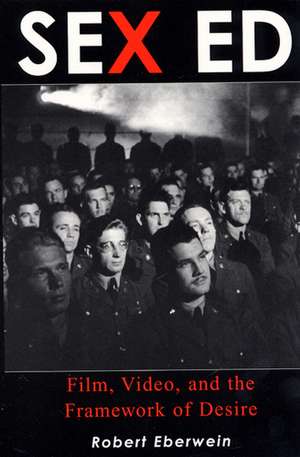
Sex Ed: Film, Video, and the Framework of Desire
Autor Robert Eberweinen Limba Engleză Paperback – iul 1999
In a 1914 movie, Damaged Goods, a doctor shows a character the horrific effects of venereal disease. In contrast, many of today's sex ed videos encourage viewers to realize their sexuality more fully as a source of pleasure. In Sex Ed, Robert Eberwein demonstrates how films and videos used for sex education have provided a complex ideological framework in which questions of sexuality, gender, and race are compellingly foregrounded.
Eberwein starts his investigation in the silent and early sound eras with educational films used both to warn audiences about venereal disease and to provide basic contraception information. World War II movies, he states, waged their own war against venereal disease-in the armed services and at home. Newer works deal with birth control and focus in particular on AIDS.
Sex Ed also highlights the classroom. Eberwein draws connections between the earliest and most recent examples of educational films as he analyzes their ideological complexity. He concludes by examining marriage-manual films of the early 1970s and very recent videos for couples and individuals seeking instruction in sexual techniques to increase pleasure.
Eberwein starts his investigation in the silent and early sound eras with educational films used both to warn audiences about venereal disease and to provide basic contraception information. World War II movies, he states, waged their own war against venereal disease-in the armed services and at home. Newer works deal with birth control and focus in particular on AIDS.
Sex Ed also highlights the classroom. Eberwein draws connections between the earliest and most recent examples of educational films as he analyzes their ideological complexity. He concludes by examining marriage-manual films of the early 1970s and very recent videos for couples and individuals seeking instruction in sexual techniques to increase pleasure.
Preț: 185.88 lei
Puncte Express: 279
Carte indisponibilă temporar
Doresc să fiu notificat când acest titlu va fi disponibil:
Se trimite...
Specificații
ISBN-13: 9780813526379
ISBN-10: 081352637X
Pagini: 288
Ilustrații: 34
Dimensiuni: 152 x 229 x 23 mm
Greutate: 0.48 kg
Ediția:None
Editura: Rutgers University Press
Colecția Rutgers University Press
ISBN-10: 081352637X
Pagini: 288
Ilustrații: 34
Dimensiuni: 152 x 229 x 23 mm
Greutate: 0.48 kg
Ediția:None
Editura: Rutgers University Press
Colecția Rutgers University Press
Notă biografică
Robert Eberwein teaches courses in film history, theory, and appreciation in the English Department at Oakland University, Rochester, Michigan. His publications include Film and the Dream Screen and other works on film theory and criticism.
Cuprins
The initial phase, 1914-1939
World War II and the attack on venereal disease
Youths and their bodies
Films and videos for adults, 1946-present
Learning about pleasure
World War II and the attack on venereal disease
Youths and their bodies
Films and videos for adults, 1946-present
Learning about pleasure
Descriere
Eberwein starts his investigation in the silent and early sound eras with educational films used both to warn audiences about venereal disease and to provide basic contraception information. World War II movies, he states, waged their own war against venereal disease-in the armed services and at home. Newer works deal with birth control and focus in particular on AIDS.
Sex Ed also highlights the classroom. Eberwein draws connections between the earliest and most recent examples of educational films as he analyzes their ideological complexity. He concludes by examining marriage-manual films of the early 1970s and very recent videos for couples and individuals seeking instruction in sexual techniques to increase pleasure.
Sex Ed also highlights the classroom. Eberwein draws connections between the earliest and most recent examples of educational films as he analyzes their ideological complexity. He concludes by examining marriage-manual films of the early 1970s and very recent videos for couples and individuals seeking instruction in sexual techniques to increase pleasure.