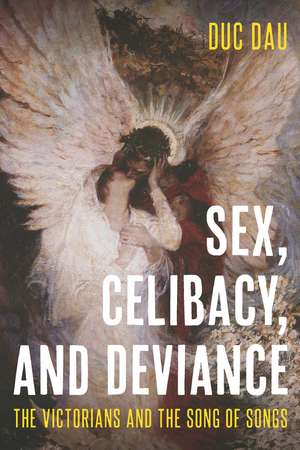
Sex, Celibacy, and Deviance: The Victorians and the Song of Songs: Literature, Religion, & Postsecular Stud
Autor Duc Dauen Hardback – 8 mar 2024
Finalist for the American Academy of Religion's Award for Excellence in Textual Studies
Sex, Celibacy, and Deviance is the first major study to explore the Song of Songs (or Song of Solomon) in Victorian literature and art. As the Bible’s only erotic poem, the Song of Songs is the canonical Judeo-Christian book about love, furnishing the Victorians with an authoritative and literary language for love, marriage, sex, mourning, and religious celibacy.
Duc Dau adopts a queer and feminist lens to consider how Victorians employed and interpreted the Song of Songs in their work. How did writers and artists fashion and, most importantly, challenge the norms of gender, romantic love, and marriage? Spanning the early Victorian era through the first two decades of the twentieth century, Sex, Celibacy, and Deviance considers the works of Charlotte Brontë, Thomas Hardy, Christina Rossetti, John Gray, Michael Field, Edward Burne-Jones, and Simeon Solomon alongside two lesser-known figures: Irish-born Scottish artist Phoebe Anna Traquair and the Catholic religious leader Augusta Theodosia Drane. By addressing the relevance of the Song of Songs in light of shifting and conflicting religious and social contexts, Dau provides a fresh perspective on Victorian literature, religion, and culture.
Sex, Celibacy, and Deviance is the first major study to explore the Song of Songs (or Song of Solomon) in Victorian literature and art. As the Bible’s only erotic poem, the Song of Songs is the canonical Judeo-Christian book about love, furnishing the Victorians with an authoritative and literary language for love, marriage, sex, mourning, and religious celibacy.
Duc Dau adopts a queer and feminist lens to consider how Victorians employed and interpreted the Song of Songs in their work. How did writers and artists fashion and, most importantly, challenge the norms of gender, romantic love, and marriage? Spanning the early Victorian era through the first two decades of the twentieth century, Sex, Celibacy, and Deviance considers the works of Charlotte Brontë, Thomas Hardy, Christina Rossetti, John Gray, Michael Field, Edward Burne-Jones, and Simeon Solomon alongside two lesser-known figures: Irish-born Scottish artist Phoebe Anna Traquair and the Catholic religious leader Augusta Theodosia Drane. By addressing the relevance of the Song of Songs in light of shifting and conflicting religious and social contexts, Dau provides a fresh perspective on Victorian literature, religion, and culture.
Din seria Literature, Religion, & Postsecular Stud
-
 Preț: 269.06 lei
 -
 Preț: 235.96 lei
 -
 Preț: 227.28 lei
 -
 Preț: 253.19 lei
 -
 Preț: 252.09 lei
 -
 Preț: 282.56 lei
 -
 Preț: 216.67 lei
 -
 Preț: 230.62 lei
 -
 Preț: 247.44 lei
 -
 Preț: 220.21 lei
 -
 Preț: 248.14 lei
 -
 Preț: 253.89 lei
 -
 Preț: 266.28 lei
 -
 Preț: 281.82 lei
 -
 Preț: 268.39 lei
 -
 Preț: 253.89 lei
 -
 Preț: 266.28 lei
 -
 Preț: 220.21 lei
 -
 Preț: 235.76 lei
Preț: 519.16 lei
Puncte Express: 779
Preț estimativ în valută:
91.78€ • 109.10$ • 79.63£
91.78€ • 109.10$ • 79.63£
Carte tipărită la comandă
Livrare economică 12-26 martie
Specificații
ISBN-13: 9780814215036
ISBN-10: 0814215033
Pagini: 180
Ilustrații: 1 table
Dimensiuni: 152 x 229 x 18 mm
Greutate: 0.44 kg
Editura: Ohio State University Press
Colecția Ohio State University Press
Seria Literature, Religion, & Postsecular Stud
ISBN-10: 0814215033
Pagini: 180
Ilustrații: 1 table
Dimensiuni: 152 x 229 x 18 mm
Greutate: 0.44 kg
Editura: Ohio State University Press
Colecția Ohio State University Press
Seria Literature, Religion, & Postsecular Stud
Recenzii
"Moving beyond binaries, Dau eloquently points out the multiple possibilities of Victorian spirituality. Summing Up: Highly recommended. Undergraduates through faculty." —N. Birns, CHOICE
“Sex, Celibacy, and Deviance is a welcome study of one of the most significant and misunderstood books in the Bible. In nuanced and lively readings, Dau makes a compelling case for the Song of Songs as the basis of a radically queer and feminist theological politics.” —Emma Mason, author of Christina Rossetti: Poetry, Ecology, Faith
“Undermining the familiar narrative that would cast Victorian literature as reflecting a struggle between faith and doubt, Dau expertly argues that literary invocations of the Song of Songs from the period evince subversive, even queer, representations of social norms—not despite but often through their expressions of faith.” —Norman W. Jones, author of Provincializing the Bible: Faulkner and Postsecular American Literature
“Drawing on reception history and existing scholarship in Victorian studies, theology, and gender and queer studies, Dau’s brilliant new book reveals how the Song of Songs informed the Victorian period’s understanding of love, marriage, and death.” —Mark Knight, author of Good Words: Evangelicalism and the Victorian Novel
“Dau’s illuminating tour through Victorian novels, poetry, sketches, stained glass, and painted pianos shows how vital the Song’s poetry was for an age wrestling with rapidly changing concepts of Scripture and sexuality. This book is a delight to read and will be of interest to many, especially those seeking to expand their resources for queer theology and hermeneutics.” —Elaine T. James, Reading Religion
“Engaging and eminently readable...Sex, Celibacy, and Deviance effectively demonstrates how reception studies can reveal the persistence of religious thought in Victorian culture, and, even more, its capacity for continuous, radical reinvention.” —Winter Jade Werner, Review 19
“Dau clearly and insightfully sets out the significance and cultural impact of the Song of Songs, and how this can be seen to dominate many aspects of Victorian theology....A refreshing delve into Victorian religion.” —Jordan Welsh, British Association of Victorian Studies
“Dau reveals how Victorians interpreted and depicted a singular Biblical book—and in turn, how they desired, loved, worshipped, and mourned. If the Victorians ‘saw themselves and their experiences reflected in a biblical text’, then Dau helps us see the Victorians more clearly and more closely.” —Katharine Williams, Victorian Review
Notă biografică
Duc Dau is an Honorary Research Fellow in Humanities at the University of Western Australia. She is the author of Touching God: Hopkins and Love and coeditor (with Shale Preston) of Queer Victorian Families: Curious Relations in Literature.
Extras
What interests me in Sex, Celibacy, and Deviance: The Victorians and the Song of Songs is the unchained Bible. In particular, I am interested in one biblical book, the Song of Songs, and how it has been received in feminist, queer, and often materialist ways in Victorian literature and art. In considering the unchained Bible, I use Richard Terdiman’s concept of the “counter-discourse” as a starting point for thinking about how, through complex modes of translation and transformation, alternative styles of reading and reinscription spring from the dominant discourses they contest. New modes of reading the Bible led to new ways of writing about it in Victorian literature. While writers such as Charlotte Brontë and Christina Rossetti considered themselves religious and therefore not questioning the authority of the Bible, their feminist reception of the Song of Songs was not always conventional, as we shall see. Indeed, the Song of Songs is a prime candidate for unchained, and more specifically, counter-readings by women, same-sex attracted authors and artists, celibates, effeminate men, and those outside the established church. The Song of Songs was, and continues to be, a different book to different people, and no other book from the Bible has been so variously interpreted.
This book contributes to the field of reception studies and its intersection with gender and queer studies. The reception of the Song of Songs is inseparable from issues of power relations and their interrogation. Given that I am influenced by liberation theologies, particularly contemporary queer and feminist interpretations, I turn most of my focus on those whose gender, gender expression, sexuality, or depictions of sexuality situated them outside the political center. For one reason or another, these artists or the characters they depicted existed on what Gayle Rubin calls “the outer limits,” which is beyond the “charmed circle” of acceptable sexual behavior. I claim a goal of queer theology, which is to investigate “what forms of non-normative love, touch, marriage and sex effectively challenge patriarchal power, and how such non-normative forms can assist in the remodeling of ‘normative’ relationships.” Similarly, I am enamored of Marcella Althaus-Reid and Lisa Isherwood’s proclamation that queer theology is “a radical form of the ‘love-talk of theology,’ that is, a theology which introduces a profound questioning into the ways of love in our lives as individuals and as society, and the things love can do in our world.” Queer theology is thus “from the margins which wants to remain at the margins.” One’s relationship to power determines both one’s interpretation of the Bible and the biblical books to which one is drawn. For instance, Jeff Nunokawa and Amy Sickels recount a story of Oscar Wilde’s rebellion at Magdalen chapel, Oxford. Wilde was to read the weekly lesson, from Deuteronomy 16, but to the assembled congregation, including Queen Victoria’s youngest son, he chose to read from Song of Songs 1:1–2: “The song of songs which is Solomon’s. Let him kiss me with the kisses of his mouth: for thy love is better than wine.” First, I must acknowledge that Wilde’s social status enabled him to perform this kind of literary subversion. Second, it is possible to see why he used the Song of Songs in an act of rebellion, given the text’s uneasy status in the biblical canon. The Song of Songs is canonical, but its erotic language invites a level of unease.
This book contributes to the field of reception studies and its intersection with gender and queer studies. The reception of the Song of Songs is inseparable from issues of power relations and their interrogation. Given that I am influenced by liberation theologies, particularly contemporary queer and feminist interpretations, I turn most of my focus on those whose gender, gender expression, sexuality, or depictions of sexuality situated them outside the political center. For one reason or another, these artists or the characters they depicted existed on what Gayle Rubin calls “the outer limits,” which is beyond the “charmed circle” of acceptable sexual behavior. I claim a goal of queer theology, which is to investigate “what forms of non-normative love, touch, marriage and sex effectively challenge patriarchal power, and how such non-normative forms can assist in the remodeling of ‘normative’ relationships.” Similarly, I am enamored of Marcella Althaus-Reid and Lisa Isherwood’s proclamation that queer theology is “a radical form of the ‘love-talk of theology,’ that is, a theology which introduces a profound questioning into the ways of love in our lives as individuals and as society, and the things love can do in our world.” Queer theology is thus “from the margins which wants to remain at the margins.” One’s relationship to power determines both one’s interpretation of the Bible and the biblical books to which one is drawn. For instance, Jeff Nunokawa and Amy Sickels recount a story of Oscar Wilde’s rebellion at Magdalen chapel, Oxford. Wilde was to read the weekly lesson, from Deuteronomy 16, but to the assembled congregation, including Queen Victoria’s youngest son, he chose to read from Song of Songs 1:1–2: “The song of songs which is Solomon’s. Let him kiss me with the kisses of his mouth: for thy love is better than wine.” First, I must acknowledge that Wilde’s social status enabled him to perform this kind of literary subversion. Second, it is possible to see why he used the Song of Songs in an act of rebellion, given the text’s uneasy status in the biblical canon. The Song of Songs is canonical, but its erotic language invites a level of unease.
Cuprins
Acknowledgments
Introduction
Chapter 1 “Love Is God”: Charlotte Brontë and Thomas Hardy
Chapter 2 Violence, Eroticism, and Art: Edward Burne-Jones and Phoebe Anna Traquair
Chapter 3 Celibacy, Sisterhoods, and Women’s Poetry: Augusta Theodosia Drane and Christina Rossetti
Chapter 4 Queer Hands, Bodies, and Masculinities: Simeon Solomon and John Gray
Chapter 5 “Stronger than Death”: Michael Field and the Culture of Death
Coda
Bibliography
Index
Introduction
Chapter 1 “Love Is God”: Charlotte Brontë and Thomas Hardy
Chapter 2 Violence, Eroticism, and Art: Edward Burne-Jones and Phoebe Anna Traquair
Chapter 3 Celibacy, Sisterhoods, and Women’s Poetry: Augusta Theodosia Drane and Christina Rossetti
Chapter 4 Queer Hands, Bodies, and Masculinities: Simeon Solomon and John Gray
Chapter 5 “Stronger than Death”: Michael Field and the Culture of Death
Coda
Bibliography
Index
Descriere
The first major study to explore the Song of Songs in Victorian culture, including how writers and artists adapted it to challenge the era’s romantic, marital, and gender norms.