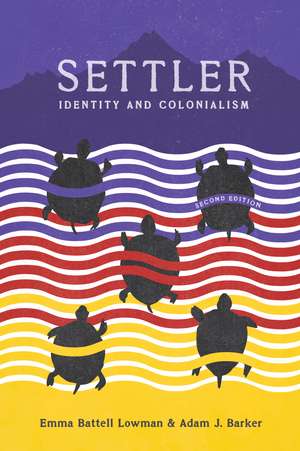
Settler, 2nd Edition: Identity and Colonialism
Autor Emma Battell Lowman, Adam J. Barkeren Limba Engleză Paperback – 17 apr 2025
The national conversation about settler colonialism has advanced significantly since that time, thanks to Indigenous struggles that have resulted in high-profile official apologies and inquiries into the devastating inequity between Indigenous and Settler lives in Canada. However, this progress is not enough — many of the same problems persist due to the underlying inequities at the core of Canadian identity, politics, and society.
In this revised second edition, Battell Lowman and Barker reflect on the term’s changing, more nuanced, and continued importance. Touching on the rise of right-wing nationalism, the power and limitations of social media, and ten years of federal Liberal government, this new edition of Settler considers the successes and failures of Settler Canadians in supporting decolonization and charting our next steps towards transformative change.
Preț: 137.22 lei
Preț vechi: 167.45 lei
-18%
Puncte Express: 206
Carte disponibilă
Livrare economică 11-25 noiembrie
Livrare express 28 octombrie-03 noiembrie pentru 53.79 lei
Livrare prin curier în România Termenul estimat este afișat lângă disponibilitate.
Transport gratuit de la 400.00 lei Plată online sau ramburs, în funcție de opțiunile comenzii.
Retur gratuit în 14 zile Comandă securizată și suport în română.
Specificații
ISBN-13: 9781773637341
ISBN-10: 1773637347
Pagini: 224
Dimensiuni: 152 x 229 x 6 mm
Greutate: 0.29 kg
Ediția:2 Revised edition
Editura: Fernwood Publishing
Colecția Fernwood Publishing
Locul publicării:Canada
ISBN-10: 1773637347
Pagini: 224
Dimensiuni: 152 x 229 x 6 mm
Greutate: 0.29 kg
Ediția:2 Revised edition
Editura: Fernwood Publishing
Colecția Fernwood Publishing
Locul publicării:Canada
Cuprins
- : Preface to the Second Edition
- : Why Say Settler?
- : Canada and Settler Colonialism
- : It’s Always All about the Land
- : “Settling” Our Differences
- : Fear, Complicity, and Productive Discomfort
- : Decolonization and Dangerous Freedom
- : References
Recenzii
“An excellent exploration of Canadian Settler constructs and ways to decolonize … aimed at redefining relationships to lands and peoples.”
“While my own thinking and practice as an educator was greatly transformed by the first edition, this one takes it to a new level. The new edition is current and deeply grounded in the theoretical, and social movement changes that have occurred since the original version was published. The authors expose how settler colonialism permeates the political landscape today and demonstrate in depth that settler colonialism is far from over, morphing as Indigenous peoples confront it. This updated version will continue to serve as a central resource in my teaching and leadership work.”
“A thought-provoking critical analysis of how settler identity and colonialism manifests across the political spectrum in contemporary Canada. Informed by the works of Indigenous scholars and activists, the authors argue that relationships to land are foundational to both Indigenous and Settler identities. Packed with fresh conceptual insights, personal experiences, political strategies, and practical tools for Settler Canadians engaged in the decolonization process. A must-read that will unsettle you, inspire you, and generate much-needed critical hope for working collaboratively with Indigenous Peoples to build a decolonial society based on truth, justice, and accountability.”
“A much-needed update to a classic, groundbreaking text, including important distinctions around region and racialization.”
“Settler offers a concise, critical analysis of Canada’s settler-colonial present and its devastating impacts on Indigenous Peoples. Drawing on current examples and amplifying Indigenous scholars’ voices, Battell Lowman and Barker highlight the complexities of Settler identities and the responsibilities of all Settlers to move beyond symbolic gestures or modest reforms. Instead, they begin to chart an unsettling yet hopeful path toward radical decolonial change and the creation of equitable, sustainable relationships with Indigenous Peoples and the lands we call home.”
“While my own thinking and practice as an educator was greatly transformed by the first edition, this one takes it to a new level. The new edition is current and deeply grounded in the theoretical, and social movement changes that have occurred since the original version was published. The authors expose how settler colonialism permeates the political landscape today and demonstrate in depth that settler colonialism is far from over, morphing as Indigenous peoples confront it. This updated version will continue to serve as a central resource in my teaching and leadership work.”
“A thought-provoking critical analysis of how settler identity and colonialism manifests across the political spectrum in contemporary Canada. Informed by the works of Indigenous scholars and activists, the authors argue that relationships to land are foundational to both Indigenous and Settler identities. Packed with fresh conceptual insights, personal experiences, political strategies, and practical tools for Settler Canadians engaged in the decolonization process. A must-read that will unsettle you, inspire you, and generate much-needed critical hope for working collaboratively with Indigenous Peoples to build a decolonial society based on truth, justice, and accountability.”
“A much-needed update to a classic, groundbreaking text, including important distinctions around region and racialization.”
“Settler offers a concise, critical analysis of Canada’s settler-colonial present and its devastating impacts on Indigenous Peoples. Drawing on current examples and amplifying Indigenous scholars’ voices, Battell Lowman and Barker highlight the complexities of Settler identities and the responsibilities of all Settlers to move beyond symbolic gestures or modest reforms. Instead, they begin to chart an unsettling yet hopeful path toward radical decolonial change and the creation of equitable, sustainable relationships with Indigenous Peoples and the lands we call home.”