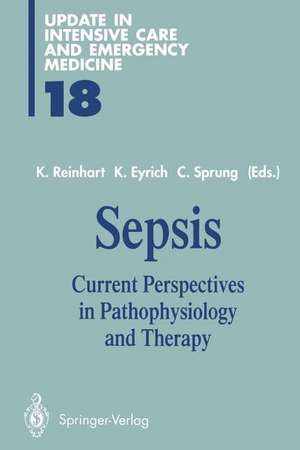
Sepsis: Update in Intensive Care and Emergency Medicine, cartea 18
Editat de Konrad Reinhart, Klaus Eyrich, Charles Sprungen Limba Engleză Paperback – 12 feb 2012
Din seria Update in Intensive Care and Emergency Medicine
- 5%
 Preț: 707.43 lei
 - 5%
 Preț: 392.88 lei
 - 5%
 Preț: 685.80 lei
 - 5%
 Preț: 695.49 lei
 - 5%
 Preț: 694.80 lei
 - 5%
 Preț: 729.76 lei
 - 5%
 Preț: 365.18 lei
 - 5%
 Preț: 729.66 lei
 - 5%
 Preț: 728.10 lei
 - 5%
 Preț: 728.81 lei
 - 15%
 Preț: 567.22 lei
 - 5%
 Preț: 358.62 lei
 - 5%
 Preț: 687.74 lei
 - 5%
 Preț: 728.94 lei
 - 5%
 Preț: 735.90 lei
 - 5%
 Preț: 364.30 lei
 - 5%
 Preț: 713.71 lei
 - 5%
 Preț: 356.57 lei
 - 5%
 Preț: 720.33 lei
 - 5%
 Preț: 364.56 lei
 - 5%
 Preț: 377.32 lei
 - 5%
 Preț: 2338.87 lei
 - 5%
 Preț: 2697.24 lei
 - 5%
 Preț: 2388.58 lei
 - 5%
 Preț: 389.17 lei
 - 5%
 Preț: 703.64 lei
 - 5%
 Preț: 687.74 lei
 - 5%
 Preț: 711.99 lei
 - 5%
 Preț: 690.03 lei
Preț: 737.22 lei
Preț vechi: 776.02 lei
-5%
Puncte Express: 1106
Carte tipărită la comandă
Livrare economică 28 noiembrie-12 decembrie
Livrare prin curier în România Termenul estimat este afișat lângă disponibilitate.
Transport gratuit pentru acest produs Plată online sau ramburs, în funcție de opțiunile comenzii.
Retur gratuit în 14 zile Comandă securizată și suport în română.
Specificații
ISBN-13: 9783642850387
ISBN-10: 3642850383
Pagini: 588
Ilustrații: XVI, 571 p.
Dimensiuni: 155 x 235 x 32 mm
Greutate: 0.88 kg
Ediția:Softcover reprint of the original 1st ed. 1994
Editura: Springer
Colecția Update in Intensive Care and Emergency Medicine
Seria Update in Intensive Care and Emergency Medicine
Locul publicării:Berlin, Heidelberg, Germany
ISBN-10: 3642850383
Pagini: 588
Ilustrații: XVI, 571 p.
Dimensiuni: 155 x 235 x 32 mm
Greutate: 0.88 kg
Ediția:Softcover reprint of the original 1st ed. 1994
Editura: Springer
Colecția Update in Intensive Care and Emergency Medicine
Seria Update in Intensive Care and Emergency Medicine
Locul publicării:Berlin, Heidelberg, Germany
V-ar putea interesa
-
 Structured Oral Examination Practice for the Final FRCARakesh Tandon-18%Preț: 596.39 lei726.76 lei
 -
 -21%Preț: 500.07 lei630.18 lei
 -
 Emergencies in Critical CareMartin Beed-21%Preț: 399.46 lei504.96 lei
 -
 Therapeutic Hypothermia After Cardiac ArrestJustin B. Lundbye-5%Preț: 742.12 lei781.18 lei
 -
 Marino's The ICU Book: Print + Ebook with UpdatesPaul L. Marino MD, PhD, FCCM-5%Preț: 804.00 lei846.31 lei
 -
 Spirituality in Patient Care: Why, How, When, and WhatHarold G Koenig-5%Preț: 223.96 lei235.75 lei
 -
 -5%Preț: 128.42 lei135.18 lei
 -
 -5%Preț: 1312.79 lei1381.88 lei
 -
 Complications and Mishaps in AnesthesiaMatthias Hübler-5%Preț: 645.73 lei679.72 lei
 -
 Core Knowledge in Critical Care MedicineWolfgang Krüger-5%Preț: 756.71 lei796.54 lei
 -
 TracheotomieC. Byhahn-5%Preț: 321.27 lei338.17 lei
 -
 Clinical Neurophysiology in Disorders of ConsciousnessAndrea O. Rossetti-5%Preț: 584.42 lei615.17 lei
 -
 ECMO-Extracorporeal Life Support in AdultsFabio Sangalli-5%Preț: 1644.31 lei1730.86 lei
Public țintă
Professional/practitionerCuprins
I. Definition/Prognosis.- Sepsis and Septic Shock: Update on Definitions.- Clinical Manifestations and Prognostic Indicators in Sepsis.- What Determines Prognosis in Sepsis? Evidence for a Comprehensive Individual Patient Risk Assessment Approach to the Design and Analysis of Clinical Trials.- A Scoring System for Multiple Organ Dysfunction Syndrome.- II. Pathogenesis.- Endotoxemia and Sepsis: Important Roles for Lipopolysaccharide Binding Protein and CD14 in Endotoxin Signal Transduction.- Bacterial Exotoxins and Sepsis.- Bacterial Translocation: Myth versus Reality.- Tumor Necrosis Factor and Other Cytokines in Septic Syndrome.- Role of Oxygen Free Radicals in the Pathophysiology of Sepsis.- III. Pathophysiology.- Cardiocirculation in Sepsis.- A Current View of Oxygen Supply Dependency.- Sepsis and Nutritional Blood Flow.- Endothelial Cell Function in the Critically Ill.- Sepsis and Cellular Metabolism.- IV. Monitoring.- Monitoring of O2 Transport and Tissue Oxygenation in Septic Shock.- V. Therapy.- Sepsis-Related Problems in Pediatric Patients.- Definitions and Therapy of Sepsis.- Role of Surgical Intervention in the Prevention and Therapy of Sepsis.- Antibacterial Treatment of Sepsis.- Diagnostic and Therapeutic Approach in Invasive Fungal Infections of Intensive Care Unit Patients.- Fluid Therapy in Sepsis.- Influence of Catecholamines on Regional Perfusion and Tissue Oxygenation in Septic Shock Patients.- Metabolic Changes in Sepsis — Can the Host Response be Influenced Metabolically?.- VI. New Therapeutic Approaches.- Is there a Place for Monoclonal Antibodies Against Endotoxin in the Therapy of Sepsis?.- Endotoxin in Septic Shock.- Tumour Necrosis Factor as a Therapeutic Target in Sepsis.- Tumor Necrosis Factor-Neutralization with a Specific MonoclonalAntibody.- Cardiovascular Effects of Repeated Administration of the F(ab’)2 Fragment of an Anti-tumor Necrosis Factor-? Monoclonal Antibody in Patients with Severe Sepsis.- Modulating Effects of Pentoxifylline on Cytokine Release Syndromes.- The Treatment of Sepsis with Interleukin-1 Receptor Antagonist.- The Function and Potential Therapeutic Value of Lipopolysaccharide Binding Protein During Gram- Negative Sepsis: Recombinant Expression and Promoter Studies.- Platelet-Activating Factor: Pathophysiological Changes and Therapeutic Implications in Sepsis.- Potential of Oxyradical Scavengers in the Therapy of Sepsis.- N-Acetylcysteine in Sepsis.- Immunoaugmentation: A Contribution to Prophylaxis and Treatment of Sepsis?.- What Is Certain in the Treatment with Immunoglobulins?.- Arachidonic Acid Metabolism in Sepsis: What is the Role of Cyclooxygenase Inhibition?.- Improvement of Monocyte Function A New Therapeutic Approach?.- From Localized Angioedema to Generalized Capillary Leak Syndrome.- Potential for Gene Therapy in the Treatment of Sepsis.- VII. Specific Therapeutic Aspects.- Step-by-Step Treatment of Acute Respiratory Distress Syndrome.- Perfluorocarbons as an Alternative Respiratory Medium.