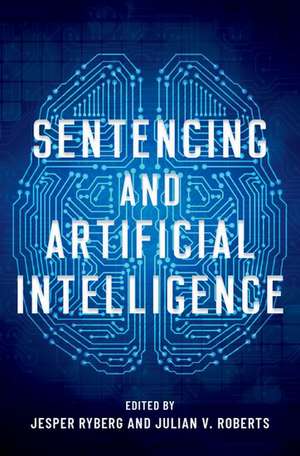
Sentencing and Artificial Intelligence: Studies in Penal Theory and Philosophy
Editat de Jesper Ryberg, Julian V. Robertsen Limba Engleză Hardback – 14 noi 2022
Din seria Studies in Penal Theory and Philosophy
- 32%
 Preț: 747.55 lei
 - 29%
 Preț: 523.49 lei
 - 32%
 Preț: 700.17 lei
 - 32%
 Preț: 587.72 lei
 - 31%
 Preț: 737.10 lei
 - 31%
 Preț: 532.28 lei
 - 30%
 Preț: 588.47 lei
 - 30%
 Preț: 589.84 lei
 - 31%
 Preț: 541.88 lei
 - 30%
 Preț: 946.11 lei
 - 27%
 Preț: 490.65 lei
 - 23%
 Preț: 773.56 lei
 - 27%
 Preț: 556.24 lei
 - 31%
 Preț: 710.69 lei
 - 30%
 Preț: 589.37 lei
 - 27%
 Preț: 469.26 lei
 - 30%
 Preț: 700.72 lei
 - 14%
 Preț: 573.39 lei
 - 28%
 Preț: 528.30 lei
Preț: 682.87 lei
Preț vechi: 1000.24 lei
-32%
Puncte Express: 1024
Carte disponibilă
Livrare economică 19-25 noiembrie
Livrare prin curier în România Termenul estimat este afișat lângă disponibilitate.
Transport gratuit pentru acest produs Plată online sau ramburs, în funcție de opțiunile comenzii.
Retur gratuit în 14 zile Comandă securizată și suport în română.
Specificații
ISBN-13: 9780197539538
ISBN-10: 019753953X
Pagini: 292
Dimensiuni: 242 x 164 x 29 mm
Greutate: 0.56 kg
Editura: Oxford University Press
Colecția OUP USA
Seria Studies in Penal Theory and Philosophy
Locul publicării:New York, United States
ISBN-10: 019753953X
Pagini: 292
Dimensiuni: 242 x 164 x 29 mm
Greutate: 0.56 kg
Editura: Oxford University Press
Colecția OUP USA
Seria Studies in Penal Theory and Philosophy
Locul publicării:New York, United States
Recenzii
This book includes several interesting studies and cases from the US on the use of AI in sentencing ... How far we will go to embrace AI in sentencing remains to be seen. This volume highlights the importance of critical assessment before further adoption.
In Sentencing and Artificial Intelligence, they have curated a powerful and compelling collection of essays on the application of a new technology to an old problem [...] Ryberg and Roberts succeed admirably
[A] brilliant volume [...] timely, readable and authoritative contributions on a contemporary issue spanning ethics and justice
In Sentencing and Artificial Intelligence, they have curated a powerful and compelling collection of essays on the application of a new technology to an old problem [...] Ryberg and Roberts succeed admirably
[A] brilliant volume [...] timely, readable and authoritative contributions on a contemporary issue spanning ethics and justice
Notă biografică
Jesper Ryberg is Professor of Ethics and Philosophy of Law at Roskilde University and Head of Research Group for Criminal Justice Ethics. He is the author of, among others, Neurointerventions, Crime, and Punishment (OUP 2020), Sentencing Multiple Crimes (ed. with Roberts and de Keijser; OUP 2018) and Popular Punishment: On the Normative Significance of Public Opinion (ed. with J. V. Roberts; OUP 2014.)Julian V. Roberts is Professor of Criminology in the Faculty of Law, University of Oxford and was a member of the Sentencing Council of England and Wales and an advisor to the American Law Institute Model Penal Code Sentencing project. His recent books include Paying for the Past (OUP 2019), Criminal Justice: A Very Short Introduction (OUP 2015), and Popular Punishment (OUP 2014).
Cuprins
- Acknowledgements
- List of Contributors
- Chapter One: Sentencing and Artificial Intelligence: Setting the Stage
- Jesper Ryberg and Julian V. Roberts
- Chapter Two: Sentencing and Algorithmic Transparency
- Jesper Ryberg
- Chapter Three: Sentencing and the right to reasons
- Vincent Chiao
- Chapter Four: Sentencing and the Conflict Between Algorithmic Accuracy and Transparency
- Jesper Ryberg and Thomas S. Petersen
- Chapter Five: Algorithm-based sentencing and discrimination
- Kasper Lippert-Rasmussen
- Chapter Six: Learning to discriminate: The Perfect Proxy Problem in Artificially Intelligent Crime Prediction
- Benjamin Davies and Thomas Douglas
- Chapter Seven: Enhancing the Integrity of the Sentencing Process Through the Use of Artificial Intelligence
- Mirko Bagaric and Dan Hunter
- Chapter Eight: The Compassionate Computer: Algorithms, Sentencing, and Mercy
- Netanel Dagan and Shmuel Baron
- Chapter Nine: Algorithmic Sentencing: Drawing Lessons from Human Factors Research
- John Zerilli
- Chapter Ten: Plea Bargaining, Principled Sentencing, and Artificial Intelligence
- Richard Lippke
- Chapter Eleven: Reconciling Artificial and Human Intelligence: Supplementing and Not Supplanting the Sentencing Judge
- Mathis Schwarze and Julian V. Roberts
- Chapter Twelve: Artificial Intelligence and Sentencing: Humans against the Machine
- Sigrid van Wingerden and Mojca Plesnicar
- Chapter Thirteen: Iudicium ex Machinae - The Ethical Challenges of Automated Decision-Making at Sentencing
- Frej Klem Thomsen
- Index