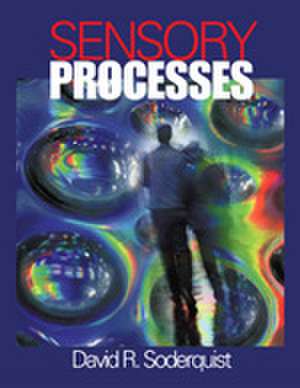
Sensory Processes
Autor David R. Soderquisten Limba Engleză Electronic book text – 2 iul 2012
· Detailed coverage of sense modalities beyond vision and audition offers students more in-depth coverage of the somatosensory system, pain, olfaction, gustation, and the vestibular system than most traditional sensation and perception books provide.
· Inclusion of sensory disorders and dysfunctions, with clinical examples, illustrate the real-world importance and impact of the subject matter.
· Pedagogical aids and a "user-friendly" style and approach make the subject matter understandable to students; these aids include brief chapter intros that put the material into contexts students can readily relate to; key terms bolded in text and defined in an end-of-book glossary; chapter summaries; and selected references for further reading.
Preț: 675.59 lei
Preț vechi: 742.41 lei
-9%
Puncte Express: 1013
Indisponibil temporar
Doresc să fiu notificat când acest titlu va fi disponibil:
Se trimite...
Specificații
ISBN-13: 9781452262833
ISBN-10: 1452262837
Pagini: 400
Dimensiuni: 187 x 232 mm
Ediția:1
Editura: SAGE Publications
Colecția Sage Publications, Inc
Locul publicării:Thousand Oaks, United States
ISBN-10: 1452262837
Pagini: 400
Dimensiuni: 187 x 232 mm
Ediția:1
Editura: SAGE Publications
Colecția Sage Publications, Inc
Locul publicării:Thousand Oaks, United States
V-ar putea interesa
-
 Preț: 66.66 lei
 -
 -20%Preț: 462.74 lei581.25 lei
 -
 The Island of the Colour-blindOliver Sacks-34%Preț: 52.53 lei79.10 lei
 -
 Jung in the 21st Century Volume One: Evolution and ArchetypeJohn Ryan HaulePreț: 411.62 lei
 -
 Jung in the 21st Century Volume Two: Synchronicity and ScienceJohn Ryan HaulePreț: 371.33 lei
 -
 Fixing Hell: An Army Psychologist Confronts Abu GhraibLarry C. JamesPreț: 220.36 lei
 -
 IdentityPaul Du GayPreț: 443.09 lei
 -
 Jungian PsychoanalysisMurray SteinPreț: 337.67 lei
 -
 Nature HealsPaul GoodmanPreț: 195.75 lei
 -
 Key Thinkers in PsychologyHorace Romano Harre-15%Preț: 668.87 lei786.91 lei
 -
 Essential Evolutionary PsychologySimon HamptonPreț: 462.87 lei
 -
 Love Is Letting Go of FearGerald G JampolskyPreț: 74.80 lei
 -
 -18%Preț: 772.99 lei942.68 lei
Recenzii
"Thereis
no
comparable
text
for
a
course
in
perception
that
emphasizes
the
neuralbasis
of
perception
rather
than
simply
perceptual
phenomena
andpsychophysics…It
is
strong
in
the
clarity
with
which
some
difficult
conceptsare
explained.
The
author
does
not
restrict
himself
to
a
physics
andengineering
approach,
but
rather
gives
the
reader
a
mental
image
of
what
ishappening
biologically.
Inclusion
of
disorders
is
another
big
advantage…Thequality
of
writing
is
excellent.
The
level
is
appropriate
for
upper
levelundergraduates."
"Ithink
the
book’s
primary
strengths
are
its
attention
to
detail
and
willingnessto
tackle
difficult
topics
and
offer
very
good
explanations
andanalogies."
"I’mvery
sympathetic
to
the
goal
of
this
book
in
taking
an
enhancedmultidisciplinary
approach
to
the
area
of
Sensation/Perception,
with
particularemphasis
on
the
neuroscience
background.
Also
commendable
is
the
detailedtreatment
of
sense
modalities
other
than
vision
and
audition."
"I
like
the
general
tone
of
thebook.
The
overall
approach
and
the
metaphors
are
quite
nice."
Cuprins
Preface
Acknowledgments
1. Introduction to the Nervous System
The Nervous System
Dysfunctions
2. Synapses and Receptors
A Brief Review
Potential Sensitivity
Calcium Influx
Neurotransmitter Release
Postsynaptic Potentials
Chemical Sensitivity
Neurotransmitters
Introduction to Receptors
Receptor Transduction
Dysfunctions
Summary
Suggested Readings
3. Somatosensory System
Overview of the Chapter
Somatosensory Paths Revisited
Receptors and Fibers
Proprioception and Kinesthesis
Receptive Fields
The Thalamus
The Somatosensory Cortex
Dysfunctions
Summary
Suggested Readings
4. Pain
Pain: One Definition
Classic Paths
The Gate Control Theory of Pain
Pain and Drugs
Summary
Suggested Readings
5. Olfaction
The peripheral Olfactory System
Olfactory Transduction
The Olfactory Bulb
Central Olfactory Structures
Olfactory Perception
How Many Odors Are there?
Dysfunctions
Suggested Readings
6. Gustation
Peripheral Processes
Central Processes
Taste Perception
The Hedonics
Dysfunctions
Summary
Suggested Readings
7. The Vestibular System
Introduction
Vestibular Periphery
Vestibular Central Pathways
Dysfunctions
Summary
Suggested Readings
8. Auditory Stimuli
Introduction
Summary
Suggested Readings
9. Audition
External and Middle Ear
The Inner Ear
Auditory Pathways
The Auditory Cortex
Dysfunctions
Summary
Suggested Readings
10. Vision
The Visual Stimulus
The Structure of the Eye
The Retina
Central Pathways
The Thalamus and Other Neutral Centers
The Visual Cortex
Dysfunctions
Summary
Suggested Readings
Glossary
References
Index
About the Author
Acknowledgments
1. Introduction to the Nervous System
The Nervous System
Dysfunctions
2. Synapses and Receptors
A Brief Review
Potential Sensitivity
Calcium Influx
Neurotransmitter Release
Postsynaptic Potentials
Chemical Sensitivity
Neurotransmitters
Introduction to Receptors
Receptor Transduction
Dysfunctions
Summary
Suggested Readings
3. Somatosensory System
Overview of the Chapter
Somatosensory Paths Revisited
Receptors and Fibers
Proprioception and Kinesthesis
Receptive Fields
The Thalamus
The Somatosensory Cortex
Dysfunctions
Summary
Suggested Readings
4. Pain
Pain: One Definition
Classic Paths
The Gate Control Theory of Pain
Pain and Drugs
Summary
Suggested Readings
5. Olfaction
The peripheral Olfactory System
Olfactory Transduction
The Olfactory Bulb
Central Olfactory Structures
Olfactory Perception
How Many Odors Are there?
Dysfunctions
Suggested Readings
6. Gustation
Peripheral Processes
Central Processes
Taste Perception
The Hedonics
Dysfunctions
Summary
Suggested Readings
7. The Vestibular System
Introduction
Vestibular Periphery
Vestibular Central Pathways
Dysfunctions
Summary
Suggested Readings
8. Auditory Stimuli
Introduction
Summary
Suggested Readings
9. Audition
External and Middle Ear
The Inner Ear
Auditory Pathways
The Auditory Cortex
Dysfunctions
Summary
Suggested Readings
10. Vision
The Visual Stimulus
The Structure of the Eye
The Retina
Central Pathways
The Thalamus and Other Neutral Centers
The Visual Cortex
Dysfunctions
Summary
Suggested Readings
Glossary
References
Index
About the Author
Descriere
This
core
text
emphasizes
the
underlying
neural
structures
and
functions
of
sensory
systems
(pain,
olfaction,
gustation,
audition,
vision,
etc.)
and
presents
this
complex
material
at
a
level
comprehensible
to
undergraduates
as
well
as
beginning
graduate
students.
The
text
begins
with
a
review
of
the
central
nervous
system
and
its
sensory
components
and
includes
discussions
of
methodological
techniques
and
procedures
used
to
study
sensory
processes.
Notă biografică
David R. Soderquist is Professor of Psychology at the University of North Carolina at Greensboro. He received his Ph.D. in Experimental Psychology from Vanderbilt University in 1968. His primary research interest is in psychoacoustics, and he has published in the Journal of the Acoustical Society of America, the Journal of Auditory Research, Perception and Psychophysics, Acoustical Letters, the Bulletin of the Psychonomic Society, Educational and Psychological Measurement, Human Factors, and elsewhere. He has taught courses on sensory processes at both the undergraduate and graduate levels and has class-tested early drafts of this book with his students.