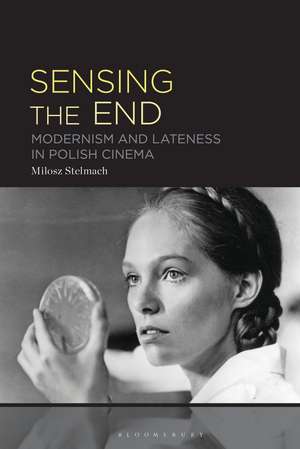
Sensing the End: Modernism and Lateness in Polish Cinema
Autor Milosz Stelmachen Limba Engleză Hardback – 18 feb 2027
The book presents an interdisciplinary understanding of modernism, which addresses theoretical and historical studies related to cinematic modernism, with a particular focus on philosophy, literature, and art history. The reactions of Polish cinema of the 1950s and 1960s to the global movement enabled the emergence of a specific form of modernism, which encapsulated the Eastern Bloc's cinematic postwar modernity and led to a phase of lateness in the 1970s, referred to as the decadent phase. The heart of this book focuses on Polish films from this late period, primarily between 1971 and 1984, to highlight subjectivity, self-reflection, and the pursuit of formalism accompanied by a singular authorial presence of the filmmakers and non-classical narrative patterns.
Preț: 636.26 lei
Preț vechi: 926.65 lei
-31% Precomandă
Puncte Express: 954
Carte nepublicată încă
Livrare prin curier în România Precomanda se expediază când titlul devine disponibil.
Transport gratuit pentru acest produs Plată online sau ramburs, în funcție de opțiunile comenzii.
Retur gratuit în 14 zile Comandă securizată și suport în română.
Doresc să fiu notificat când acest titlu va fi disponibil:
Se trimite...
Specificații
ISBN-13: 9798765141939
Pagini: 288
Ilustrații: 68 bw illus
Dimensiuni: 152 x 229 mm
Greutate: 0.45 kg
Editura: Bloomsbury Publishing
Colecția Bloomsbury Academic
Locul publicării:New York, United States
Pagini: 288
Ilustrații: 68 bw illus
Dimensiuni: 152 x 229 mm
Greutate: 0.45 kg
Editura: Bloomsbury Publishing
Colecția Bloomsbury Academic
Locul publicării:New York, United States
Cuprins
Acknowledgments
Introduction: Alternative Historiography of Polish Cinema and Distant Reading
Part One: What Is (Cinematic) Modernism?
1. Cinematic Modernism: A Reconfiguration
2. Modernism as an Institution
3. The Local Tradition of the New: Polish Modernist Cinema
Part Two: Late Modernism in Polish Cinema
4. Late Style, or How Cinematic Modernism Lived Its Own End
5. Formulas of Late Modernism
6. Facing the End: Cinema as the Eschatology of Modernity
7. Out of Joint: Time in Modernism
An Epilogue?: Modernism after Modernity
Filmography
Bibliography
List of Figures
Index
Recenzii
This is an important contribution to the literature of cinematic modernism and film history in general, and placing Polish cinema history into a broader transnational context is a very valuable and rare enterprise. Stemlach's approach is comprehensive, taking formal, narrative, stylistic, institutional, and thematic and philosophical aspects into consideration and fills a gap in this domain.
Milosz Stelmach's Sensing the End: Modernism, Lateness, and Polish Cinema is an innovative attempt to "rewrite" the history of Polish cinema from the perspective of modernism. This comprehensive survey of a rich body of research in theories of modernism and modernity is skillfully weaved into a historical analysis of Polish cinema. This erudite and bold study is a brave and original effort to see national cinema from transnational angle which makes it attractive for wide international readership.
Milosz Stelmach's Sensing the End: Modernism, Lateness, and Polish Cinema is an innovative attempt to "rewrite" the history of Polish cinema from the perspective of modernism. This comprehensive survey of a rich body of research in theories of modernism and modernity is skillfully weaved into a historical analysis of Polish cinema. This erudite and bold study is a brave and original effort to see national cinema from transnational angle which makes it attractive for wide international readership.