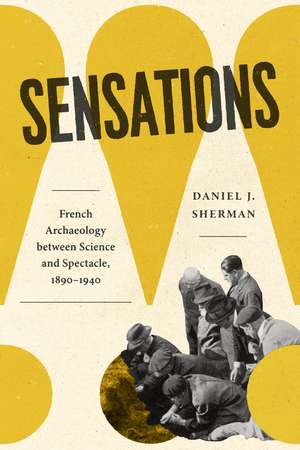
Sensations: French Archaeology between Science and Spectacle, 1890–1940
Autor Daniel J. Shermanen Limba Engleză Hardback – 7 mai 2025
Prin volumul Sensations, Daniel J. Sherman propune o analiză riguroasă a modului în care arheologia s-a cristalizat ca disciplină nu doar în laboratoare și pe teren, ci și sub lumina reflectoarelor presei. Aplicabilitatea practică a acestui studiu rezidă în demonstrarea faptului că validarea științifică a fost, istoric, inseparabilă de gestionarea imaginii publice. Remarcăm modul în care autorul folosește două studii de caz contrastante — situl colonial de la Cartagina și scandalul „falsurilor” neolitice de la Glozel — pentru a ilustra fragilitatea autorității academice în fața senzaționalismului.
Această lucrare extinde cadrul propus de Archaeology and the Media de Timothy Clack, aducând date noi din arhivele franceze ale perioadei 1890–1940. În timp ce volumul lui Clack oferă o perspectivă generală asupra comunicării, Sensations se concentrează pe mecanismele interne ale puterii și pe modul în care „spectacolul” a forțat profesionalizarea metodelor de excavare. Notăm cu interes structura tematică a cărții: după prezentarea crizelor arhivistice, autorul dedică secțiuni esențiale performativității arheologului și modului în care obiectele descoperite au alimentat imaginarul colectiv.
Poziționată în continuarea preocupărilor sale pentru memoria culturală și instituțiile muzeale, vizibile în The Construction of Memory in Interwar France și Worthy Monuments, noua lucrare a lui Sherman rafinează înțelegerea politicii patrimoniului. Dacă în scrierile anterioare se concentra pe monumente și muzee ca spații de putere, aici investighează însuși procesul de generare a cunoașterii sub presiunea publicului, oferind un context istoric crucial pentru dezbaterile actuale despre „fake news” în știință.
Preț: 349.66 lei
Carte disponibilă
Livrare economică 06-20 noiembrie
Livrare express 22-28 octombrie pentru 55.31 lei
Specificații
ISBN-10: 0226835375
Pagini: 288
Ilustrații: 8 color plates, 40 halftones
Dimensiuni: 152 x 229 x 25 mm
Greutate: 0.65 kg
Ediția:First Edition
Editura: University of Chicago Press
Colecția University of Chicago Press
De ce să citești această carte
Recomandăm această carte profesioniștilor din arheologie și istorie culturală care doresc să înțeleagă rădăcinile mediatice ale disciplinei lor. Cititorul câștigă o perspectivă critică asupra modului în care scandalurile și atenția presei au forțat arheologia să își definească standardele de rigoare. Este un instrument esențial pentru a înțelege de ce arheologia rămâne, până astăzi, una dintre cele mai vizibile și disputate științe umaniste în spațiul public.
Despre autor
Daniel J. Sherman este profesor de istoria artei și istorie la University of North Carolina, Chapel Hill. Expert recunoscut în studii muzeale critice și în politica memoriei, acesta a explorat extensiv modul în care societatea franceză a secolului al XIX-lea și interbelică și-a construit identitatea prin artă și monumente. Lucrările sale anterioare, precum The Construction of Memory in Interwar France, publicată tot de University of Chicago Press, s-au impus ca referințe în analiza impactului social al conflictelor și patrimoniului, teme pe care le extinde acum spre domeniul arheologiei.
Descriere scurtă
For well over a century, from Heinrich Schliemann’s sensational discoveries at Troy in the 1880s, through the Tutankhamun excavations of the 1920s, to the recent LIDAR-aided uncovering of lost Maya cities, archaeology has made headlines. In this new history of archaeology and its archival traces, Daniel J. Sherman treats the friction between science and spectacle as constitutive of the field. By exploring two long-running controversies that roiled the French archaeological world and its wider public in the first third of the twentieth century, he gives the science/media relationship a unique place in the history of archaeology—and its present.
The first controversy involves a dispute over the conduct of excavations at Carthage in Tunisia, then under French colonial rule. In the second, accusations of forgery clouded what seemed to be a stunning Neolithic find at a hamlet called Glozel, in the Auvergne region in central France. The affair divided the scholarly community and attracted enormous media attention across Europe and North America. Both controversies occurred at a transitional moment between what has been called the heroic age of archaeology, dominated by explorers and adventurers with little specialized training, and the beginnings of its professionalization. As Sherman shows, the two affairs put the methods, procedures, and networks of archaeology in the spotlight and profoundly shaped its history.
Notă biografică
Cuprins
Introduction: From the Archaeological Archive
1. “For Carthage”: Scientific Networks and the Glare of Publicity
Prologue: The Field and the Network
Serious Men (and Their Archives)
“To Save Carthage”: Networks, Authority, Publicity
Enter the Americans
Heritage and/as Science
2. The News from Glozel: Scholars, Media, and the Making of a Scandal
The Glozel Archive: Exit the State
Exchanging News
Blame the Media
Fake News/News of Fakes
Affairs to Remember
Coda
3. Bodies and Minds: The Work of Archaeology
The Archaeologist’s Police File
Bodies at/of Work
Looking Like an Archaeologist
4. Reality Effects: Staging Archaeology
Performing Carthage
Glozel and the Performative
5. Picturing Things: Archaeology and the Imagined Past
What Are These Objects?
Who Were These People?
Imagining the Glozelians
Epilogue
After Bizerte: 1926–1933–1962
“Glozel For Ever”: 1968–1974–2021
Objects, Knowledge, and the Archive: 2022–
Notes
Index