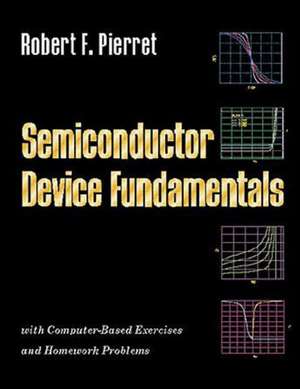
Semiconductor Device Fundamentals
Autor Robert F. Pierret, Pierret Editat de Katherine Harutunianen Limba Engleză Hardback – 31 oct 1995
Considerăm că un exercițiu reprezentativ pentru abordarea acestui volum este simularea numerică a caracteristicilor de transfer pentru un tranzistor MOSFET, integrată progresiv prin scripturi MATLAB. Semiconductor Device Fundamentals nu se limitează la prezentarea teoretică a ecuațiilor de transport, ci obligă cititorul să experimenteze scenarii de tip „ce s-ar întâmpla dacă”, oferind o perspectivă practică asupra abaterilor de la modelul ideal al dispozitivelor semiconductoare. Remarcăm prezența tabelelor de evaluare a dificultății problemelor, un instrument de lucru esențial pentru organizarea studiului individual.
Subliniem structura inovatoare propusă de Robert F. Pierret, care fragmentează materia în trei părți distincte, urmate de „mini-capitole” de sinteză. Acestea funcționează ca un punct de control, oferind liste de termeni cheie și seturi de probleme similare celor de examen. Spre deosebire de textele introductive clasice, autorul include capitole de lectură strategic plasate pentru a varia ritmul parcurgerii materialului, menținând un echilibru între rigoarea matematică și înțelegerea fenomenologică.
Cititorul care a aplicat ideile din Introduction to Semiconductor Devices for Engineering Students de Leonid Tsybeskov va găsi aici o extensie naturală către zona de modelare numerică și proiectare asistată de calculator. În timp ce volumul lui Tsybeskov pune accent pe fizica materialelor și diagramele de bandă, lucrarea de față, publicată de Pearson, face tranziția către ingineria aplicată, oferind detalii de măsurare reale care demonstrează natura imperfectă a caracteristicilor dispozitivelor în practică. Este o resursă care transformă teoria abstractă a joncțiunilor pn și a tranzistorilor bipolari în competențe tehnice verificabile prin simulare.
Preț: 1566.91 lei
Preț vechi: 2034.94 lei
-23%
Carte tipărită la comandă
Livrare economică 04-18 decembrie
Specificații
ISBN-10: 0201543931
Pagini: 800
Dimensiuni: 194 x 241 x 35 mm
Greutate: 1.32 kg
Ediția:New.
Editura: Pearson
Locul publicării:Upper Saddle River, United States
V-ar putea interesa
-
 Modern Semiconductor Devices for Integrated CircuitsChenming Calvin Hu-65%Preț: 555.75 lei1588.09 lei
 -
 Concepts in Organic ElectronicsStephen R. Forrest-9%Preț: 352.46 lei386.06 lei
 -
 Solid State Electronic DevicesK. BhattacharyaPreț: 400.00 lei
 -
 Semiconductor Physics: Principles, Theory and NanoscaleSandip Tiwari-22%Preț: 663.36 lei850.62 lei
 -
 -11%Preț: 668.13 lei750.70 lei
 -
 Introduction to Microfabrication 2eSami Franssila-19%Preț: 493.30 lei609.01 lei
 -
 Fundamentals of Semiconductor Materials and DevicesAdrian Kitai-23%Preț: 643.68 lei835.95 lei
 -
 Electronic Principles: 2025 Release ISEAlbert Malvino-4%Preț: 405.08 lei421.97 lei
 -
 Electronic Devices and Circuit TheoryRobert Boylestad-11%Preț: 725.15 lei814.77 lei
 -
 -9%Preț: 563.36 lei619.07 lei
 -
 -9%Preț: 623.90 lei685.60 lei
 -
 Electronics FundamentalsThomas Floyd-9%Preț: 597.91 lei657.04 lei
 -
 Foundations of Analog and Digital Electronic CircuitsAnant Agarwal-28%Preț: 546.19 lei754.30 lei
 -
 Fundamentals of Power Semiconductor DevicesB. Jayant Baliga-19%Preț: 734.25 lei906.48 lei
 -
 Springer Handbook of Semiconductor DevicesMassimo Rudan-18%Preț: 2490.71 lei3037.45 lei
 -
 Physics of Semiconductor DevicesMassimo Rudan-19%Preț: 701.62 lei866.20 lei
 -
 Fundamentals of Solid-State Electronics: Solution ManualChih-Tang SahPreț: 247.42 lei
 -
 Handbook of Emerging Materials for Semiconductor IndustryYoung Suh Song-18%Preț: 5149.36 lei6279.70 lei
De ce să citești această carte
Această lucrare este recomandată studenților la inginerie electrică și energetică care doresc să stăpânească funcționarea dispozitivelor semiconductoare prin aplicații practice. Cititorul câștigă nu doar o înțelegere profundă a componentelor precum MOSFET sau BJT, ci și competențe de utilizare a MATLAB în contextul ingineresc. Este un manual tehnic complet, care include resurse de recapitulare și soluții care facilitează pregătirea pentru examene și proiectare.
Cuprins
1. Semiconductors -- A General Introduction.
General Material Properties. Crystal Structure. Crystal Growth.2. Carrier Modeling.
The Quantization Concept. Semiconductor Models. Carrier Properties. State and Carrier Distributions. Equilibrium Carrier Concentrations.3. Carrier Action.
Drift. Diffusion. Recombination -- Generation. Equations of State. Supplemental Concepts.4. Basics of Device Fabrication.
Fabrication Processes. Device Fabrication Examples.R1. Part I Supplement and Review.
Alternative/Supplemental Reading List. Figure Sources/Cited References. Review List of Terms. Part I Review Problem Sets and Answers. IIA. PN JUNCTION DIODES.
5. PN Junction Electrostatics.
Preliminaries. Quantitative Electrostatic Relationships.6. PN Junction Diode -- I-V Characteristics.
The Ideal Diode Equation. Deviations from the Ideal. Special Considerations.7. PN Junction Diode -- Small-Signal Admittance.
Introduction. Reverse-Bias Junction Capacitance. Forward-Bias Diffusion Admittance.8. PN Junction Diode -- Transient Response.
Turn-Off Transient. Turn-On Transient.9. Optoelectronic Diodes.
Introduction. Photodiodes. Solar Cells. LEDs. IIB. BJTS AND OTHER JUNCTION DEVICES.
10. BJT Fundamentals.
Terminology. Fabrication. Electrostatics. Introductory Operational Considerations. Performance Parameters.11. BJT Static Characteristics.
Ideal Transistor Analysis. Deviations from the Ideal. Modern BJT Structures.12. BJT Dynamic Response Modeling.
Equivalent Circuits. Transient (Switching) Response.13. PNPN Devices.
Silicon Controlled Rectifier (SCR). SCR Operational Theory. Practical Turn-on/Turn-off Considerations. Other PNPN Devices.14. MS Contacts and Schottky Diodes.
Ideal MS Contacts. Schottky Diode. Practical Contact Considerations.R2. Part II Supplement and Review.
Alternative/Supplemental Reading List. Figure Sources/Cited References. Review List of Terms. Part II Review Problem Sets and Answers. III. FIELD EFFECT DEVICES.
15. Field Effect Introduction -- the J-FET and MESFET.
General Introduction. J-FET. MESFET.16. MOS Fundamentals.
Ideal Structure Definition. Electrostatics -- Mostly Qualitative. Electrostatics -- Quantitative Formulation. Capacitance-Voltage Characteristics.17. MOSFETs -- The Essentials.
Qualitative Theory of Operation. Quantitative ID - VD Relationships. ac Response.18. Nonideal MOS.
Metal-Semiconductor Workfunction Difference. Oxide Charges. MOSFET Threshold Considerations.19. Modern FET Structures.
Small Dimension Effects. Select Structure Survey.R3. Part III Supplement and Review.
Alternative/Supplemental Reading List. Figure Sources/Cited References. Review List of Terms. Part III Review Problem Sets and Answers.Appendix A. Elements of Quantum Mechanics.
Appendix B. MOS Semiconductor Electrostatics -- Exact Solution.
Appendix C. MOS C-V Supplement.
Appendix D. MOS I-Vsupplement.
Appendix E. List of Symbols.
Appendix M. MATLAB Program Script.
Textul de pe ultima copertă
From one of the principal authors of the Addison-Wesley Modular Series on Solid State Devices comes a first: an authoritative and innovative text for the undergraduate course, Semiconductor Device Fundamentals by Robert F. Pierret of Purdue University. By incorporating computer-based exercises and homework problems and providing interesting supplementary readings, the author gives students a meaningful and challenging experience in their first substantial encounter with semiconductor devices.
Special Features- Computer-based exercises and homework problems -- unique to this text and comprising 25% of the total number of problems -- encourage students to address realistic and challenging problems, experiment with "what if" scenarios, and easily obtain graphical outputs. Problems are designed to progressively enhance MATLAB(R)-use proficiency, so students need not be familiar with MATLAB at the start of your course. Program scripts that are answers to exercises in the text are available at no charge in electronic form (see Teaching Resources below).
- Supplement and Review "Mini-Chapters" after each of the text's three parts contain an extensive review list of terms, test-like problem sets with answers, and detailed suggestions on supplemental reading to reinforce students' learning and help them prepare for exams.
- Read-Only Chapters, strategically placed to provide a change of pace during the course, provide informative, yet enjoyable reading for students.
- Measurement Details and Results samples offer students a realistic perspective on the seldom-perfect nature of device characteristics, contrary to the way they are often represented in introductory texts.
- Covers basic terminology, models, properties, and concepts associated with semiconductors and semiconductor devices.
- Provides detailed coverage of the internal workings of such "building-block" device structures as the pn junction diode, Schottky diode, BJT, and MOSFET.
- Includes coverage of a variety of additional devices such as solar cells, LEDs, HBTs, and modern field effect devices.
- In-text Problem Information Tables after each chapter assist you in assigning homework. The tables rate end-of-chapter problems according to their difficulty, suggest credit or point weighting, and list the text section that must be completed prior to working the given problem.
- Program files of the MATLAB scripts associated with the computer-based exercises are available via ftp (ftp: //ftp.mathworks.com/pub/books/pierret) or distributed free on disk by MathWorks, Inc. (both Macintosh and IBM-PC compatible versions)
- Crib-sheet-like equation summaries are included in the critical beginning chapters.
- A Solutions Manual with Instructor's Disk is available for both IBM-PC and Macintosh. Solutions Manual includes solutions to all end-of-chapter problems. Instructor's Disk contains MATLAB problem file solutions and a suggested day-by-day course outline. (Available only through your sales rep.)