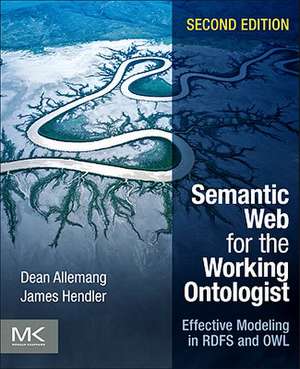
Semantic Web for the Working Ontologist: Effective Modeling in RDFS and OWL
Autor Dean Allemang, James Hendleren Limba Engleză Paperback – 5 iul 2011
Structura progresivă — de la concept la implementare — transformă Semantic Web for the Working Ontologist într-un instrument de lucru indispensabil pentru dezvoltatorii care doresc să depășească faza de colectare haotică a datelor în favoarea partajării inteligente de informații. Notăm cu interes felul în care autorii Dean Allemang și James Hendler evită abstractizarea excesivă, preferând să ancoreze teoriile complexe despre ontologii în exemple tangibile, precum viața și opera lui Shakespeare, pentru a ilustra logica din spatele RDFS și OWL.
Putem afirma că forța acestui volum rezidă în abordarea sa pragmatică. Cuprinsul relevă o evoluție logică: după stabilirea bazei cu RDF și limbajul de interogare SPARQL, cititorul este ghidat prin arhitecturi de aplicații și mecanisme de inferență, ajungând la subtilitățile SKOS pentru gestionarea vocabularelor. Merită menționat capitolul dedicat bunelor și relelor practici de modelare, un ghid esențial pentru evitarea erorilor comune în designul ontologic. Față de lucrarea anterioară a autorului, The Semantic Web - ISWC 2006, care analiza evoluția sistemelor vii ale web-ului, acest volum se concentrează pe execuția tehnică și pe standardele actuale precum OWL 2.0.
Cititorul care a aplicat ideile fundamentale din Foundations of Semantic Web Technologies de Pascal Hitzler va găsi aici puntea necesară către implementarea în scenarii reale de business. În timp ce Hitzler se concentrează pe fundamentele teoretice stabile, Allemang și Hendler extind perspectiva către „ontologii în sălbăticie”, analizând proiecte precum Linked Open Data sau Open Graph, esențiale pentru aplicațiile moderne de e-commerce și data mining.
Preț: 291.11 lei
Preț vechi: 463.45 lei
-37%
Carte tipărită la comandă
Livrare economică 28 noiembrie-12 decembrie
Specificații
ISBN-10: 0123859654
Pagini: 384
Ilustrații: Illustrations
Dimensiuni: 191 x 235 x 23 mm
Greutate: 0.64 kg
Ediția:2nd revised edition.
Editura: Elsevier
V-ar putea interesa
-
 Internet & World Wide Web: How to ProgramHarvey Deitel-20%Preț: 641.26 lei801.58 lei
 -
 Programming Language PragmaticsMichael Scott-40%Preț: 488.30 lei808.04 lei
 -
 The Data Warehouse ToolkitRalph Kimball-20%Preț: 406.19 lei507.75 lei
 -
 HTML & CSSJon Duckett-20%Preț: 259.57 lei324.46 lei
 -
 R-ticulateMartin Bader-23%Preț: 653.46 lei848.65 lei
 -
 SQL Essentials for DummiesRichard Blum-20%Preț: 65.83 lei82.30 lei
 -
 Agentic AI For DummiesPam Baker-20%Preț: 145.95 lei182.44 lei
 -
 The Organization of InformationDaniel N. Joudrey-24%Preț: 435.12 lei575.20 lei
 -
 MongoDB in Action, Third EditionArek Borucki-20%Preț: 357.89 lei447.36 lei
 -
 The Definitive Book of SNES RPGs Vol.1Bitmap BooksPreț: 354.23 lei
 -
 Handbook of Metadata, Semantics and OntologiesSaurabh Pal-18%Preț: 1041.55 lei1270.18 lei
 -
 -19%Preț: 606.02 lei748.17 lei
 -
 The Semantic Web: ESWC 2022 Satellite EventsPaul Groth-20%Preț: 519.66 lei649.57 lei
 -
 The Semantic Web - ISWC 2023Terry R. Payne-20%Preț: 562.50 lei703.13 lei
 -
 The Semantic WebAlbert Meroño Peñuela-20%Preț: 437.83 lei547.29 lei
 -
 The Semantic Web: Research and ApplicationsLora Aroyo-20%Preț: 343.97 lei429.96 lei
 -
 -20%Preț: 322.61 lei403.26 lei
 -
 -20%Preț: 334.49 lei418.11 lei
 -
 -20%Preț: 321.03 lei401.30 lei
Public țintă
Programmers, web developers, and application developers in numerous fields, including health care, finance, artificial intelligence, engineering, national intelligence, and enterprise architecture; technologists and graduate students in computer scienceDe ce să citești această carte
Recomandăm această carte programatorilor și arhitecților de sistem care au nevoie de un ghid aplicat pentru modelarea datelor. Spre deosebire de manualele pur teoretice, volumul oferă soluții concrete pentru probleme de modelare întâlnite în finanțe, sănătate și inteligență artificială. Veți câștiga o înțelegere profundă a modului în care OWL și SPARQL pot fi utilizate pentru a transforma web-ul într-o bază de date globală, interconectată și procesabilă automat.
Descriere scurtă
- Updated with the latest developments and advances in Semantic Web technologies for organizing, querying, and processing information, including SPARQL, RDF and RDFS, OWL 2.0, and SKOS
- Detailed information on the ontologies used in today's key web applications, including ecommerce, social networking, data mining, using government data, and more
- Even more illustrative examples and case studies that demonstrate what semantic technologies are and how they work together to solve real-world problems
Cuprins
Recenzii
"Allemang, a scientist at a company that consults, trains, and provides products for the Semantic Web, and Hendler (computer and cognitive science, Rensselaer Polytechnic Institute) explain how web developers who are practitioners in another field, such as health care, finance, engineering, national intelligence, and enterprise architecture, can model data to fit the requirements of the Semantic Web. They detail how to construct semantic models, with a focus on the use of RDF (Resource Description Framework), RDFS (RDF schema), and OWL (Web Ontology Language) to accomplish specific tasks and model data and domains. This edition has been updated to incorporate new technologies such as SPARQL (SPARQL Protocol And RDF Query Language), OWL 2.0, and SKOS (Simple Knowledge Organization System). They include examples of Quantities, Units, Dimensions, and Types (QUDT) and The Open Biological and Biomedical Ontologies (OBO), as well as examples of how to use the Semantic Web to solve common modeling problems and a FAQ section on challenges." --SciTech Book News
"Overall, this is an easy-to-follow guide to the basic concepts related to building semantic Web ontologies. The book flows well from chapter to chapter, and the many examples illustrate the different topics. For beginners, it’s an excellent introduction to the subject, which is exactly what the authors intended…" --Computing Reviews.com