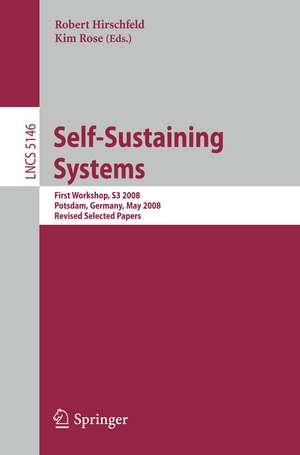
Self-Sustaining Systems
Editat de Robert Hirschfeld, Kim Roseen Limba Engleză Paperback – 22 oct 2008
Preț: 328.20 lei
Preț vechi: 410.26 lei
-20%
Puncte Express: 492
Carte tipărită la comandă
Livrare economică 28 noiembrie-12 decembrie
Livrare prin curier în România Termenul estimat este afișat lângă disponibilitate.
Transport gratuit de la 400.00 lei Plată online sau ramburs, în funcție de opțiunile comenzii.
Retur gratuit în 14 zile Comandă securizată și suport în română.
Specificații
ISBN-13: 9783540892748
ISBN-10: 3540892745
Pagini: 172
Ilustrații: VII, 157 p.
Dimensiuni: 155 x 235 x 10 mm
Greutate: 0.27 kg
Ediția:2008
Editura: Springer
Locul publicării:Berlin, Heidelberg, Germany
ISBN-10: 3540892745
Pagini: 172
Ilustrații: VII, 157 p.
Dimensiuni: 155 x 235 x 10 mm
Greutate: 0.27 kg
Ediția:2008
Editura: Springer
Locul publicării:Berlin, Heidelberg, Germany
V-ar putea interesa
-
 Information System ConceptsEckhard D Falkenberg-20%Preț: 1327.38 lei1659.23 lei
 -
 Fault-Tolerant Parallel and Distributed SystemsDimiter R Avresky-20%Preț: 1003.34 lei1254.18 lei
 -
 Handbook of Bipolar Disorder: Diagnosis and Therapeutic ApproachesSiegfried Kasper-5%Preț: 1616.46 lei1701.54 lei
 -
 -18%Preț: 1487.90 lei1814.51 lei
 -
 The Basics of Line Balancing and JIT KittingBeverly TownsendPreț: 218.15 lei
 -
 Capacity Management in MRP, APS & S&op SoftwareShaun SnappPreț: 328.86 lei
 -
 High Performance ComputingMichela Taufer-20%Preț: 357.42 lei446.78 lei
 -
 Computer Performance EngineeringDieter Fiems-20%Preț: 331.86 lei414.82 lei
 -
 -20%Preț: 316.03 lei395.04 lei
 -
 Tools for High Performance Computing 2016Christoph Niethammer-20%Preț: 666.97 lei833.71 lei
 -
 -20%Preț: 656.02 lei820.02 lei
 -
 PARLE '92. Parallel Architectures and Languages EuropeDaniel Etiemble-20%Preț: 365.66 lei457.08 lei
 -
 Euro-Par'98 Parallel ProcessingDavid Pritchard-20%Preț: 438.69 lei548.37 lei
 -
 -20%Preț: 648.13 lei810.16 lei
 -
 -20%Preț: 326.47 lei408.09 lei
 -
 -20%Preț: 323.23 lei404.04 lei
 -
 Transactions on Aspect-Oriented Software Development XIIShigeru Chiba-20%Preț: 331.42 lei414.27 lei
 -
 Data-oriented ReengineeringJörg P. Wadsack-20%Preț: 528.92 lei661.14 lei
 -
 InternetwareHong Mei-20%Preț: 692.04 lei865.06 lei
Public țintă
ResearchCuprins
Invited Talks.- Open, Extensible Object Models.- The Lively Kernel A Self-supporting System on a Web Page.- On Sustaining Self.- Research Papers.- Huemul – A Smalltalk Implementation.- SBCL: A Sanely-Bootstrappable Common Lisp.- Reflection for the Masses.- Back to the Future in One Week — Implementing a Smalltalk VM in PyPy.- Are Bytecodes an Atavism?.
Textul de pe ultima copertă
This book constitutes the refereed proceedings of the First Workshop on Self-sustaining Systems, S3, held in Potsdam, Germany, in May 2008.
S3 is a forum for discussion of topics relating to computer systems and languages that are able to bootstrap, implement, modify, and maintain themselves. One property of these systems is that their implementation is based on small but powerful abstractions; examples include (amongst others) Squeak/Smalltalk, COLA, Klein/Self, PyPy/Python, Rubinius/Ruby, and Lisp. Such systems are the engines of their own replacement, giving researchers and developers great power to experiment with, and explore future directions from within their own small language kernels.
S3 is a forum for discussion of topics relating to computer systems and languages that are able to bootstrap, implement, modify, and maintain themselves. One property of these systems is that their implementation is based on small but powerful abstractions; examples include (amongst others) Squeak/Smalltalk, COLA, Klein/Self, PyPy/Python, Rubinius/Ruby, and Lisp. Such systems are the engines of their own replacement, giving researchers and developers great power to experiment with, and explore future directions from within their own small language kernels.