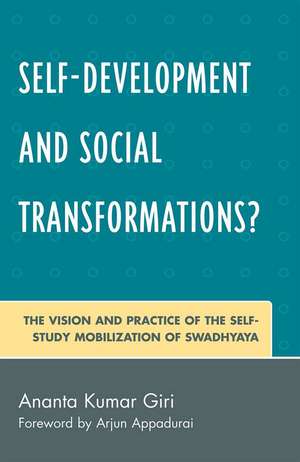
Self-Development and Social Transformations?: The Vision and Practice of the Self-Study Mobilization of Swadhyaya
Autor Ananta Kumar Giri Cuvânt înainte de Arjun Appaduraien Limba Engleză Hardback – 16 dec 2008
Preț: 706.90 lei
Preț vechi: 1067.85 lei
-34%
Puncte Express: 1060
Preț estimativ în valută:
125.19€ • 146.21$ • 108.75£
125.19€ • 146.21$ • 108.75£
Carte tipărită la comandă
Livrare economică 21 februarie-07 martie
Preluare comenzi: 021 569.72.76
Specificații
ISBN-13: 9780739111987
ISBN-10: 0739111981
Pagini: 318
Dimensiuni: 161 x 239 x 29 mm
Greutate: 0.68 kg
Editura: Bloomsbury Publishing
Colecția Lexington Books
Locul publicării:New York, United States
ISBN-10: 0739111981
Pagini: 318
Dimensiuni: 161 x 239 x 29 mm
Greutate: 0.68 kg
Editura: Bloomsbury Publishing
Colecția Lexington Books
Locul publicării:New York, United States
Cuprins
Chapter 1 Foreword by Arjun Appadurai
Chapter 2 Preface
Chapter 3 1. Understanding the Vision and Practice of Swadhyaya
Chapter 4 2. Active Devotion in Local Context: The Dynamics of Swadhyaya in Simar
Chapter 5 3. Understanding Expanding Universes and Experiments: The Dynamics of Swadhyaya in Veraval and Beyond
Chapter 6 4. From Matsyagandha to Ghar Mandir: The Work of Swadhyaya in Tribal Areas
Chapter 7 5. The Educational Dynamics of Swadhyaya
Chapter 8 6. Globalization of Swadhyaya
Chapter 9 7. Self-Development and Social Transformations? Swadhyaya and Beyond
Chapter 2 Preface
Chapter 3 1. Understanding the Vision and Practice of Swadhyaya
Chapter 4 2. Active Devotion in Local Context: The Dynamics of Swadhyaya in Simar
Chapter 5 3. Understanding Expanding Universes and Experiments: The Dynamics of Swadhyaya in Veraval and Beyond
Chapter 6 4. From Matsyagandha to Ghar Mandir: The Work of Swadhyaya in Tribal Areas
Chapter 7 5. The Educational Dynamics of Swadhyaya
Chapter 8 6. Globalization of Swadhyaya
Chapter 9 7. Self-Development and Social Transformations? Swadhyaya and Beyond
Recenzii
Ananta Kumar Giri's fascinating work on Swadhyaya is one of the most detailed ethnographies I have read on the burgeoning indigenous movements to foster economic, social and ethical development in South Asia and other parts of the world. Swadhyaya espouses what Giri calls a 'practical spirituality' in which the ethnographer engages in simultaneous participation and in an 'integrally involving criticism.' This movement on the one hand combines a kind of neo-Vedic ideology that opens up a world not just for Hindus but also for Muslims, Buddhists and other religions. Giri discusses the movement in great detail, sympathetically but without sentimentality, and does not ignore the internal conflicts and leadership struggles that such a movement inevitably faces. I recommend this book for anyone interested in engaged ethnography and the new social movements that attempt to combine socio-economic welfare intrinsically tied to ethical concerns.
Professor Giri's book provides an important and very interesting analysis of one of the most interesting cases of modern social movements and gives very important indications about the wide range of such movements in the inter-civilizational comparative framework.
With Self-Development and Social Transformations? Ananta Kumar Giri adds yet another fascinating book to an already impressive range of publications. It is at one and the same time a careful and detailed study of the Indian Swadhyaya movement and an illuminating analysis of the trajectory followed by a social imaginary as it becomes transposed from the local to the transnational level. At the core of the book, however, is that most interesting and urgent of concerns in contemporary social movement studies, namely the problem of subject formation.
The book will prove a useful resource on graduate-level courses on Hindu and other Asian religious movements.
At a time when individuals and societies are addicted to the pursuit of narrow self-interest, here comes a welcome reminder of an alternative path: the path of ethical and spiritual self-cultivation in the service of others. We are greatly indebted to Ananta Kumar Giri for his detailed study of this uplifting social movement or network called Swadhyaya. As he shows, Swadhyaya is a necessary complement to, and even has priority over, projects focused on purely economic or technical advancement. Widely renowned for his string of earlier publications, Giri with this book emerges as a major voice in the contemporary global civic discourse.
Professor Giri's book provides an important and very interesting analysis of one of the most interesting cases of modern social movements and gives very important indications about the wide range of such movements in the inter-civilizational comparative framework.
With Self-Development and Social Transformations? Ananta Kumar Giri adds yet another fascinating book to an already impressive range of publications. It is at one and the same time a careful and detailed study of the Indian Swadhyaya movement and an illuminating analysis of the trajectory followed by a social imaginary as it becomes transposed from the local to the transnational level. At the core of the book, however, is that most interesting and urgent of concerns in contemporary social movement studies, namely the problem of subject formation.
The book will prove a useful resource on graduate-level courses on Hindu and other Asian religious movements.
At a time when individuals and societies are addicted to the pursuit of narrow self-interest, here comes a welcome reminder of an alternative path: the path of ethical and spiritual self-cultivation in the service of others. We are greatly indebted to Ananta Kumar Giri for his detailed study of this uplifting social movement or network called Swadhyaya. As he shows, Swadhyaya is a necessary complement to, and even has priority over, projects focused on purely economic or technical advancement. Widely renowned for his string of earlier publications, Giri with this book emerges as a major voice in the contemporary global civic discourse.