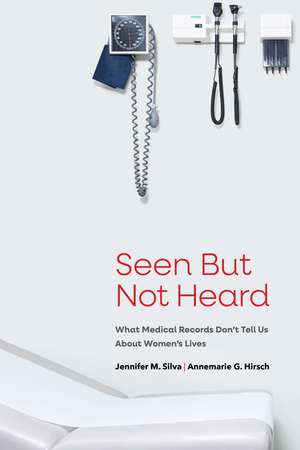
Seen But Not Heard: What Medical Records Don’t Tell Us About Women’s Lives
Autor Jennifer M. Silva, Annemarie G. Hirschen Limba Engleză Paperback – 19 aug 2026 – vârsta ani
Drawing on interviews with 87 non-college-educated, economically disadvantaged women living in rural America and their health records from a large, non-profit health system, Silva and Hirsch find that the stories that medical records provide and the stories that women tell about themselves differ dramatically. Medical charts often translate women’s suffering into sterile diagnostic codes, prescriptions, and treatment plans. Some women felt heard by their clinicians, believed they received adequate care. Many of these women thought their clinicians went above and beyond to help meet their needs by offering them information on how to apply for benefits like food stamps or childcare subsidies and helping them obtain necessary items like mattress covers and winter coats. More often, however, women felt that clinicians were detached from their everyday struggles to survive, whether that meant keeping their families intact even in the face of violence or finding money to pay the never-ending string of bills.
Silva and Hirsch argue that because the system of healthcare delivery interprets social problems as individual failings it often reproduces long-standing injurious stereotypes of women as hysterical, recalcitrant, impure, and gluttonous. For some healthcare providers, knowledge about patients’ social risk factors can become a source of control and punishment, such as denying patients care or reporting patients to child welfare services. Patients described clinicians mobilizing harmful stereotypes about marriage and motherhood, race, and poverty during their appointments. Some of the women’s most traumatic experiences in the healthcare system were completely missing from their EHRs. These troubling experiences ultimately deter women from accessing healthcare, discourages them from sharing their experiences with clinicians, and in some cases, makes their health and social problems worse. Silva and Hirsch offer several policies and practices that would improve women’s experiences in clinical encounters, such as training clinicians in trauma-informed and culturally responsive care, as well as national investments in housing, food security, transportation, and environmental justice.
Seen But Not Heard is a disturbing but necessary examination of the ways vulnerable women are often failed by the healthcare system and offers solutions that will allow healthcare workers to better address the structural barriers faced by their patients.
Preț: 208.84 lei
Preț vechi: 219.82 lei
-5% Nou
Puncte Express: 313
Carte disponibilă
Livrare economică 17 noiembrie-01 decembrie
Livrare prin curier în România Termenul estimat este afișat lângă disponibilitate.
Transport gratuit de la 400.00 lei Plată online sau ramburs, în funcție de opțiunile comenzii.
Retur gratuit în 14 zile Comandă securizată și suport în română.
Specificații
ISBN-13: 9780871548672
ISBN-10: 0871548674
Pagini: 224
Dimensiuni: 152 x 229 x 20 mm
Greutate: 0.46 kg
Editura: Russell Sage Foundation
Colecția Russell Sage Foundation
ISBN-10: 0871548674
Pagini: 224
Dimensiuni: 152 x 229 x 20 mm
Greutate: 0.46 kg
Editura: Russell Sage Foundation
Colecția Russell Sage Foundation
Recenzii
“Seen but Not Heard is a powerful and unflinching book that exposes the profound gap between what health systems record and what patients actually live, revealing how inequality is not merely treated within clinical settings but often reproduced through them. Offering deeply humanizing accounts, Jennifer Silva and Annemarie Hirsch show how racism, poverty, gendered violence, and stigma are translated into medical shorthand, obscuring suffering while shaping care in consequential ways. Urgent and illuminating, this work challenges us to rethink the ethical limits of healthcare as a solution to social inequality and to imagine more just and humane approaches to healing.”—CELESTE WATKINS-HAYES, Joan and Sanford Weill Dean, Gerald R. Ford School of Public Policy, and University Diversity and Social Transformation Professor, Jean E. Fairfax Collegiate Professor of Public Policy, and professor of sociology, University of Michigan
“Be careful what you wish for. Jennifer Silva and Annemarie Hirsch show in this gripping book that asking medical professionals to address social determinants of health may sow distrust and harm marginalized women’s well-being.”—STEFAN TIMMERMANS, professor of sociology, University of California, Los Angeles
“In this propulsive text, we learn that attending to patients’ social needs can inspire compassion and improve care. All too often, though, these needs are weaponized, stoke race and class tropes, and degrade care, with sometimes horrific results. A harrowing reminder of the urgent need for reform in patient care, Seen but Not Heard is a book that should be read by health researchers, policy makers, and healthcare practitioners alike.” —KATHRYN J. EDIN, William Church Osborn Professor of Sociology and Public Affairs, Princeton University
“Be careful what you wish for. Jennifer Silva and Annemarie Hirsch show in this gripping book that asking medical professionals to address social determinants of health may sow distrust and harm marginalized women’s well-being.”—STEFAN TIMMERMANS, professor of sociology, University of California, Los Angeles
“In this propulsive text, we learn that attending to patients’ social needs can inspire compassion and improve care. All too often, though, these needs are weaponized, stoke race and class tropes, and degrade care, with sometimes horrific results. A harrowing reminder of the urgent need for reform in patient care, Seen but Not Heard is a book that should be read by health researchers, policy makers, and healthcare practitioners alike.” —KATHRYN J. EDIN, William Church Osborn Professor of Sociology and Public Affairs, Princeton University
Notă biografică
JENNIFER M. SILVA is an associate professor, Paul H. O’Neill School of Public and Environmental Affairs, Indiana University.
ANNEMARIE G. HIRSCH is director of the Center for Community Environment and Health, Geisinger College of Health Sciences.
ANNEMARIE G. HIRSCH is director of the Center for Community Environment and Health, Geisinger College of Health Sciences.
Textul de pe ultima copertă
Medical clinicians, who are already overworked and burned out, are increasingly expected to understand and treat systemic social issues like poverty and racism. One aspect of this is documenting patient’s social risk factors in electronic health records (EHRs). But EHRs do not aways give the full story. Critically, they omit patients’ voices and perspectives about their lives, care, and whether their needs are being met. In Seen But Not Heard, sociologist Jennifer M. Silva and epidemiologist Annemarie G. Hirsch explore the gaps between what clinicians document in EHRs and women’s lived experiences.
Drawing on interviews with 87 non-college-educated, economically disadvantaged women living in rural America and their health records from a large, non-profit health system, Silva and Hirsch find that the stories that medical records provide and the stories that women tell about themselves differ dramatically. Medical charts often translate women’s suffering into sterile diagnostic codes, prescriptions, and treatment plans. Some women felt heard by their clinicians, believed they received adequate care. Many of these women thought their clinicians went above and beyond to help meet their needs by offering them information on how to apply for benefits like food stamps or childcare subsidies and helping them obtain necessary items like mattress covers and winter coats. More often, however, women felt that clinicians were detached from their everyday struggles to survive, whether that meant keeping their families intact even in the face of violence or finding money to pay the never-ending string of bills.
Silva and Hirsch argue that because the system of healthcare delivery interprets social problems as individual failings it often reproduces long-standing injurious stereotypes of women as hysterical, recalcitrant, impure, and gluttonous. For some healthcare providers, knowledge about patients’ social risk factors can become a source of control and punishment, such as denying patients care or reporting patients to child welfare services. Patients described clinicians mobilizing harmful stereotypes about marriage and motherhood, race, and poverty during their appointments. Some of the women’s most traumatic experiences in the healthcare system were completely missing from their EHRs. These troubling experiences ultimately deter women from accessing healthcare, discourages them from sharing their experiences with clinicians, and in some cases, makes their health and social problems worse. Silva and Hirsch offer several policies and practices that would improve women’s experiences in clinical encounters, such as training clinicians in trauma-informed and culturally responsive care, as well as national investments in housing, food security, transportation, and environmental justice.
Seen But Not Heard is a disturbing but necessary examination of the ways vulnerable women are often failed by the healthcare system and offers solutions that will allow healthcare workers to better address the structural barriers faced by their patients.
Drawing on interviews with 87 non-college-educated, economically disadvantaged women living in rural America and their health records from a large, non-profit health system, Silva and Hirsch find that the stories that medical records provide and the stories that women tell about themselves differ dramatically. Medical charts often translate women’s suffering into sterile diagnostic codes, prescriptions, and treatment plans. Some women felt heard by their clinicians, believed they received adequate care. Many of these women thought their clinicians went above and beyond to help meet their needs by offering them information on how to apply for benefits like food stamps or childcare subsidies and helping them obtain necessary items like mattress covers and winter coats. More often, however, women felt that clinicians were detached from their everyday struggles to survive, whether that meant keeping their families intact even in the face of violence or finding money to pay the never-ending string of bills.
Silva and Hirsch argue that because the system of healthcare delivery interprets social problems as individual failings it often reproduces long-standing injurious stereotypes of women as hysterical, recalcitrant, impure, and gluttonous. For some healthcare providers, knowledge about patients’ social risk factors can become a source of control and punishment, such as denying patients care or reporting patients to child welfare services. Patients described clinicians mobilizing harmful stereotypes about marriage and motherhood, race, and poverty during their appointments. Some of the women’s most traumatic experiences in the healthcare system were completely missing from their EHRs. These troubling experiences ultimately deter women from accessing healthcare, discourages them from sharing their experiences with clinicians, and in some cases, makes their health and social problems worse. Silva and Hirsch offer several policies and practices that would improve women’s experiences in clinical encounters, such as training clinicians in trauma-informed and culturally responsive care, as well as national investments in housing, food security, transportation, and environmental justice.
Seen But Not Heard is a disturbing but necessary examination of the ways vulnerable women are often failed by the healthcare system and offers solutions that will allow healthcare workers to better address the structural barriers faced by their patients.