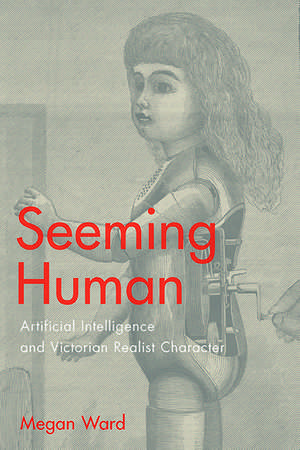
Seeming Human: Artificial Intelligence and Victorian Realist Character
Autor Megan Warden Limba Engleză Hardback – 23 aug 2018
Offers a new theory of realist character through character’s unexpected afterlife: the intelligent machine.
In Seeming Human, Megan Ward contends that mid-twentieth-century versions of artificial intelligence (AI) offer a theory of verisimilitude omitted by traditional histories of character, which often focus on the development of interiority and the shift from “flat” to “round” characters in the Victorian era. Instead, by reading character through AI, Megan Ward’s Seeming Human argues that routinization, predictability, automation, and even flatness are all features of realist characters.
Early artificial intelligence movements such as cybernetics, information theory, and the Turing test define ways of seeming—rather than being—human. Using these theories of verisimilitude to read Victorian novelists such as Elizabeth Gaskell, Margaret Oliphant, Anthony Trollope, Thomas Hardy, and Henry James, Seeming Human argues that mechanicity has been perceived as anti-realist because it is the element that we least want to identify as human. Because AI produces human-like intelligence, it makes clear that we must actually turn to machines in order to understand what makes realist characters seem so human.
In Seeming Human, Megan Ward contends that mid-twentieth-century versions of artificial intelligence (AI) offer a theory of verisimilitude omitted by traditional histories of character, which often focus on the development of interiority and the shift from “flat” to “round” characters in the Victorian era. Instead, by reading character through AI, Megan Ward’s Seeming Human argues that routinization, predictability, automation, and even flatness are all features of realist characters.
Early artificial intelligence movements such as cybernetics, information theory, and the Turing test define ways of seeming—rather than being—human. Using these theories of verisimilitude to read Victorian novelists such as Elizabeth Gaskell, Margaret Oliphant, Anthony Trollope, Thomas Hardy, and Henry James, Seeming Human argues that mechanicity has been perceived as anti-realist because it is the element that we least want to identify as human. Because AI produces human-like intelligence, it makes clear that we must actually turn to machines in order to understand what makes realist characters seem so human.
Preț: 484.49 lei
Puncte Express: 727
Preț estimativ în valută:
85.60€ • 98.41$ • 74.33£
85.60€ • 98.41$ • 74.33£
Carte tipărită la comandă
Livrare economică 13-27 mai
Specificații
ISBN-13: 9780814213759
ISBN-10: 0814213758
Pagini: 216
Dimensiuni: 152 x 229 x 18 mm
Greutate: 0.45 kg
Ediția:1
Editura: Ohio State University Press
Colecția Ohio State University Press
ISBN-10: 0814213758
Pagini: 216
Dimensiuni: 152 x 229 x 18 mm
Greutate: 0.45 kg
Ediția:1
Editura: Ohio State University Press
Colecția Ohio State University Press
V-ar putea interesa
-
 -23%Preț: 429.50 lei557.80 lei
 -
 James Baldwin, Toni Morrison, and the Rhetorics of Black Male SubjectivityAaron Ngozi OforleaPreț: 297.76 lei
 -
 Preț: 301.72 lei
 -
 Brief Interviews with the Romantic PastKathryn NuernbergerPreț: 104.48 lei
 -
 Albertus Magnus On Animals V1: A Medieval Summa Zoologica Revised EditionKenneth F. Kitchell Jr.Preț: 493.03 lei
 -
 Albertus Magnus On Animals V2: A Medieval Summa Zoologica Revised EditionKenneth F. Kitchell Jr.Preț: 497.61 lei
 -
 Preț: 185.75 lei
 -
 The Columbus AnthologyAmanda PagePreț: 102.03 lei
 -
 EzioPietro MetastasioPreț: 51.46 lei
 -
 Ciro RiconosciutoPietro MetastasioPreț: 51.68 lei
 -
 HorusMichele PisculliPreț: 68.61 lei
 -
 Il Re PastorePietro MetastasioPreț: 49.49 lei
 -
 IssipilePietro MetastasioPreț: 50.28 lei
 -
 IpermestraPietro MetastasioPreț: 49.66 lei
 -
 Il Teatro E Gianni BreraPaolo BreraPreț: 53.02 lei
 -
 Satira E AntisatiraFrancesco BuoninsegniPreț: 49.88 lei
 -
 Ludro E La Sua Gran GiornataFrancesco Augusto BonPreț: 50.85 lei
 -
 Manuale Di Geografia AnticaGerolamo BoccardoPreț: 49.28 lei
 -
 La TanciaMichelangelo Buonarrotti Il GiovanePreț: 53.86 lei
 -
 La Gondola a Tre RemiGirolamo BrusoniPreț: 80.25 lei
 -
 Il Peccato Di LoretaAlberto BoccardiPreț: 57.39 lei
 -
 I Costumi Delle APIPaolo BonizziPreț: 47.32 lei
 -
 L'ImmoraleEnrico Annibale ButtiPreț: 50.06 lei
 -
 FedraUmberto BozziniPreț: 53.02 lei
 -
 Il Nostro E L'Altrui IndividualismoArmando BorghiPreț: 49.88 lei
 -
 Preț: 49.66 lei
 -
 Conchiologia Fossile SubappenninaGiovanni Battista BrocchiPreț: 69.24 lei
 -
 Filosofia SocialeGiovanni BovioPreț: 51.46 lei
Recenzii
“Literary realism has been a recurrent subject of revisionist scholarship for several generations of critics and scholars. Seeming Human both exemplifies this strain of criticism and contributes to it in a way that is not only innovative but utterly unique.” —Richard Menke, author of Telegraphic Realism: Victorian Fiction and Other Information Systems
“Seeming Human is a surprising and inventive project that successfully challenges conventional wisdom in literary studies on three important questions: historical methods, the realist novel’s representation of consciousness, and the relation between humans and machines.” —Caroline Levine, author of The Serious Pleasures of Suspense: Victorian Realism and Narrative Doubt
Notă biografică
Megan Ward is Associate Professor in the School of Writing, Literature, and Film at Oregon State University, where she teaches courses on British literature from 1800 to the present, the history of the novel, and archival theory. Her work on technology and realism has appeared or is forthcoming in edited collections such as AI Narratives and The Routledge Guide to Politics and Literature as well as journals such as New Literary History and Public Humanities. She is also Co-Editor of the Nineteenth-Century Data Collective and has published writing on the Victorian antecedents of contemporary culture for general audiences in The Atlantic, Wired, The Washington Post, and the Los Angeles Review of Books. Seeming Human is her first book.
Extras
Introduction
AI as a Theory of Character
IN THE MIDDLE of the twentieth century, scientists and mathematicians began
creating machines that imitated human intelligence. Their definition of intelligence went beyond solving math problems to include what we might call subjectivity: creativity, tastes and preferences, self-awareness, and learned behaviors. We have come to call this artificial intelligence (AI), a term that captures the tensions inherent in that project between artifice and nature, between reproduction and original creation. How might intelligence, which is fundamental to defining human subjectivity, be created anew? Does intelligence mean looking, walking, and acting like a human? Or is human intelligence more abstract, disconnected from behavior and material form? These questions were fundamental to the inception of AI and their answers dramatically changed the direction of AI research.
Though these questions have been identified as inaugurating a new era, they had been posed before. The Victorian novel, too, asks how to create human subjectivity: can it be represented through the material surfaces ofthe body? Or is it an ineffable essence, untouchably interiorized? Can it be programmed or is it spontaneous? Such questions are at the heart not only of twentieth-century AI but also of the Victorian novel’s fictional practice. But the Victorians did not see themselves as producing artificial intelligence; they called it character.
This book reconsiders realist character by reading Victorian novels through mid-twentieth-century forms of artificial intelligence. Theorists of the novel at least since Ian Watt have defined realist form by its “stress on the subjective and psychological direction.” (1) This has been a remarkably durable argument; when in 2007 George Levine defines realism by “the shift to focus on characters’ interiority,” he is not advancing an argument so much as voicing an established commonplace.(2) In turn, the focus on inner life shapes the history of the novel into a narrative of ever-increasing interiority, as in Blakey Vermeule’s observation that “the history of literary forms is punctuated by [. . .] changes designed to get inside the mind and go along for the ride.”(3)
The result of the critical emphasis on interiority is a progressive narrative of the development of an ineffable, idiosyncratic sense of consciousness as definitive of realist, “round” characters. (4) This narrative depends on a belief that psychological depth defines humanlikeness. (5) Victorian characters that do not conform to the depth model have been dismissed as stereotypical, didactic, sensational, or flat, or recuperated as deliberately antirealist or posthumanist. Although realism’s self-referentiality, its awareness of its own artifice, has long been the best critical defense against charges of realism’s political conservatism, (6) the attribution of self-awareness has not extended fully to fictional character, of whom we expect human-like referentiality, usually in the form of represented thought. (7) In other words, we adhere to a definition of realist character that is at odds with the essential fictionality—the non-human-ness—of fictional character.
Seeming Human reconsiders the critical history of realism through Victorian character’s unexpected afterlife: the intelligent machine. Rather than reading fictional character through the study of humans, I turn to machines meant to seem human for a theory of character verisimilitude. The emergence of AI in the 1940s through the 1960s offers a theory of human mimesis that is not limited to represented thought but instead sees behavior, connections, surfaces, and perceptions as key elements of seeming human. Perceiving human-likeness in mechanicity as well as idiosyncrasy, in connectedness as well as particularity, disrupts the critical emphasis on fictional techniques of individual inner life such as free indirect discourse and represented thought. (8)
By reading Victorian novels through AI’s mimetic theories, Seeming Human argues for an alternate genealogy of realist character, one that is not predicated on the development of individual interiority but encompasses a variety of fictional selves. This genealogy tempers the dominance of individual inner life through these characters’ blatant artifice. They may be feedback loops, information systems, flat fakers, or networked bodies; each one challenges prevailing assumptions about what makes a realist character seem real.
Each chapter takes as its starting point one aspect of fictional character—development, predictability, flatness, and mind—that AI also conceives of as central to the cultivation of intelligent machines. Forms of AI here constitute structures of mimesis: the cybernetic feedback loop; the connected surfaces of information theory; the Turing test’s imitation game; the perceptron’s web of embodied sense perceptions; and the physical symbol system’s abstracted cognition. This book has been inspired by studies of Victorian culture’s afterlife by scholars such as Alison Byerly, Jay Clayton, and Richard Menke, who read Victorian literature through its anticipation of contemporary technological concepts such as virtuality, networks, cyborgs, and informatics. It departs from these studies, though, in identifying an afterlife for Victorian culture in the under-studied, under-theorized period between the Victorian era and the present—the afterlife of Victorian ideas and the past of our own. This project excavates mid-twentieth-century models of machine intelligence in order to, in turn, resuscitate the realist characters that came before them and of which they bear traces.
AI as a Theory of Character
IN THE MIDDLE of the twentieth century, scientists and mathematicians began
creating machines that imitated human intelligence. Their definition of intelligence went beyond solving math problems to include what we might call subjectivity: creativity, tastes and preferences, self-awareness, and learned behaviors. We have come to call this artificial intelligence (AI), a term that captures the tensions inherent in that project between artifice and nature, between reproduction and original creation. How might intelligence, which is fundamental to defining human subjectivity, be created anew? Does intelligence mean looking, walking, and acting like a human? Or is human intelligence more abstract, disconnected from behavior and material form? These questions were fundamental to the inception of AI and their answers dramatically changed the direction of AI research.
Though these questions have been identified as inaugurating a new era, they had been posed before. The Victorian novel, too, asks how to create human subjectivity: can it be represented through the material surfaces ofthe body? Or is it an ineffable essence, untouchably interiorized? Can it be programmed or is it spontaneous? Such questions are at the heart not only of twentieth-century AI but also of the Victorian novel’s fictional practice. But the Victorians did not see themselves as producing artificial intelligence; they called it character.
This book reconsiders realist character by reading Victorian novels through mid-twentieth-century forms of artificial intelligence. Theorists of the novel at least since Ian Watt have defined realist form by its “stress on the subjective and psychological direction.” (1) This has been a remarkably durable argument; when in 2007 George Levine defines realism by “the shift to focus on characters’ interiority,” he is not advancing an argument so much as voicing an established commonplace.(2) In turn, the focus on inner life shapes the history of the novel into a narrative of ever-increasing interiority, as in Blakey Vermeule’s observation that “the history of literary forms is punctuated by [. . .] changes designed to get inside the mind and go along for the ride.”(3)
The result of the critical emphasis on interiority is a progressive narrative of the development of an ineffable, idiosyncratic sense of consciousness as definitive of realist, “round” characters. (4) This narrative depends on a belief that psychological depth defines humanlikeness. (5) Victorian characters that do not conform to the depth model have been dismissed as stereotypical, didactic, sensational, or flat, or recuperated as deliberately antirealist or posthumanist. Although realism’s self-referentiality, its awareness of its own artifice, has long been the best critical defense against charges of realism’s political conservatism, (6) the attribution of self-awareness has not extended fully to fictional character, of whom we expect human-like referentiality, usually in the form of represented thought. (7) In other words, we adhere to a definition of realist character that is at odds with the essential fictionality—the non-human-ness—of fictional character.
Seeming Human reconsiders the critical history of realism through Victorian character’s unexpected afterlife: the intelligent machine. Rather than reading fictional character through the study of humans, I turn to machines meant to seem human for a theory of character verisimilitude. The emergence of AI in the 1940s through the 1960s offers a theory of human mimesis that is not limited to represented thought but instead sees behavior, connections, surfaces, and perceptions as key elements of seeming human. Perceiving human-likeness in mechanicity as well as idiosyncrasy, in connectedness as well as particularity, disrupts the critical emphasis on fictional techniques of individual inner life such as free indirect discourse and represented thought. (8)
By reading Victorian novels through AI’s mimetic theories, Seeming Human argues for an alternate genealogy of realist character, one that is not predicated on the development of individual interiority but encompasses a variety of fictional selves. This genealogy tempers the dominance of individual inner life through these characters’ blatant artifice. They may be feedback loops, information systems, flat fakers, or networked bodies; each one challenges prevailing assumptions about what makes a realist character seem real.
Each chapter takes as its starting point one aspect of fictional character—development, predictability, flatness, and mind—that AI also conceives of as central to the cultivation of intelligent machines. Forms of AI here constitute structures of mimesis: the cybernetic feedback loop; the connected surfaces of information theory; the Turing test’s imitation game; the perceptron’s web of embodied sense perceptions; and the physical symbol system’s abstracted cognition. This book has been inspired by studies of Victorian culture’s afterlife by scholars such as Alison Byerly, Jay Clayton, and Richard Menke, who read Victorian literature through its anticipation of contemporary technological concepts such as virtuality, networks, cyborgs, and informatics. It departs from these studies, though, in identifying an afterlife for Victorian culture in the under-studied, under-theorized period between the Victorian era and the present—the afterlife of Victorian ideas and the past of our own. This project excavates mid-twentieth-century models of machine intelligence in order to, in turn, resuscitate the realist characters that came before them and of which they bear traces.
Cuprins
Acknowledgments vii
Introduction: AI as a Theory of Character 1
Chapter 1: Development
The Cybernetic Feedback Loop of Domestic Realism 18
Chapter 2: Predictability
The Informatics of Character 42
Chapter 3: Flatness
Trollope, Turing, and the Art of Imitation 67
Chapter 4: Mind
Hardy, James, and Theories of Artificial Mind 97
Epilogue: How a Machine Thinks . . . 123
Notes 129
Works Cited 157
Index 175
Introduction: AI as a Theory of Character 1
Chapter 1: Development
The Cybernetic Feedback Loop of Domestic Realism 18
Chapter 2: Predictability
The Informatics of Character 42
Chapter 3: Flatness
Trollope, Turing, and the Art of Imitation 67
Chapter 4: Mind
Hardy, James, and Theories of Artificial Mind 97
Epilogue: How a Machine Thinks . . . 123
Notes 129
Works Cited 157
Index 175
Descriere
Connecting current discussions of artificial intelligence with Victorian studies, offers a new theory of realist character through the realist novel’s unexpected afterlife: the intelligent machine.