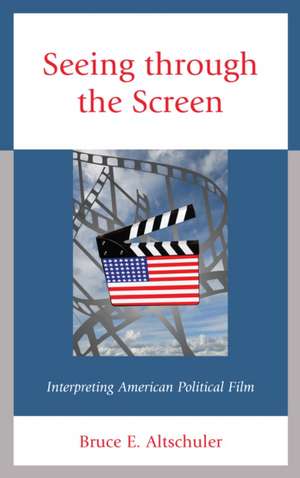
Seeing through the Screen
Autor Bruce E. Altschuleren Limba Engleză Hardback – 27 noi 2017
Preț: 648.93 lei
Preț vechi: 763.45 lei
-15%
Puncte Express: 973
Carte tipărită la comandă
Livrare economică 30 noiembrie-14 decembrie
Livrare prin curier în România Termenul estimat este afișat lângă disponibilitate.
Transport gratuit pentru acest produs Plată online sau ramburs, în funcție de opțiunile comenzii.
Retur gratuit în 14 zile Comandă securizată și suport în română.
Specificații
ISBN-13: 9781498557481
ISBN-10: 1498557481
Pagini: 194
Dimensiuni: 157 x 235 x 15 mm
Greutate: 0.44 kg
Editura: Bloomsbury Publishing
Locul publicării:New York, United States
ISBN-10: 1498557481
Pagini: 194
Dimensiuni: 157 x 235 x 15 mm
Greutate: 0.44 kg
Editura: Bloomsbury Publishing
Locul publicării:New York, United States
Cuprins
Introduction
Chapter 1: Political Campaigns
Chapter 2: The President
Chapter 3: Congress
Chapter 4: Law and Courts
Chapter 5: The Media
Chapter 6: War and Peace
Chapter 7: Domestic Policy
Chapter 8: State and Local Politics
References
About the Author
Chapter 1: Political Campaigns
Chapter 2: The President
Chapter 3: Congress
Chapter 4: Law and Courts
Chapter 5: The Media
Chapter 6: War and Peace
Chapter 7: Domestic Policy
Chapter 8: State and Local Politics
References
About the Author
Recenzii
Though not a textbook per se, Seeing through the Screen was written for the college and university classroom. Altschuler (emer., political science, SUNY, Oswego) examines films by subject, devoting chapters to political campaigns, the presidency, Congress, laws and courts, the media, war and peace, domestic issues, and state and local politics. In each chapter, he analyzes five or six seminal films that address the particular subject. Each analysis includes a brief introduction, a summary of the film's content, and pivotal questions to ask after screening the movie. These open-ended questions are not answered but instead left to viewers or the classroom. . . this is material ready-made for the undergraduate classroom. The author does begin each chapter with valuable guidance on the depiction of the subject over time. One strength of the volume is the chronological breadth of its coverage of American screen history. Not much is written for the undergraduate classroom other than textbooks, so this book is valuable for filling a niche, particularly in political science courses.
Summing Up: Recommended. Lower- and upper-division undergraduates; faculty; general readers.
The book's better film selections can be helpful to film studies and political science professors, especially in the formulation of film choices and discussion questions.
Seeing Through the Screen is an essential contribution to the increasingly vigorous and vital literature on politics and popular culture. Bruce Altschuler first tackles the contentious challenge of defining the American political film genre, and then seeks to discover the messages being communicated in that genre. The analyses are rich, thoughtful, and a delight to read.
In Seeing Through the Screen, Bruce Altschulerexamines the most significant movies of our time to observe and challenge our ideas about American politics and our institutions of government. In doing so, he shines a bright light onto the construction of our beliefs, the way we regard our government, and the consequences of this meaning. Students will be thoroughly engaged by the film descriptions and challenged by the questions about the implications of popular culture.
How should we interpret films' political messages? What relevance do these movies and meanings have for our current political institutions and processes-and what does that reveal about the efficacy of our politics, the pace of socio-political change, and, perhaps, our own political socialization? Moving effectively across genres and topics, reviewing trenchant classics and lesser-known gems from an ever-expanding film canon, Altschuler's approach provides readers with practical questions aimed at facilitating thoughtful discussion and debate. As such, as we see through the screen, we can employ these films to consider the state of our campaigns, presidents, the media, state and local politics, and more.
Summing Up: Recommended. Lower- and upper-division undergraduates; faculty; general readers.
The book's better film selections can be helpful to film studies and political science professors, especially in the formulation of film choices and discussion questions.
Seeing Through the Screen is an essential contribution to the increasingly vigorous and vital literature on politics and popular culture. Bruce Altschuler first tackles the contentious challenge of defining the American political film genre, and then seeks to discover the messages being communicated in that genre. The analyses are rich, thoughtful, and a delight to read.
In Seeing Through the Screen, Bruce Altschulerexamines the most significant movies of our time to observe and challenge our ideas about American politics and our institutions of government. In doing so, he shines a bright light onto the construction of our beliefs, the way we regard our government, and the consequences of this meaning. Students will be thoroughly engaged by the film descriptions and challenged by the questions about the implications of popular culture.
How should we interpret films' political messages? What relevance do these movies and meanings have for our current political institutions and processes-and what does that reveal about the efficacy of our politics, the pace of socio-political change, and, perhaps, our own political socialization? Moving effectively across genres and topics, reviewing trenchant classics and lesser-known gems from an ever-expanding film canon, Altschuler's approach provides readers with practical questions aimed at facilitating thoughtful discussion and debate. As such, as we see through the screen, we can employ these films to consider the state of our campaigns, presidents, the media, state and local politics, and more.