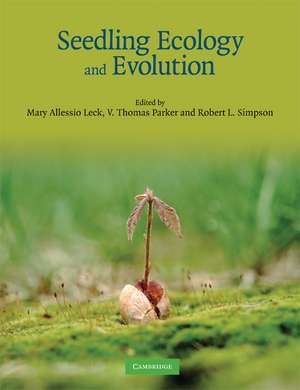
Seedling Ecology and Evolution
Editat de Mary Allessio Leck, V Thomas Parker, Robert L Simpsonen Limba Engleză Paperback – 18 sep 2008
Nivel de studiu: Master, doctorat și referință pentru cercetători în ecologie vegetală, botanică și conservare. Seedling Ecology and Evolution reprezintă o sinteză riguroasă a celei mai vulnerabile etape din ciclul de viață al plantelor. Apreciem modul în care editorii Mary Allessio Leck, V Thomas Parker și Robert L Simpson au reușit să consolideze date disparate despre stadiul de plantulă, o perioadă marcată de o mortalitate ridicată, dar esențială pentru dinamica populațiilor vegetale. Lucrarea depășește simpla descriere morfologică, propunând o abordare integrată care corelează fiziologia și evoluția cu succesul ecologic în habitate diverse. Structura volumului urmărește o progresie logică, de la diversitatea strategiilor de supraviețuire în medii stresante, până la analize detaliate ale fitohormonilor și ecofiziologiei. Ne-a atras atenția includerea unor grupuri botanice cu cerințe complexe, precum plantele parazite sau orhideele, oferind astfel o perspectivă taxonomică largă. Putem afirma că rigoarea celor 536 de pagini transformă acest titlu într-un instrument de lucru indispensabil pentru înțelegerea modului în care comunitățile vegetale se regenerează în contextul schimbărilor climatice și al intervenției umane. Ca alternativă la Seed Ecology (din seria Outline Studies in Ecology) pentru cursurile de ecologie a regenerării, acest volum de la Cambridge University Press vine cu avantajul unei focalizări stricte pe tranziția de la sămânță la plantă adultă, oferind detalii despre evoluția embrionară și fosilele primelor angiosperme care nu se regăsesc în manualele introductive.
Preț: 540.46 lei
Preț vechi: 607.26 lei
-11%
Carte tipărită la comandă
Livrare economică 20 noiembrie-04 decembrie
Specificații
ISBN-10: 0521694663
Pagini: 536
Ilustrații: 73 b/w illus. 15 tables
Dimensiuni: 188 x 244 x 25 mm
Greutate: 1.13 kg
Editura: Cambridge University Press
Locul publicării:Cambridge, United Kingdom
V-ar putea interesa
-
 -19%Preț: 68.56 lei85.15 lei
 -
 Darwin: A Very Short IntroductionJonathan Howard-21%Preț: 55.64 lei70.02 lei
 -
 -14%Preț: 255.92 lei296.09 lei
 -
 Origins of Life: From the Birth of Life to the Origin of LanguageJohn Maynard Smith-17%Preț: 162.40 lei195.86 lei
 -
 -28%Preț: 421.40 lei582.39 lei
 -
 Genomics and Evolution of Microbial EukaryotesLaura A. Katz-28%Preț: 407.25 lei567.11 lei
 -
 Darwin's Legacy: What Evolution Means TodayJohn Dupré-17%Preț: 99.96 lei119.80 lei
 -
 Darwinian HeresiesLustig AbigailPreț: 297.32 lei
 -
 Evolution and BeliefRobert J. AsherPreț: 253.83 lei
 -
 The Cambridge Companion to the "Origin of Species"Michael RusePreț: 299.91 lei
 -
 The Cambridge Companion to DarwinJonathan HodgePreț: 351.85 lei
 -
 OriginsFrederick BurkhardtPreț: 287.43 lei
 -
 Sex AllocationStuart West-19%Preț: 459.87 lei567.74 lei
 -
 The Correspondence of Charles DarwinFrederick Burkhardt-23%Preț: 978.28 lei1270.48 lei
 -
 Charles Darwin: VoyagingJanet BrownePreț: 214.22 lei
De ce să citești această carte
Această resursă este esențială pentru cercetătorii care doresc să înțeleagă mecanismele de supraviețuire ale plantelor tinere. Cititorul câștigă acces la o bază de date vastă despre ecofiziologia plantulelor, utilă atât în studii academice de botanică, cât și în aplicații practice de restaurare a habitatelor degradate. Este o lectură de referință ce explică succesul sau eșecul regenerării speciilor în ecosisteme variate.
Despre autor
Mary Allessio Leck este Profesor Emerit de Biologie la Universitatea Rider din New Jersey, unde și-a desfășurat activitatea didactică și de cercetare timp de peste trei decenii. Expertiza sa principală se concentrează pe ecologia germinației semințelor în zonele umede (wetlands), fiind o autoritate recunoscută în studiul băncilor de semințe din sol. Colaborarea sa cu V. Thomas Parker și Robert L. Simpson pentru acest volum subliniază angajamentul său pe termen lung față de înțelegerea fazelor juvenile ale plantelor, combinând observația de teren cu rigoarea academică necesară studiilor de ecologie vegetală.
Descriere scurtă
Cuprins
Recenzii
'The editors have succeeded well in creating an account with a relatively seamless progression of concepts and a minimum of overlap and omission, which is not easy in a collection of chapters by different authors. They are also to be congratulated on bringing together such a wide variety of approaches, from evolution and physiology to ecology and conservation, and moulding them into such a coherent whole.' Bulletin of the British Ecological Society
'Each chapter is authoritative, accurate and excellently well-illustrated with line diagrams and photographs some of which are in colour. The value of each chapter is increased by the inclusion of a final set of conclusions or its own synthesis … both a valuable work of reference and an entry level volume for undergraduate students and generalist readers … a magnificent achievement worthy of a place on the book shelves of both natural and applied biologists.' Biologist
'Seedling Ecology and Evolution illustrates questions that remain unresolved and brings us up-to-date on current thinking. … The book does an amazing job … of amassing and synthesizing, for the first time, our knowledge of the lives of seedlings, and it provides a great jumping-off point for future seedling research.' BioScience
'This book provides a comprehensive review of the interconnected topics that constitute seedling ecology and ecophysiology, focusing on how and why seedlings are successful.' www.cabi.org