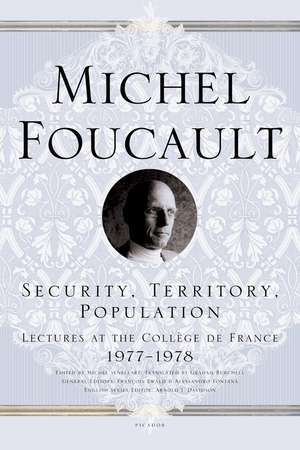
Security, Territory, Population
Autor Michel Foucault Editat de Michel Senellart, François Ewald, Alessandro Fontana, Arnold I. Davidson Traducere de Graham Burchellen Limba Engleză Paperback – 3 feb 2009
Prezentat sub forma unei culegeri de studii ce transcrie prelegerile susținute la Collège de France, Security, Territory, Population constituie un jalon fundamental în evoluția gândirii lui Michel Foucault. Putem afirma că acest volum nu este doar o simplă analiză istorică, ci reprezintă momentul în care filosoful francez își reorientează centrul de greutate al cercetării de la tehnologiile de control asupra populației — bioputerea — către o genealogie a statului modern și a „guvernamentalității”. Remarcăm rigurozitatea cu care autorul deconstruiește mecanismele de putere, făcând distincția între sistemul juridic, mecanismele disciplinare și noile aparate de securitate care au început să prindă contur odată cu emergența rațiunii de stat. Structura volumului urmărește cronologia cursurilor începând cu ianuarie 1978, debutând cu o perspectivă generală asupra bioputerii și evoluând spre studii de caz fascinante despre urbanismul secolelor XVI și XVII, precum proiectele lui Alexandre Le Maître sau planificarea orașului Nantes. Comparabil cu The Foucault Effect de Graham Burchell în ceea ce privește rigoarea analizei raționalităților guvernamentale, acest volum oferă avantajul de a fi sursa primară, prezentând conceptele în starea lor brută, în plină formare. Spre deosebire de lucrările anterioare, precum Archäologie des Wissens, unde accentul cădea pe structurile epistemice, aici Michel Foucault plasează securitatea și populația în centrul unei analize politice care va prefigura marile teme din The History of Sexuality: 1 și volumele ulterioare.
Preț: 174.49 lei
Carte disponibilă
Livrare economică 16-30 noiembrie
Specificații
ISBN-10: 0312203608
Pagini: 464
Dimensiuni: 140 x 211 x 19 mm
Greutate: 0.35 kg
Ediția:1
Editura: Picador USA
V-ar putea interesa
-
 Scientism: Prospects and ProblemsJeroen de Ridder-31%Preț: 629.37 lei906.85 lei
 -
 Pornography: A Philosophical IntroductionMari Mikkola-13%Preț: 301.32 lei346.20 lei
 -
 -12%Preț: 290.23 lei331.24 lei
 -
 Exemplars of TruthKeith Lehrer-14%Preț: 474.86 lei551.99 lei
 -
 -5%Preț: 331.86 lei351.10 lei
 -
 The Shadow of Unfairness: A Plebeian Theory of Liberal DemocracyJeffrey Edward Green-11%Preț: 268.65 lei302.22 lei
 -
 Not In Their Name: Are Citizens Culpable For Their States' Actions?Holly Lawford-Smith-12%Preț: 366.13 lei413.80 lei
 -
 The Birth of BiopoliticsMichel FoucaultPreț: 133.09 lei
 -
 Government of Self and OthersMichel FoucaultPreț: 170.40 lei
 -
 Equality and Representation: New Perspectives in Democratic TheoryAnthoula MalkopoulouPreț: 444.29 lei
 -
 Herculine BarbinMichel FoucaultPreț: 95.14 lei
 -
 History of MadnessMichel Foucault-5%Preț: 312.95 lei329.43 lei
 -
 Religion and CultureMichel FoucaultPreț: 329.97 lei
 -
 Discipline and PunishMichel FoucaultPreț: 105.22 lei
 -
 Preț: 221.03 lei
 -
 Dialogues on Ethical VegetarianismMichael Huemer-18%Preț: 1000.09 lei1219.62 lei
 -
 Courage of TruthMichel FoucaultPreț: 152.90 lei
 -
 On the Government of the LivingMichel FoucaultPreț: 157.53 lei
 -
 Penal Theories and InstitutionsMichel FoucaultPreț: 128.66 lei
 -
 Counterfactuals: Paths of the Might have BeenChristopher Prendergast-19%Preț: 185.18 lei227.67 lei
 -
 Preț: 72.29 lei
 -
 The Essential FoucaultMichel FoucaultPreț: 232.71 lei
 -
 Preț: 217.08 lei
 -
 Frantz Fanon, Psychiatry and PoliticsNigel C. Gibson-23%Preț: 288.34 lei372.94 lei
 -
 -23%Preț: 288.03 lei372.78 lei
 -
 Die Wahrheit und die juristischen FormenMichel FoucaultPreț: 119.15 lei
 -
 Schriften zur LiteraturMichael BischoffPreț: 136.10 lei
 -
 -22%Preț: 225.51 lei289.83 lei
De ce să citești această carte
Această carte este indispensabilă cercetătorilor din domeniul științelor politice, sociologiei și filosofiei care doresc să înțeleagă rădăcinile statului modern. Cititorul câștigă o perspectivă critică asupra modului în care securitatea nu este doar o măsură de protecție, ci un mecanism de guvernare a populațiilor. Este un instrument teoretic esențial pentru a descifra logica politicilor publice contemporane și a mecanismelor de control social dincolo de cadrul juridic clasic.
Despre autor
Paul-Michel Foucault (1926–1984) a fost un filosof, istoric al ideilor și teoretician social francez, a cărui operă a redefinit înțelegerea relației dintre putere și cunoaștere. Profesor la Collège de France, Foucault a explorat modul în care instituțiile sociale folosesc cunoașterea pentru a exercita controlul social, dezvoltând metode de analiză precum „arheologia” și „genealogia”. De la lucrările sale timpurii despre istoria nebuniei și a clinicii, până la monumentala serie despre istoria sexualității, gândirea sa a influențat profund discipline diverse, de la antropologie și criminologie la teoria literară, rămânând unul dintre cei mai citați intelectuali ai secolului XX.
Descriere scurtă
Notă biografică
Michel Foucault (1926-1984) was acknowledged as the preeminent philosopher of France in the 1970s and 1980s, and continues to have enormous impact throughout the world in many disciplines.
His books include The Government of Self and Others, The Courage of Truth, The Birth of Biopolitics, and The Punitive Society.
Cuprins
Introduction: Arnold I. Davidson
One: 11 January 1978
General perspective of the lectures: the study of bio-power. - Five proposals on the analysis of mechanisms of power. - Legal system, disciplinary mechanisms, and security apparatuses ( dipositifs ). Two examples: ( a ) the punishment of theft; ( b ) the treatment of leprosy, plague, and smallpox. - General features of security apparatuses ( 1 ): the spaces of security. - The example of the town. - Three examples of planning urban space in the sixteenth and seventeenth centuries: ( a ) Alexandre Le Maître's La Métrpolitée ( 1682 ): ( b ) Richelieu; ( c ) Nantes.
Two: 18 January 1978
General features of apparatuses of security ( II ): relationship to the event: the art of governing and treatment of the uncertain ( l'aléatoire ). - The problem of scarcity ( la disette ) in the seventeenth and eighteenth centuries. - From the mercantilists to the physiocrats. - Differences between apparatuses of security and disciplinary mechanisms in ways of dealing with the event. - The new governmental rationality and the emergence of "population." - Conclusion on liberalism: liberty as ideology and technique of government.
Three: 25 January 1978
General features of apparatuses of security ( III ). - Normation ( normation ) and normalization. - The example of the epidemic ( smallpox ) and inoculation campaigns in the eighteenth century. - The emergence of new notions: case, risk, danger, and crisis. - The forms of normalization in discipline and in mechanisms of security. - Deployment of a new political technology: the government of populations. - The problem of population in the mercantilists and the physiocrats. - The population as operator ( operateur ) of transformations in domains of knowledge: from the analysis of wealth to political economy, from natural history to biology, from general grammar to historical philology.
Four: 1 February 1978
The problem of "government in the sixteenth century. - Multiplicity of practices of government ( government of self, government of souls, government of children, etcetera ). - The specific problem of the government of the state. - The point of repulsion of the literature on government: Machiavelli's The Prince. - Brief history of the reception of The Prince until the nineteenth century. - The art of government distinct from the Prince's simple artfulness. - Example of this new art of government: Guillaume de la Perrière Le Miroir politique ( 1555 ). - A government that finds its end in the "things" to be directed. - Decline of law to the advantage of a variety of tactics. - The historical and institutional obstacles to the implementation of this art of government until the eighteenth century. - The problem of population an essential factor in unblocking the art of government. - The triangle formed by government, population, and political economy. - Questions of method: the project of a history of "governmentality." Overvaluation of the problem of the state.
Five: 8 February 1978
Why study governmentality? - The problem of the state and population. - Reminder of the general project: triple displacement of the analysis in relation to ( a ) the institution, ( b ) the function, and ( c ) the object. - The stake of this year's lectures. - Elements for a history of "government." Its semantic field from the thirteenth to the sixteenth century. - The idea of the government of men. Its sources : ( A ) The organization of a pastoral power in the pre-Christian and Christian East. ( B ) Spiritual direction ( direction de conscience ). - First outline of the pastorate. Its specific features: ( a ) it is exercised over a multiplicity on the move; ( b ) it is a fundamentally beneficent power with salvation of the flocks as its objective; ( c ) it is a power which individualizes. Omnes et singulatim. The paradox of the shepherd ( berger ). -The institutionalization of the pastorate by the Christian Church.
Six: 15 February 1978
Analysis of the pastorate ( continuation ). - The problem of the shepherd-flock relationship in Greek literature and thought: Homer, the Pythagorean tradition. Rareness of the shepherd metaphor in classical political literature ( Isocrates, Demosthenes ). - A major exception: Plato's The Statesman. The use of the metaphor in other Plato texts ( Critias, Laws, The Republic ). The critique of the idea of a magistrate-shepherd in The Statesman. The pastoral metaphor applied to the doctor, farmer, gymnast, and teacher. - The history of the pastorate in the West, as a model of the government of men, in inseparable from Christianity. Its transformations and crises up to the eighteenth century. Need for a history of the pastorate. - Characteristics of the "government of souls": encompassing power coextensive with the organization of the Church and distinct from political power. - The problem of the relationships between political power and pastoral power in the West. Comparison with the Russian tradition.
Seven: 22 February 1978
Analysis of the pastorate ( end ). - Specificity of the Christian pastorate in comparison with Eastern and Hebraic traditions. - An art of governing men. Its role in the history of governmentality. - Main features of the Christian pastorate from the third to the sixth century ( Saint John Chrysostom, Saint Cyprian, Saint Ambrose, Gregory the Great, Cassian, Saint Benedict ): ( 1 ) the relationship to salvation. An economy of merits and faults: ( a ) the principle of analytical responsibility; ( b ) the principle of exhaustive and instantaneous transfer; ( c ) the principle of sacrificial reversal; ( d ) the principle of alternate correspondence. ( 2 ) The relationship to the law: institution of a relationship of complete subordination of the sheep to the person who directs them. An individual and non-finalized relationship. Difference between Greek and Christian apatheia. ( 3 ) The relationship to the truth; the production of hidden truths. Pastoral teaching and spiritual direction. - Conclusion: an absolutely new form of power that marks the appearance of specific modes of individualization. Its decisive importance for the history of the subject.
Eight: 1 March 1978
The notion of "conduct." - The crisis of the pastorate. - Revolts of conduct in the field of the pastorate. - The shift of forms of resistance to the borders of political institutions in the modern age: examples of the army, secret societies, and medicine. - Problem of vocabulary: "Revolts of conduct," "insubordination" ( insoumission )," "dissidence," and "counter-conduct." Pastoral counter-conducts. Historical reminder: ( a ) asceticism; ( b ) communities; ( c ) mysticism; ( d ) Scripture; ( e ) eschatological beliefs. - Conclusion: what is at stake in the reference to the notion of "pastoral power" for an analysis of the modes of exercise of power in general.
Nine: 8 March 1978
From the pastoral of souls to the political government of men. - General context of this transformation: the crisis of the pastorate and the insurrections of conduct in the sixteenth century. The Protestant Reformation and the Counter Reformation. Other factors. - Two notable phenomena; the intensification of the religious pastorate and the increasing question of conduct, on both private and public levels. - Governmental reason specific to the exercise of sovereignty. - Comparison with Saint Thomas. - Break-up of the cosmological-theological continuum. - The question of the art of governing. - Comment on the problem of intelligibility in history. - Raison d'État ( 1 ): newness and object of scandal. - Three focal points of the polemical debate around raison d'État: Machiavelli, "politics" ( la "politique" ), and the "state."
Ten: 15 March 1978
Raison d'État ( II ): its definition and principal characteristics in the seventeenth century. - The new model of historical temporality entailed by raison d'État. - Specific features of raison d'État with regard to pastoral government: ( 1 ) The problem of salvation: the theory of coup d'État ( Naudé ). Necessity, violence, theatricality. - ( 2 ) The problem of obedience. Bacon: the question of sedition. Differences between Bacon and Machiavelli. - ( 3 ) The problem of truth: from the wisdom of the prince to knowledge of the state. Birth of statistics. The problem of the secret. - The reflexive prism in which the problem of the state appeared. - Presence-absence of "population" in this new problematic.
Eleven: 22 March 1978
Raison d'État ( III ). - The state as principle of intelligibility and as objective. - The functioning of this governmental reason: ( A ) In theoretical texts. The theory of the preservation of the state. ( B ) In political practice. Competition between states. - The Treaty of Westphalia and the end of the Roman Empire. - Force, a new element of political reason. - Politics and the dynamic of forces. - The first technological ensemble typical of this new art of government: the diplomatic-military system. - Its objective: the search for a European balance. What is Europe? The idea of "balance." - Its instruments: ( 1 ) war; ( 2 ) diplomacy; ( 3 ) the installation of a permanent military apparatus ( dispositif ).
Twelve: 29 March 1978
The second technological assemblage characteristic of the new art of government according to raison d'État: police. Traditional meanings of the word up to the sixteenth century. Its new sense in the seventeenth and eighteenth centuries: calculation and technique making possible the good sue of the state's forces. - The triple relationship between the system of European balance and police. - Diversity of Italian, German, and French situations. - Turquet de Mayerne, La Monarchie aristodémocratique. - The control of human activity as constitutive element of the force of the state. - Objects of police: ( 1 ) the number of citizens; ( 2 ) the necessities of life; ( 3 ) health; ( 4 ) occupations; ( 5 ) the coexistence and circulation of men. - Police as the art of managing life and the well-being of populations.
Thirteen: 5 April 1978
Police ( continuation ). - Delamare. - The town as site for the development of police. Police and urban regulation. Urbanization of the territory. Relationship between police and the mercantilist problematic. - Emergence of the market town. - Methods of police. Difference between police and justice. An essentially regulatory type of power. Regulation and discipline. - Return to the problem of grain. - Criticism of the police state on the basis of the problem of scarcity. - The theses of the économistes. - The transformations of raison d'État: ( 1 ) the naturalness of society; ( 2 ) new relationships between power and knowledge; ( 3 ) taking charge of the population ( public hygiene, demography, etc. ); ( 4 ) new forms of state intervention; ( 5 ) the status of liberty. - Elements of the new art of government: economic practice, management of the population, law and respect for liberties, police with a repressive function. - Different forms of counter-conduct relative to this governmentality. - General conclusion.
Course Summary
Course Context
Index of Names
Subject Index