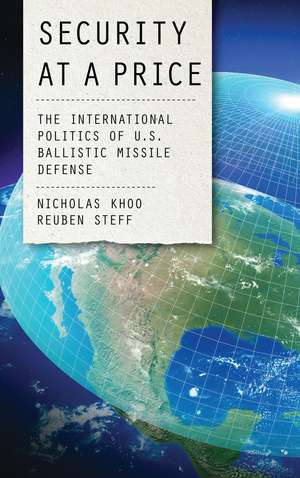
Security at a Price: The International Politics of U.S. Ballistic Missile Defense: Weapons of Mass Destruction and Emerging Technologies
Autor Nicholas Khoo, Reuben Steffen Limba Engleză Hardback – 26 oct 2017




Preț: 503.92 lei
Preț vechi: 721.00 lei
-30%
Puncte Express: 756
Carte tipărită la comandă
Livrare economică 08-22 decembrie
Livrare prin curier în România Termenul estimat este afișat lângă disponibilitate.
Transport gratuit pentru acest produs Plată online sau ramburs, în funcție de opțiunile comenzii.
Retur gratuit în 14 zile Comandă securizată și suport în română.
Specificații
ISBN-13: 9781442254572
ISBN-10: 1442254572
Pagini: 174
Ilustrații: 2 Graphs
Dimensiuni: 158 x 239 x 19 mm
Greutate: 0.44 kg
Editura: Bloomsbury Publishing
Colecția Rowman & Littlefield
Seria Weapons of Mass Destruction and Emerging Technologies
Locul publicării:New York, United States
ISBN-10: 1442254572
Pagini: 174
Ilustrații: 2 Graphs
Dimensiuni: 158 x 239 x 19 mm
Greutate: 0.44 kg
Editura: Bloomsbury Publishing
Colecția Rowman & Littlefield
Seria Weapons of Mass Destruction and Emerging Technologies
Locul publicării:New York, United States
Cuprins
Chapter 1. Missile Defense Politics: Unipolarity, the Security Dilemma and the Balancing Debate
Chapter 2. Russia and Lavrov's "Law of Politics"
Chapter 3. China and the Nuclear Politics of Power Transition
Chapter 4. Iran's Response to Missile Defense
Chapter 5. North Korea's Nuclear Quest
Chapter 6. U.S. Missile Defense: Security at a Price
Chapter 2. Russia and Lavrov's "Law of Politics"
Chapter 3. China and the Nuclear Politics of Power Transition
Chapter 4. Iran's Response to Missile Defense
Chapter 5. North Korea's Nuclear Quest
Chapter 6. U.S. Missile Defense: Security at a Price
Recenzii
A thoughtful and thought-provoking book by two leading thinkers on the topic. Ballistic missile defence is here to stay and it is imperative that we fully think through its strategic implications and how some of the programme's most destabilising effects can be mitigated and managed.
The issue of ballistic missile defence is permeating deeper into the security culture and force posture of an expanding group of states. These authors have constructed a remarkably readable account of this intriguing story. Don't have a lot of time but need to catch up with what has happened to BMD since Ronald Reagan and Star Wars? Look no further.
The appeal of missile defense is built on its promise to do away with the vulnerability of mutual deterrence and tilt the existing balance of power. However, as the authors of this study show, this quest for invulnerability comes with a price. Other states adjust to restore the balance and deny the gains that missile defense seems to offer.
This is an insightful and well-researched study of the self-defeating nature of the US obsession with missile defense. As the late Kenneth Waltz warned, states' unilateral quest for superiority triggers counterbalancing by others. Rising threats posed by China's nuclear modernization and North Korea's nuclear ambition are good examples of how missile defense results in less security for the US.
The issue of ballistic missile defence is permeating deeper into the security culture and force posture of an expanding group of states. These authors have constructed a remarkably readable account of this intriguing story. Don't have a lot of time but need to catch up with what has happened to BMD since Ronald Reagan and Star Wars? Look no further.
The appeal of missile defense is built on its promise to do away with the vulnerability of mutual deterrence and tilt the existing balance of power. However, as the authors of this study show, this quest for invulnerability comes with a price. Other states adjust to restore the balance and deny the gains that missile defense seems to offer.
This is an insightful and well-researched study of the self-defeating nature of the US obsession with missile defense. As the late Kenneth Waltz warned, states' unilateral quest for superiority triggers counterbalancing by others. Rising threats posed by China's nuclear modernization and North Korea's nuclear ambition are good examples of how missile defense results in less security for the US.