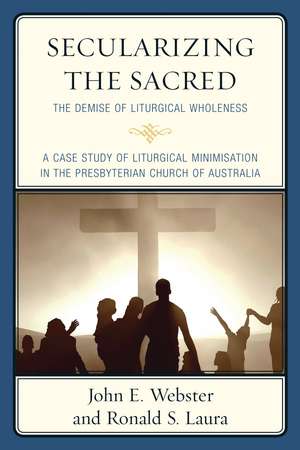
Secularizing the Sacred: The Demise of Liturgical Wholeness
Autor John E. Webster, Ronald S. Lauraen Limba Engleză Paperback – 26 apr 2016
The authors show how the theological predilection for 'minimization' has become inextricably woven into the fabric of what we call 'the theory of transformative subjugation' which drives the rationale for religious secularization. The book argues that it is necessary to consider a serious reconstruction of theological education in which its framework is located in a specific Christian theory of knowledge which engenders the Lordship of Christ and encourages a spirit of transformative love and connectedness. It is only in this context that the theology of worship and the beauty and usefulness of liturgical forms can be appreciated.
Preț: 255.93 lei
Puncte Express: 384
Carte tipărită la comandă
Livrare economică 09-23 noiembrie
Livrare prin curier în România Termenul estimat este afișat lângă disponibilitate.
Transport gratuit de la 400.00 lei Plată online sau ramburs, în funcție de opțiunile comenzii.
Retur gratuit în 14 zile Comandă securizată și suport în română.
Specificații
ISBN-13: 9780761867616
ISBN-10: 0761867619
Pagini: 226
Ilustrații: 5 tables
Dimensiuni: 152 x 229 x 17 mm
Greutate: 0.32 kg
Editura: Bloomsbury Publishing
Colecția University Press of America
Locul publicării:New York, United States
ISBN-10: 0761867619
Pagini: 226
Ilustrații: 5 tables
Dimensiuni: 152 x 229 x 17 mm
Greutate: 0.32 kg
Editura: Bloomsbury Publishing
Colecția University Press of America
Locul publicării:New York, United States
V-ar putea interesa
-
 Velvet ElvisRob BellPreț: 77.28 lei
 -
 Scripture and the Authority of GodN T WrightPreț: 99.67 lei
 -
 -31%Preț: 1026.52 lei1494.02 lei
 -
 CBFEAlister McgrathPreț: 86.87 lei
 -
 Immortal DiamondRichard RohrPreț: 99.08 lei
 -
 A Silent ActionRowan WilliamsPreț: 90.85 lei
 -
 Preț: 81.19 lei
 -
 UnapologeticFrancis SpuffordPreț: 91.11 lei
 -
 Rice's Church PrimerMatthew Rice-26%Preț: 101.52 lei136.62 lei
 -
 I Am a Church MemberThom S RainerPreț: 79.20 lei
Cuprins
Introduction
Chapter 1 Socio-political Pattern in Early Presbyterianism in New South Wales
Chapter 2 Defining the Practice of Worship in the Presbyterian Church
Chapter 3 The Climax of Calvinist Liturgical Development in New South Wales
Chapter 4 A Brief History of the Theological Aetiology of Liturgical Minimisation
Chapter 5 Minimisation since 1977 in the Presbyterian Church of Australia
Chapter 6 Towards an Epistemology of Worship
Chapter 7 Towards a Reconstruction of Theological Education
Conclusion
Bibliography
About the Authors
Chapter 1 Socio-political Pattern in Early Presbyterianism in New South Wales
Chapter 2 Defining the Practice of Worship in the Presbyterian Church
Chapter 3 The Climax of Calvinist Liturgical Development in New South Wales
Chapter 4 A Brief History of the Theological Aetiology of Liturgical Minimisation
Chapter 5 Minimisation since 1977 in the Presbyterian Church of Australia
Chapter 6 Towards an Epistemology of Worship
Chapter 7 Towards a Reconstruction of Theological Education
Conclusion
Bibliography
About the Authors
Recenzii
It is indeed a great attempt to argue that the epistemology of worship should be grounded not on the model of power and control, but on the model of love and connectedness. The role of theological education is to educate the sense of interconnections with God and nature, the sense of feelings, caring and love and love for humanity. These are the foundational issues needed to be addressed by modern educators. On the whole, the author has done a thorough research, both on the historical understanding of the liturgical minimization process and the discussion of the related theologies and educational theories underlying the issues.
Well argued and rigorously presented outline of how the foundational elements present in the theological thought and liturgical expression of Calvin has been supplanted by a Zwinglian trend that has become the overarching force in Presbyterianism in New South Wales. This carefully orchestrated and politically engineered reshaping of the epistemology from primary virtues of love and connectedness to a technological, mechanical view based on power and control is forcefully documented.
I was ordained as an Elder of the Presbyterian Church in 1985, after decades in the Methodist tradition, and have been deeply concerned by the progressive minimisation of the liturgical heritage of the Church described and analysed so brilliantly by the authors. I embraced the explicit symbolism and liturgy of my new Church from 1977, which deepened my spiritual understanding and was a defining moment in my Christian journey. I was impressed by the theological application of transformative subjugation and the notion of power and control. The authors insistence on the development of a specific Christian epistemology is critically important and a paradynamic shift which will impact on theological education for decades to come. The profound influence of Scottish Presbyterianism on the development of my own Sydney medical school, and of the current downgrading of the importance of many of their Christian traditions, hallmarks of the school, provide uncomfortable parallels to this narrative. I would commend this book wholeheartedly to anyone who values the legacy of the Church, and can think laterally to the implications for other disciplines facing similar challenges.
This work is important because the writer indicates that there is little or no formal attention played to the subject of worship within the Australian Church and this is particularly the case in the Presbyterian tradition. This work therefore fills a gap in the historical literature.
Well argued and rigorously presented outline of how the foundational elements present in the theological thought and liturgical expression of Calvin has been supplanted by a Zwinglian trend that has become the overarching force in Presbyterianism in New South Wales. This carefully orchestrated and politically engineered reshaping of the epistemology from primary virtues of love and connectedness to a technological, mechanical view based on power and control is forcefully documented.
I was ordained as an Elder of the Presbyterian Church in 1985, after decades in the Methodist tradition, and have been deeply concerned by the progressive minimisation of the liturgical heritage of the Church described and analysed so brilliantly by the authors. I embraced the explicit symbolism and liturgy of my new Church from 1977, which deepened my spiritual understanding and was a defining moment in my Christian journey. I was impressed by the theological application of transformative subjugation and the notion of power and control. The authors insistence on the development of a specific Christian epistemology is critically important and a paradynamic shift which will impact on theological education for decades to come. The profound influence of Scottish Presbyterianism on the development of my own Sydney medical school, and of the current downgrading of the importance of many of their Christian traditions, hallmarks of the school, provide uncomfortable parallels to this narrative. I would commend this book wholeheartedly to anyone who values the legacy of the Church, and can think laterally to the implications for other disciplines facing similar challenges.
This work is important because the writer indicates that there is little or no formal attention played to the subject of worship within the Australian Church and this is particularly the case in the Presbyterian tradition. This work therefore fills a gap in the historical literature.