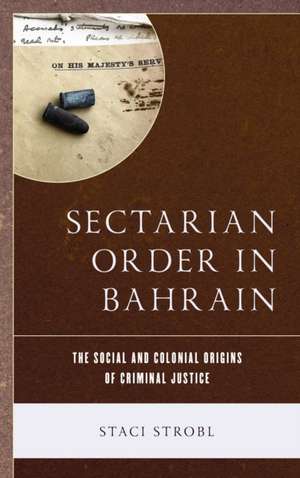
Sectarian Order in Bahrain: The Social and Colonial Origins of Criminal Justice
Autor Staci Stroblen Limba Engleză Hardback – 15 sep 2018
Preț: 549.22 lei
Preț vechi: 819.06 lei
-33%
Puncte Express: 824
Carte tipărită la comandă
Livrare economică 16-30 noiembrie
Livrare prin curier în România Termenul estimat este afișat lângă disponibilitate.
Transport gratuit pentru acest produs Plată online sau ramburs, în funcție de opțiunile comenzii.
Retur gratuit în 14 zile Comandă securizată și suport în română.
Specificații
ISBN-13: 9781498541602
ISBN-10: 1498541607
Pagini: 192
Ilustrații: 2 Tables
Dimensiuni: 158 x 230 x 22 mm
Greutate: 0.6 kg
Editura: Bloomsbury Publishing
Colecția Lexington Books
Locul publicării:New York, United States
ISBN-10: 1498541607
Pagini: 192
Ilustrații: 2 Tables
Dimensiuni: 158 x 230 x 22 mm
Greutate: 0.6 kg
Editura: Bloomsbury Publishing
Colecția Lexington Books
Locul publicării:New York, United States
Cuprins
Chapter 1: Land and Sea: The Two Historical Disruptions and Sectarian Order Maintenance
Chapter 2: Shooting at the Sheikh: The Criminalization of Tribal Rivalry
Chapter 3: "You Brother of a Prostitute": Honor, Insults, and Crime
Chapter 4: Sectarian Tashwish: Anti- Shi`a Violence and Sunni-Dominated Policing
Chapter 5: "Mad, No House, No Money": Sect-Based Citizenship and Crime
Chapter 2: Shooting at the Sheikh: The Criminalization of Tribal Rivalry
Chapter 3: "You Brother of a Prostitute": Honor, Insults, and Crime
Chapter 4: Sectarian Tashwish: Anti- Shi`a Violence and Sunni-Dominated Policing
Chapter 5: "Mad, No House, No Money": Sect-Based Citizenship and Crime
Recenzii
The book by Staci Strobl builds on an untapped archival cache of colonial criminal court cases in the British Library, which shed light on the birth of the Bahraini criminal justice system under the aegis of British colonial authorities. . . . Documenting a particularly important historical period, this book helps readers to better understand important current issues of Bahraini politics, in particular the state of intra-dynastic factional balances, the situation of the stateless people (bidun) and the structure of the security apparatus.
Sectarian Order in Bahrain is an innovative contribution to the literature on Gulf politics and the sociology of policing. Weaving together scrupulous historical research, ethnographic fieldwork, and theories of criminology, Staci Strobl traces the roots of contemporary sectarian discrimination in Bahrain to the practices and narratives of British colonial administration. This is a work of great empathy and authority that will interest scholars of the Gulf as well as anyone studying the intersection of identity, history, and social justice.
Sectarian Order in Bahrain is a fascinating book that investigates the history of criminal justice of a former British colony. Drawing on extensive primary and secondary sources the book illustrates how the colonial criminal justice system institutionalized Sunni hegemony while discriminating against Shi'a population of Bahrain by de-legitimizing tribal systems of authority and social control. This meticulously researched book adds to a growing innovative body of new studies drawing inspiration from southern and cultural criminology and theories of post-colonialism. The book should appeal to a wide readership across the social sciences - history, sociology, criminology, anthropology and religious studies.
Empirically rich and conceptually original, Staci Strobl's fascinating book traverses several academic disciplines to shed light on the historical experience that has shaped sectarian relations in modern Bahrain. Combining criminology, ethnography, historical sociology and postcolonial theory, Strobl unpacks the social and political construction (and reproduction) of modern sectarian categories and hierarchies in Bahrain as evidenced through the criminal justice system. In addition to its contribution to criminology and history, this book is a valuable contribution to the study of sectarian relations. Going beyond the bland instrumentalism and stultifying binaries that dominate the literature, Strobl illuminates how sectarian identities are socially and politically perceived, used and experienced by Bahrainis today. This she achieves with a fascinating ethnographic and historic examination of Bahrain's criminal justice system, its colonial history and its nation/state-building efforts and how these have cast a heavy shadow on sectarian identity and sectarian relations today.
This detailed historical study shows how the rise of political sectarianism is deeply intertwined with the growth of the modern state apparatus, in particular with the criminal justice system. The book makes a real contribution to scholarship of the British Empire, the Gulf States, and Sunni-Shii relations.
Sectarian Order in Bahrain is an innovative contribution to the literature on Gulf politics and the sociology of policing. Weaving together scrupulous historical research, ethnographic fieldwork, and theories of criminology, Staci Strobl traces the roots of contemporary sectarian discrimination in Bahrain to the practices and narratives of British colonial administration. This is a work of great empathy and authority that will interest scholars of the Gulf as well as anyone studying the intersection of identity, history, and social justice.
Sectarian Order in Bahrain is a fascinating book that investigates the history of criminal justice of a former British colony. Drawing on extensive primary and secondary sources the book illustrates how the colonial criminal justice system institutionalized Sunni hegemony while discriminating against Shi'a population of Bahrain by de-legitimizing tribal systems of authority and social control. This meticulously researched book adds to a growing innovative body of new studies drawing inspiration from southern and cultural criminology and theories of post-colonialism. The book should appeal to a wide readership across the social sciences - history, sociology, criminology, anthropology and religious studies.
Empirically rich and conceptually original, Staci Strobl's fascinating book traverses several academic disciplines to shed light on the historical experience that has shaped sectarian relations in modern Bahrain. Combining criminology, ethnography, historical sociology and postcolonial theory, Strobl unpacks the social and political construction (and reproduction) of modern sectarian categories and hierarchies in Bahrain as evidenced through the criminal justice system. In addition to its contribution to criminology and history, this book is a valuable contribution to the study of sectarian relations. Going beyond the bland instrumentalism and stultifying binaries that dominate the literature, Strobl illuminates how sectarian identities are socially and politically perceived, used and experienced by Bahrainis today. This she achieves with a fascinating ethnographic and historic examination of Bahrain's criminal justice system, its colonial history and its nation/state-building efforts and how these have cast a heavy shadow on sectarian identity and sectarian relations today.
This detailed historical study shows how the rise of political sectarianism is deeply intertwined with the growth of the modern state apparatus, in particular with the criminal justice system. The book makes a real contribution to scholarship of the British Empire, the Gulf States, and Sunni-Shii relations.