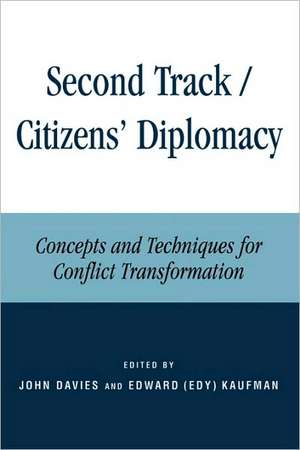
Second Track Citizens' Diplomacy: Concepts and Techniques for Conflict Transformation
Editat de John L. Davies, Edward (Edy) Kaufman Contribuţii de Edward Azar, Eileen R. Borris, Ronald J. Fisher, Victor J. Friedman, Ted Robert Gurr, Herbert C. Kelman, Ambassador John W. McDonald, Christopher Moore, Jay Rothman, Andrea L. Strimling, Peter Woodrowen Limba Engleză Paperback – 6 mai 2003
In this volume, prominent contributors explain the development, theory and current practice of second track diplomacy. They examine the dynamics of modern complex conflicts, such as those in Sri Lanka, Israel/Palestine, Cyprus, or the Caucasus. Exploring innovative problem-solving methodologies, the book provides a detailed program for guiding "Partners in Conflict" in the search for common ground and analyzes core issues that arise in the practice and evaluation of second track diplomacy. This book will be valuable to both academics and professionals involved in first or second track diplomacy, or interested in integrative methods of dispute resolution or conflict prevention, as well as to those working in development, peace-building or humanitarian programs at any phase of the conflict cycle.
Preț: 351.69 lei
Preț vechi: 509.17 lei
-31%
Puncte Express: 528
Carte tipărită la comandă
Livrare economică 30 noiembrie-14 decembrie
Livrare prin curier în România Termenul estimat este afișat lângă disponibilitate.
Transport gratuit de la 400.00 lei Plată online sau ramburs, în funcție de opțiunile comenzii.
Retur gratuit în 14 zile Comandă securizată și suport în română.
Specificații
ISBN-13: 9780847695522
ISBN-10: 0847695522
Pagini: 328
Dimensiuni: 151 x 230 x 25 mm
Greutate: 0.5 kg
Ediția:Revised
Editura: Bloomsbury Publishing
Colecția Rowman & Littlefield
Locul publicării:New York, United States
ISBN-10: 0847695522
Pagini: 328
Dimensiuni: 151 x 230 x 25 mm
Greutate: 0.5 kg
Ediția:Revised
Editura: Bloomsbury Publishing
Colecția Rowman & Littlefield
Locul publicării:New York, United States
V-ar putea interesa
-
 China and Japan: History, Trends, and ProspectsChristopher Howe-29%Preț: 383.87 lei537.13 lei
 -
 The Third World Beyond the Cold War: Continuity and ChangeLouise Fawcett-28%Preț: 406.14 lei566.47 lei
 -
 The State of the European Union: Risks, Reform, Resistance, and RevivalMaria Green Cowles-21%Preț: 368.49 lei468.86 lei
 -
 The General Principles of EU LawTakis Tridimas-31%Preț: 687.52 lei989.78 lei
 -
 Accountability in the European UnionCarol Harlow-23%Preț: 391.90 lei506.89 lei
 -
 -19%Preț: 360.22 lei445.70 lei
 -
 -19%Preț: 330.59 lei408.55 lei
 -
 International Society and its CriticsAlex J. Bellamy-28%Preț: 394.67 lei548.88 lei
 -
 Between Europe and America: The Future of British PoliticsProfessor Andrew GamblePreț: 321.35 lei
 -
 Taming American PowerStephen M. WaltPreț: 146.44 lei
 -
 The Middle East in International RelationsFred HallidayPreț: 287.68 lei
 -
 America AloneStefan HalperPreț: 290.15 lei
 -
 Devil's GameRobert Dreyfuss-16%Preț: 142.45 lei169.70 lei
 -
 Preț: 120.16 lei
 -
 Key Concepts in International RelationsThomas DiezPreț: 394.84 lei
 -
 No-Nonsense Guide To TourismPamela Nowicka-31%Preț: 38.44 lei55.38 lei
Cuprins
Chapter 1 Second Track Diplomacy: An Overview
Part 2 Part I: Conflict Dynamics and the Evolution of Second Track Diplomacy
Chapter 3 Protracted Social Conflicts and Second Track Diplomacy
Chapter 4 Dynamics and Management of Ethnopolitical Conflicts
Chapter 5 The Need for Multi-Track Diplomacy
Chapter 6 Historical Mapping of the Field of Interactive Conflict Resolution
Part 7 Part II: Strategies for Conflict Transformation and Peace Building
Chapter 8 Interactive Problem Solving as a Tool for Second Track Diplomacy
Chapter 9 Power, Rights, Interests, and Identity: Conflict Management Strategies for Building a Democratic Peace
Chapter 10 Mapping Cultures: Strategies for Effective Intercultural Conflict Resolution
Chapter 11 Reconciliation in Post-Conflict Peace Building: Lessons Learned from South Africa
Part 12 Part III: The Innovative Problem Solving Workshop
Chapter 13 Sharing the Experience of Citizens' Diplomacy with Partners in Conflict
Chapter 14 Toward Innovative Solutions
Part 15 Part IV: Capacity Building and Action Evaluation
Chapter 16 Building Capacity for JustPeace: Design, Implementation and Evaluation of Training Programs
Chapter 17 Action Evaluation for Conflict Management Organizations and Projects
Chapter 18 References
Part 2 Part I: Conflict Dynamics and the Evolution of Second Track Diplomacy
Chapter 3 Protracted Social Conflicts and Second Track Diplomacy
Chapter 4 Dynamics and Management of Ethnopolitical Conflicts
Chapter 5 The Need for Multi-Track Diplomacy
Chapter 6 Historical Mapping of the Field of Interactive Conflict Resolution
Part 7 Part II: Strategies for Conflict Transformation and Peace Building
Chapter 8 Interactive Problem Solving as a Tool for Second Track Diplomacy
Chapter 9 Power, Rights, Interests, and Identity: Conflict Management Strategies for Building a Democratic Peace
Chapter 10 Mapping Cultures: Strategies for Effective Intercultural Conflict Resolution
Chapter 11 Reconciliation in Post-Conflict Peace Building: Lessons Learned from South Africa
Part 12 Part III: The Innovative Problem Solving Workshop
Chapter 13 Sharing the Experience of Citizens' Diplomacy with Partners in Conflict
Chapter 14 Toward Innovative Solutions
Part 15 Part IV: Capacity Building and Action Evaluation
Chapter 16 Building Capacity for JustPeace: Design, Implementation and Evaluation of Training Programs
Chapter 17 Action Evaluation for Conflict Management Organizations and Projects
Chapter 18 References
Recenzii
This book makes evident the growing contributions and the potentiality for even greater contributions of nonofficial meetings and exchanges in overcoming destructive conflicts in the contemporary world. The authors are distinguished practitioners and analysts doing significant work in this vital field.
Despite hopes that the twenty-first century would be the age of maturity and peace, events since September 11, 2001, indicate that many political leaders and nonstate actors have been seduced by the power of violence. This book is an excellent antidote to those who think that force is the best or only way of dealing with complex intractable conflicts. It is an excellent guide to the theoretical underpinnings, development, and practical uses of track-two diplomacy. These track-two initiatives play critical roles in the management and transformation of complex conflicts. The book provides scholars and practitioners with a rich resource of theoretical and practical examples of ways in which civil society actors can play more central roles in the delicate art of peacebuilding around the world. I strongly recommend it to anyone seeking more enlightened paths to peace than those currently being pursued in the Middle East and elsewhere.
In recent years, conflicts, especially in the developing world, have resulted in untold suffering of innocent civilians. Teaching and research in conflict analysis, management, and prevention are especially needed. This book is a very useful addition to the field, for scholars and practitioners alike. It provides a firm foundation in the theories of conflict resolution, as well as practical approaches to peacemaking and peacebuilding. The contributions are from both scholars and professionals with practical experience, and the book should be a 'must-read' for anybody who wants to gain insight into the field or who is interested in its applications to real-life situations. I would strongly recommend the book to anyone interested in conflict management.
Second-track diplomacy is worthy of attention, and so is this book. . . . Scholars and practitioners interested in approaches to peace will find much in it that is useful, some that is thought-provoking. A few, perhaps, will find it an incitement.
I find this book a valuable resource for those of us teaching, researching, and/or working to transform conflicts both in and outside the so-called Western world. It offers powerful conceptual and theoretical frameworks for conflict analysis, as well as an abundance of practical, proven tools for empowering people to deal with complex, protracted conflicts. The authors, an impressive array featuring a welcome mix of top academic scholarship and hands-on experience, incite us to share the challenge of thinking about conflict management within and across different cultural settings.
Despite hopes that the twenty-first century would be the age of maturity and peace, events since September 11, 2001, indicate that many political leaders and nonstate actors have been seduced by the power of violence. This book is an excellent antidote to those who think that force is the best or only way of dealing with complex intractable conflicts. It is an excellent guide to the theoretical underpinnings, development, and practical uses of track-two diplomacy. These track-two initiatives play critical roles in the management and transformation of complex conflicts. The book provides scholars and practitioners with a rich resource of theoretical and practical examples of ways in which civil society actors can play more central roles in the delicate art of peacebuilding around the world. I strongly recommend it to anyone seeking more enlightened paths to peace than those currently being pursued in the Middle East and elsewhere.
In recent years, conflicts, especially in the developing world, have resulted in untold suffering of innocent civilians. Teaching and research in conflict analysis, management, and prevention are especially needed. This book is a very useful addition to the field, for scholars and practitioners alike. It provides a firm foundation in the theories of conflict resolution, as well as practical approaches to peacemaking and peacebuilding. The contributions are from both scholars and professionals with practical experience, and the book should be a 'must-read' for anybody who wants to gain insight into the field or who is interested in its applications to real-life situations. I would strongly recommend the book to anyone interested in conflict management.
Second-track diplomacy is worthy of attention, and so is this book. . . . Scholars and practitioners interested in approaches to peace will find much in it that is useful, some that is thought-provoking. A few, perhaps, will find it an incitement.
I find this book a valuable resource for those of us teaching, researching, and/or working to transform conflicts both in and outside the so-called Western world. It offers powerful conceptual and theoretical frameworks for conflict analysis, as well as an abundance of practical, proven tools for empowering people to deal with complex, protracted conflicts. The authors, an impressive array featuring a welcome mix of top academic scholarship and hands-on experience, incite us to share the challenge of thinking about conflict management within and across different cultural settings.