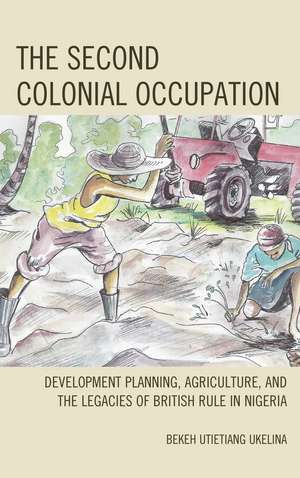
The Second Colonial Occupation: Development Planning, Agriculture, and the Legacies of British Rule in Nigeria
Autor Bekeh Utietiang Ukelinaen Limba Engleză Hardback – 28 iul 2017
Ukelina outlines the processes that led to the 1945 Nigerian Development Plan and the evolution of colonial agricultural policy and practices in Nigeria. He argues that a few key factors led to the failure of development in the late colonial period: the imperial and neocolonial imperative to exploit African resources and people, poor planning as a result of this imperative, and the racial ideologies of the colonial state that resulted in a total rejection of local African experience and knowledge in favor of Western 'experts.'
The Second Colonial Occupation uncovers and analyzes the short and long term impact of colonialism. It reveals that though colonial rule was promoted as a benevolent mission, at heart, it was a system that guaranteed that Africans continuously paid for their own exploitation. Ukelina argues that 'postcolonial' Africa will continue to face development challenges unless it breaks free from the intellectual relics of colonial rule and the economic shackles of neocolonialism.
Preț: 553.72 lei
Preț vechi: 836.60 lei
-34%
Puncte Express: 831
Preț estimativ în valută:
97.100€ • 114.53$ • 85.08£
97.100€ • 114.53$ • 85.08£
Carte tipărită la comandă
Livrare economică 20 februarie-06 martie
Preluare comenzi: 021 569.72.76
Specificații
ISBN-13: 9781498529242
ISBN-10: 1498529240
Pagini: 246
Dimensiuni: 154 x 232 x 20 mm
Greutate: 0.5 kg
Editura: Bloomsbury Publishing
Colecția Lexington Books
Locul publicării:New York, United States
ISBN-10: 1498529240
Pagini: 246
Dimensiuni: 154 x 232 x 20 mm
Greutate: 0.5 kg
Editura: Bloomsbury Publishing
Colecția Lexington Books
Locul publicării:New York, United States
Cuprins
Chapter 1: Joseph Chamberlain, Constructive Imperialism, and Colonial Development
Chapter 2: Negotiating Development: Nigeria's 1945 Development Plan
Chapter 3: The Agrarian Bias: Mackiean Policy of Agricultural Development in Nigeria
Chapter 4: Late Colonial Agricultural Development: The Mokwa Scheme
Chapter 5: The Legacies of British Rule in Nigeria
Chapter 2: Negotiating Development: Nigeria's 1945 Development Plan
Chapter 3: The Agrarian Bias: Mackiean Policy of Agricultural Development in Nigeria
Chapter 4: Late Colonial Agricultural Development: The Mokwa Scheme
Chapter 5: The Legacies of British Rule in Nigeria
Recenzii
In this well-researched, well-written, and fascinating study, the author provides us with valuable and penetrating insights into the nature and practice of British imperialism in Africa, focusing especially on the nuts and bolts of development planning, the centrality of agriculture to the colonial economy, and the clash and ultimate failures of development ideologies in Africa during the late colonial period. Using Africa's most populous nation, Nigeria, as a case study, the book rejects the conventional explanations, by scholars, that are focused on implementation. A product of careful archival research and nuanced analyses, this is a new and refreshing perspective on the failure of development plans in colonial Africa and a major contribution to our understanding of the successes and failures of British imperialism in Africa.
Why did late-colonial development policy not develop Africa? Why does Africa today remain, in general, the supplier of primary products both vegetable and mineral to the industrialized world? In this impeccably researched, lucidly written study, Ukelina's answer ranges from village politics in southern Nigeria to the Colonial Office in London and, more recently, the World Bank. But he also makes room for real people on the ground, some of them local heroes: political officers, agricultural experts, and 'native authorities', each competing for authority on shoe-string budgets and on programs that aimed to enlarge production within existing export economies, subject to the world's unstable terms of trade, rather than to transform them by diversification.
Why did late-colonial development policy not develop Africa? Why does Africa today remain, in general, the supplier of primary products both vegetable and mineral to the industrialized world? In this impeccably researched, lucidly written study, Ukelina's answer ranges from village politics in southern Nigeria to the Colonial Office in London and, more recently, the World Bank. But he also makes room for real people on the ground, some of them local heroes: political officers, agricultural experts, and 'native authorities', each competing for authority on shoe-string budgets and on programs that aimed to enlarge production within existing export economies, subject to the world's unstable terms of trade, rather than to transform them by diversification.