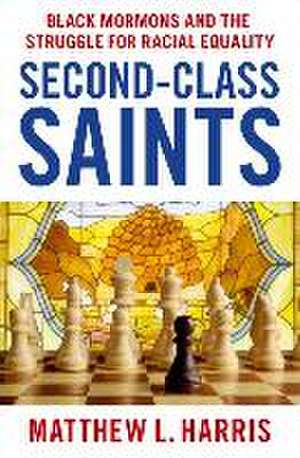
Second-Class Saints: Black Mormons and the Struggle for Racial Equality
Autor Matthew L. Harrisen Limba Engleză Hardback – 9 ian 2025
Preț: 270.85 lei
Preț vechi: 298.55 lei
-9%
Puncte Express: 406
Carte disponibilă
Livrare economică 19-24 noiembrie
Livrare prin curier în România Termenul estimat este afișat lângă disponibilitate.
Transport gratuit de la 400.00 lei Plată online sau ramburs, în funcție de opțiunile comenzii.
Retur gratuit în 14 zile Comandă securizată și suport în română.
Specificații
ISBN-13: 9780197695715
ISBN-10: 019769571X
Pagini: 488
Ilustrații: 26 photos
Dimensiuni: 163 x 236 x 36 mm
Greutate: 0.86 kg
Editura: Oxford University Press
Colecția OUP USA
Locul publicării:New York, United States
ISBN-10: 019769571X
Pagini: 488
Ilustrații: 26 photos
Dimensiuni: 163 x 236 x 36 mm
Greutate: 0.86 kg
Editura: Oxford University Press
Colecția OUP USA
Locul publicării:New York, United States
Recenzii
A nuanced account of the Mormon church's uneven progress toward social justice.
Second-Class Saints is a tour de force of historical research. It would be hard for me to overstate the importance of this book as well as my admiration for it.
This striking book deals with arguably the Mormon church's most challenging, enduring, and thorniest social and religious issue. Harris is superb at showcasing Black Mormons' efforts to overcome LDS leaders' bigotry. Second-Class Saints is a must-read for anyone hoping to increase their understanding of how the Mormon faith has produced dubious racial theories as well as Black Mormons' ongoing struggle for racial equity.
Offering fresh insights and drawing on untapped sources, Second-Class Saints provides an Unprecedented peek behind Mormonism's administrative curtain. Readers will discover New and sometimes painful stories that help to explain the faith's ongoing struggle to Transcend its racial past.
This painstakingly researched book tells the heart-rending history of Mormonism's race-based Priesthood and temple restrictions. In tracking the conflicts, constraints, and contingencies, The politics, pretexts, and planning, and the human actors who struggled for and against a more inclusive theology and church organization, Harris creates a powerful narrative - one that opens possibilities for healing in the present.
Second-Class Saints is a masterful exploration of the Black struggle for racial equality within The LDS Church. Harris dissects the entrenched history of documented white supremacy Among church leadership and its theology, revealing a compelling, yet often overlooked, Chapter of religious history.
Second-Class Saints by Matthew Harris should, if grappled with appropriately, force a reckoning... It will be impossible for anyone who reads it to be unaffected by what it clearly and irrefutably shows about the history of the priesthood and temple ban.
A remarkable new book -- one of the best I've read in a long time.
A gripping, and often heartbreaking, read.
Harris has written the best and most digestible history of the debates and decisions that culminated in the end of the Latter-day Saint racial restriction. Any future histories on the topic will stand on Harris's shoulders.
This story will be riveting to New Mormon historians-itswealth of juicy detail will appeal as much as its argument. Harris has transformed a story of procedures into a story about people, and every bit of it illuminates the largely unspoken theoretical question of the definition of race, and its service as a theological, biological, or social category.
It is both well-researched and well-written. Readers will be richly rewarded for engaging with it.
This is an excellent model for appropriate social history: extensively researched and documented, fairly interpreted, well written. Although not a general work on the topic, it is nevertheless crucial.
Second-Class Saints should be praised, and praised extensively, for what it did accomplish. Harris's monumental achievement is in the vein of D. Michael Quinn: an archival-rich reckoning that will both prompt discussions within the Mormon community and serve as a foundation for future scholarship. It is an immediate classic.
Second-Class Saints is a tour de force of historical research. It would be hard for me to overstate the importance of this book as well as my admiration for it.
This striking book deals with arguably the Mormon church's most challenging, enduring, and thorniest social and religious issue. Harris is superb at showcasing Black Mormons' efforts to overcome LDS leaders' bigotry. Second-Class Saints is a must-read for anyone hoping to increase their understanding of how the Mormon faith has produced dubious racial theories as well as Black Mormons' ongoing struggle for racial equity.
Offering fresh insights and drawing on untapped sources, Second-Class Saints provides an Unprecedented peek behind Mormonism's administrative curtain. Readers will discover New and sometimes painful stories that help to explain the faith's ongoing struggle to Transcend its racial past.
This painstakingly researched book tells the heart-rending history of Mormonism's race-based Priesthood and temple restrictions. In tracking the conflicts, constraints, and contingencies, The politics, pretexts, and planning, and the human actors who struggled for and against a more inclusive theology and church organization, Harris creates a powerful narrative - one that opens possibilities for healing in the present.
Second-Class Saints is a masterful exploration of the Black struggle for racial equality within The LDS Church. Harris dissects the entrenched history of documented white supremacy Among church leadership and its theology, revealing a compelling, yet often overlooked, Chapter of religious history.
Second-Class Saints by Matthew Harris should, if grappled with appropriately, force a reckoning... It will be impossible for anyone who reads it to be unaffected by what it clearly and irrefutably shows about the history of the priesthood and temple ban.
A remarkable new book -- one of the best I've read in a long time.
A gripping, and often heartbreaking, read.
Harris has written the best and most digestible history of the debates and decisions that culminated in the end of the Latter-day Saint racial restriction. Any future histories on the topic will stand on Harris's shoulders.
This story will be riveting to New Mormon historians-itswealth of juicy detail will appeal as much as its argument. Harris has transformed a story of procedures into a story about people, and every bit of it illuminates the largely unspoken theoretical question of the definition of race, and its service as a theological, biological, or social category.
It is both well-researched and well-written. Readers will be richly rewarded for engaging with it.
This is an excellent model for appropriate social history: extensively researched and documented, fairly interpreted, well written. Although not a general work on the topic, it is nevertheless crucial.
Second-Class Saints should be praised, and praised extensively, for what it did accomplish. Harris's monumental achievement is in the vein of D. Michael Quinn: an archival-rich reckoning that will both prompt discussions within the Mormon community and serve as a foundation for future scholarship. It is an immediate classic.
Notă biografică
Matthew L. Harris is Professor of History at Colorado State University Pueblo, where he has taught since 2005. He specializes in race and religion, civil rights, Mormon history, African American history, legal history, and American religious history.
Cuprins
- Acknowledgements
- Abbreviations
- Introduction: Mormon Revelation
- Chapter 1: From Policy to Doctrine, 1830--1949
- Chapter 2: Racial Passing, 1949--1954
- Chapter 3: Segregation, 1954--1962
- Chapter 4: Civil Rights Resistance, 1962--1967
- Chapter 5: Investigations and Protests, 1968--1970
- Chapter 6: Lobbying for the Priesthood, 1970--1973
- Chapter 7: Lifting the Ban, 1973--1978
- Chapter 8: Debris in the Streets, 1978--1985
- Chapter 9: The Stigma Still Goes On, 1985--2000
- Chapter 10: Hard Doctrine, 2000--2013
- Epilogue: Black (Mormon) Lives Matter, 2013--2023
- Notes
- Index