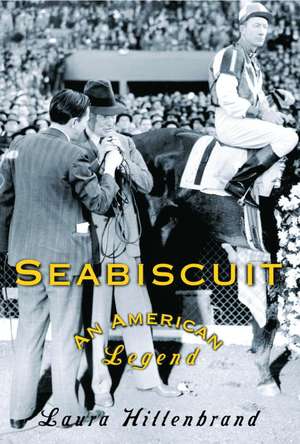
Seabiscuit
Autor Laura Hillenbranden Limba Engleză Hardback – 6 mar 2001
Descoperim în Seabiscuit nu doar cronica unei ere apuse a sportului hipic, ci o ocazie rară de a înțelege cum o națiune întreagă, aflată în pragul colapsului economic, și-a găsit speranța într-un animal considerat un rebut. Într-o perioadă în care știrile erau dominate de figuri politice sumbre, acest cal cu picioare strâmbe și coadă rărită a reușit performanța de a ocupa primele pagini ale ziarelor mai des decât președintele FDR. Notăm cu interes felul în care Laura Hillenbrand reconstruiește universul curselor de cai din anii '30, transformând datele istorice riguroase într-o narațiune vibrantă despre reziliență. Putem afirma că forța acestui volum rezidă în dinamica neobișnuită a celor trei oameni care i-au schimbat destinul lui Seabiscuit: Charles Howard, un antreprenor vizionar, Tom Smith, un dresor enigmatic, și Red Pollard, un jocheu marcat de traume fizice. Stilul autoarei este unul direct, lipsit de artificii verbale inutile, preferând să lase faptele și contextul istoric să ghideze ritmul lecturii. Pe aceeași linie cu Come on Seabiscuit! de Ralph Moody, lucrarea de față păstrează entuziasmul competiției, dar aduce un plus de profunzime documentară și un accent mult mai puternic pe contextul social al Marii Depresiuni. Față de alte biografii hipice, precum Man O' War de Dorothy Ours, unde accentul cade pe genetica și superioritatea fizică a unui campion înnăscut, Seabiscuit explorează triumful spiritului asupra limitărilor biologice. Este o lectură care echilibrează perfect tensiunea de pe hipodrom cu portretele psihologice detaliate ale protagoniștilor, oferind o perspectivă fascinantă asupra modului în care eșecul poate fi transformat în legendă prin perseverență și viziune.
Preț: 161.69 lei
Carte indisponibilă temporar
Specificații
ISBN-10: 0375502912
Pagini: 416
Ilustrații: CHAPTER-OPENING PHOTOS
Dimensiuni: 164 x 241 x 34 mm
Greutate: 0.72 kg
Editura: Random House
Locul publicării:New York, NY
V-ar putea interesa
-
 SecretariatWilliam NackPreț: 79.39 lei
 -
 Leaving Microsoft to Change the WorldJohn WoodPreț: 120.20 lei
 -
 Start Where You AreMim E RivasPreț: 73.78 lei
 -
 -12%Preț: 142.27 lei162.42 lei
 -
 The Pursuit of HappinessDouglas Kennedy-28%Preț: 68.92 lei95.80 lei
 -
 Preț: 137.04 lei
 -
 In the Presence of HorsesBarbara DimmickPreț: 146.50 lei
 -
 Call of the Wild: My Escape to AlaskaGuy Grieve-26%Preț: 70.03 lei94.28 lei
 -
 Getting Rich Your Own WayBrian TracyPreț: 130.06 lei
 -
 SPIN® -SellingNeil RackhamPreț: 244.57 lei
 -
 Winston Churchill by His Personal SecretaryElizabeth NelPreț: 88.17 lei
 -
 Disney SolosHal Leonard Publishing CorporationPreț: 90.23 lei
 -
 -26%Preț: 58.89 lei79.15 lei
 -
 Preț: 76.87 lei
 -
 Preț: 103.04 lei
 -
 The Personal Branding PhenomenonPeter MontoyaPreț: 100.23 lei
 -
 The Richest Man in Babylon - Original EditionGeorge S. ClasonPreț: 46.23 lei
 -
 The Power of Positive ThinkingNorman Vincent PealePreț: 104.98 lei
De ce să citești această carte
Această carte este ideală pentru cei care caută o poveste reală despre depășirea limitelor, fiind mai mult decât o cronică sportivă. Veți câștiga o înțelegere profundă a Americii interbelice și a modului în care un sport poate deveni un fenomen cultural. Este recomandarea noastră pentru cititorul care apreciază non-ficțiunea scrisă cu rigoare jurnalistică, dar cu sufletul unui roman de aventuri.
Despre autor
Laura Hillenbrand este o figură remarcabilă în literatura contemporană americană, cunoscută pentru capacitatea sa de a transforma cercetarea istorică metodică în bestsellere internaționale. Deși viața sa a fost marcată de o boală cronică severă care a obligat-o să scrie majoritatea lucrărilor din izolare, Hillenbrand a reușit să publice volume monumentale precum Seabiscuit și Unbroken. Lucrările sale se disting printr-un stil narativ pur, care pune accent pe poveste și pe forța de supraviețuire a personajelor sale, fie că este vorba despre un cal de curse sau despre un erou de război precum Louis Zamperini. Cărțile sale au fost traduse în numeroase limbi și adaptate pentru marele ecran, confirmând statutul său de maestru al biografiei moderne.
Notă biografică
Extras
On an afternoon in 1903, long before the big cars and the ranch and all the money, Howard began his adulthood with only that air of destiny and 21 cents in his pocket. He sat in the swaying belly of a transcontinental train, snaking west from New York. He was twenty-six, handsome, gentlemanly, with a bounding imagination. Back then he had a lot more hair than anyone who knew him later would have guessed. Years in the saddles of
military-school horses had taught him to carry his six-foot-one-inch frame straight up.
He was eastern born and bred, but he had a westerner’s restlessness. He had tried to satisfy it by enlisting in the cavalry for the Spanish-American War, and though he became a skilled horseman, thanks to bad timing and dysentery he never got out of Camp Wheeler in Alabama. After his discharge, he got a job in New York as a bicycle mechanic, took up competitive bicycle racing, got married, and had two sons. It seems to have been a good life, but the East stifled Howard. His mind never seemed to settle down. His ambitions had fixed upon the vast new America on the other side of the Rockies. That day in 1903 he couldn’t resist the impulse anymore. He left everything he’d ever known behind, promised his wife Fannie May he’d send for her soon, and got on the train.
He got off in San Francisco. His two dimes and a penny couldn’t carry him far, but somehow he begged and borrowed enough money to open a little bicycle-repair shop on Van Ness Avenue downtown. He tinkered with the bikes and waited for something interesting to come his way.
It came in the form of a string of distressed-looking men who began appearing at his door. Eccentric souls with too much money in their pockets and far too much time on their hands, they had blown thick wads of cash on preposterous machines called automobiles. Some of them were feeling terribly sorry about it.
The horseless carriage was just arriving in San Francisco, and its debut was turning into one of those colorfully unmitigated disasters that bring misery to everyone but historians. Consumers were staying away from the “devilish contraptions” in droves. The men who had invested in them were the subjects of cautionary tales, derision, and a fair measure of public loathing. In San Francisco in 1903, the horse and buggy was not going the way of the horse and buggy.
For good reason. The automobile, so sleekly efficient on paper, was in practice a civic menace, belching out exhaust, kicking up storms of dust, becoming hopelessly mired in the most innocuous-looking puddles, tying up horse traffic, and raising an earsplitting cacophony that sent buggy horses fleeing. Incensed local lawmakers responded with monuments to legislative creativity. The laws of at least one town required automobile drivers to stop, get out, and fire off Roman candles every time horse-drawn vehicles came into view. Massachusetts tried and, fortunately, failed to mandate that cars be equipped with bells that would ring with each revolution of the wheels. In some towns police were authorized to disable passing cars with ropes, chains, wires, and even bullets, so long as they took reasonable care to avoid gunning down the drivers. San Francisco didn’t escape the legislative wave. Bitter local officials pushed through an ordinance banning automobiles from the Stanford campus and all tourist areas, effectively exiling them from the city.
Descriere scurtă
Charles Howard was a onetime bicycle repairman who introduced the automobile to the western United States and became an overnight millionaire. When he needed a trainer for his new racehorses, he hired Tom Smith, a mysterious mustang breaker from the Colorado plains. Smith urged Howard to buy Seabiscuit for a bargain-basement price, then hired as his jockey Red Pollard, a failed boxer who was blind in one eye, half-crippled, and prone to quoting passages from Ralph Waldo Emerson. Over four years, these unlikely partners survived a phenomenal run of bad fortune, conspiracy, and severe injury to transform Seabiscuit from a neurotic, pathologically indolent also-ran into an American sports icon.
Author Laura Hillenbrand brilliantly re-creates a universal underdog story, one that proves life is a horse race.
Recenzii
–The New York Times
“Engrossing . . . Fast-moving . . . More than just a horse’s tale, because the humans who owned, trained, and rode Seabiscuit are equally fascinating. . . . [Hillenbrand] shows an extraordinary talent for describing a horse race so vividly that the reader feels like the rider.”
–Sports Illustrated
“REMARKABLE . . . MEMORABLE . . . JUST AS COMPELLING TODAY AS IT WAS IN 1938.”
–The Washington Post
From the Trade Paperback edition.
Descriere
Add descriptionIn their place, modern America was born. But what defined this new era? Nothing more than the story of Seabiscuit, a stunted colt with asymmetrical knees that had for two years been hacked around no-good race tracks leading to permanent leg damage. Yet by 1937 Seabiscuit could draw crowds of 60,000 and had more newspaper column inches devoted to him than Mussolini, Hitler or Roosevelt, his popularity peaking during his appearances at the Santa Anita Handicap. America had gone to the races for the first time since the Depression and fallen in love with a misshapen colt of great character. Now it wanted a winner. 'Seabiscuit' is also the story of three men: Tom Smith, a former Wild West showman was the trainer; Red Pollard, abandoned by his poverty-stricken family at a race track became the rider; and Charles Howard, a pioneer car manufacturer in San Francisco in the 1920s was the owner and financier. These three combined to create the legend of Seabiscuit and epitomise a dream for the emerging new America.