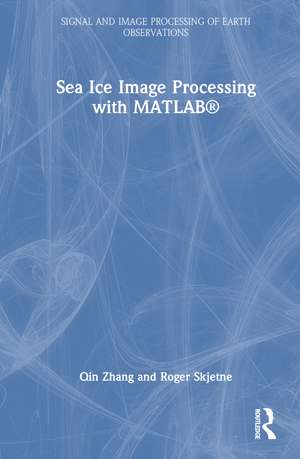
Sea Ice Image Processing with MATLAB®: Signal and Image Processing of Earth Observations
Autor Qin Zhang, Roger Skjetneen Limba Engleză Hardback – 16 feb 2018
Features


Preț: 1342.31 lei
Preț vechi: 1783.49 lei
-25%
Puncte Express: 2013
Carte indisponibilă temporar
Doresc să fiu notificat când acest titlu va fi disponibil:
Se trimite...
Specificații
ISBN-13: 9781138032668
ISBN-10: 1138032662
Pagini: 272
Ilustrații: 12 Illustrations, color; 142 Illustrations, black and white
Dimensiuni: 156 x 234 x 25 mm
Greutate: 0.59 kg
Ediția:1
Editura: CRC Press
Colecția CRC Press
Seria Signal and Image Processing of Earth Observations
Locul publicării:Boca Raton, United States
ISBN-10: 1138032662
Pagini: 272
Ilustrații: 12 Illustrations, color; 142 Illustrations, black and white
Dimensiuni: 156 x 234 x 25 mm
Greutate: 0.59 kg
Ediția:1
Editura: CRC Press
Colecția CRC Press
Seria Signal and Image Processing of Earth Observations
Locul publicării:Boca Raton, United States
Public țintă
Academic and Professional Practice & DevelopmentCuprins
Introduction; Digital Image Processing Preliminaries; Ice Pixel Detection; Ice Edge Detection; Watershed-Based Ice Floe Segmentation; GVF Snake-Based Ice Floe Boundary Identification and Ice Image Segmentation; Sea Ice Type Identification; Sea Ice Image Processing Applications; Model Sea Ice Image Processing Applications; Appendix A Geometric Calibration; Appendix B Ice Image Data Structure.
Recenzii
"Sea Ice Image Processing with MATLAB® is a large and important step forward in the creation of the necessary tools for the planning and execution of Arctic maritime operations. The ability to predict what kind of ice that one will encounter is of critical importance for safety, as you need to know what you are going to run into. This book provides an important insight to the cutting edge of technology being developed for sustainable operations in the polar regions."
—Åke Rohlén, Arctic Marine Solutions AB, Sweden
"This is a really elaborate book for the image processing to extract ice information. To my knowledge, this is the first work that describes the methods to obtain ice floe size distribution in a systematic and sophisticated way. It is still a big issue to predict the sea ice behavior in the numerical sea ice model due to the lack of our knowledge about the sub-grid scale information of sea ice, especially floe size distribution. This book aims at solving this problem and has achieved it to some extent. This work certainly contributes to this issue and sheds light on collecting observational data on an operational basis. Therefore, I sincerely hope the algorithm developed by the authors will be used by many people to improve our understanding of sea ice properties."
— Takenobu Toyota, Hokkaido University, Sapporo, Japan
—Åke Rohlén, Arctic Marine Solutions AB, Sweden
"This is a really elaborate book for the image processing to extract ice information. To my knowledge, this is the first work that describes the methods to obtain ice floe size distribution in a systematic and sophisticated way. It is still a big issue to predict the sea ice behavior in the numerical sea ice model due to the lack of our knowledge about the sub-grid scale information of sea ice, especially floe size distribution. This book aims at solving this problem and has achieved it to some extent. This work certainly contributes to this issue and sheds light on collecting observational data on an operational basis. Therefore, I sincerely hope the algorithm developed by the authors will be used by many people to improve our understanding of sea ice properties."
— Takenobu Toyota, Hokkaido University, Sapporo, Japan
Descriere
The ice concentration data on a global scale are available on a daily basis due to microwave satellite sensors. Image processing for sea ice is vital to estimate the sea ice properties and understand the behavior of sea ice especially on a relatively small scale. Currently, sea ice concentration is estimated from lower-resolution passive microwave sensors. This book aims to present the most recent image processing techniques including the so-called gradient vector flow snake algorithm to identify individual ice floes from the ice images. It makes an extensive use of this powerful technique to extract or estimate the sea-ice parameters and to develop tools useful to scientists and engineers.