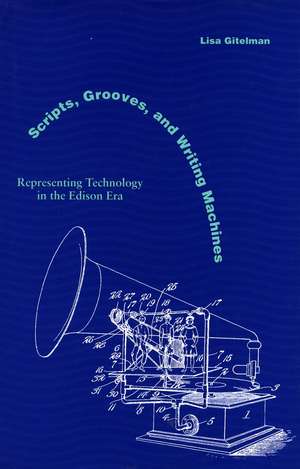
Scripts, Grooves, and Writing Machines: Representing Technology in the Edison Era
Autor Lisa Gitelmanen Limba Engleză Paperback – 2000
Subliniem că lectura lucrării Scripts, Grooves, and Writing Machines necesită un nivel de experiență academic sau profesional, presupunând cunoștințe solide în istoria media, teoria comunicării și studiul tehnologiei. Această lucrare nu este doar o cronică istorică, ci o investigație tehnică și culturală asupra modului în care dispozitivele de la sfârșitul secolului al XIX-lea au redefinit actul scrierii și al citirii.
Putem afirma că Lisa Gitelman propune o perspectivă riguroasă asupra tehnologiilor de inscripționare, privindu-le ca pe niște „teorii materializate ale limbajului”. Analizând de la eșecul stiloului electric al lui Edison până la succesul mașinii de scris, autoarea deconstruiește mecanismele prin care aceste obiecte au modelat subiectivitatea modernă. Dacă Gramophone, Film, Typewriter de Friedrich Kittler v-a oferit cadrul teoretic al modului în care noile medii au spart hegemonia cuvântului tipărit, această carte oferă instrumentele practice și contextul istoric specific erei Edison, ancorând teoria în realitatea arhivelor de brevete și a producției de înregistrări.
În contextul operei sale, Scripts, Grooves, and Writing Machines servește drept fundament pentru explorările ulterioare din Always Already New, unde autoarea continuă să interogheze noutatea media, și din Paper Knowledge, unde se concentrează pe istoria documentului. Aici, focalizarea pe „șanțurile” fonografului și pe primele filme mute evidențiază o tranziție critică în conștiința comunicațională. Credem că abordarea interdisciplinară, care îmbină analiza tehnică a dispozitivelor de memorie cu impactul lor asupra științelor umane, transformă acest volum într-o resursă esențială pentru înțelegerea rădăcinilor erei digitale.
Preț: 241.14 lei
Carte tipărită la comandă
Livrare economică 04-18 decembrie
Specificații
ISBN-10: 0804738726
Pagini: 304
Ilustrații: 22 half-tones
Dimensiuni: 140 x 216 x 25 mm
Greutate: 0.38 kg
Ediția:1
Editura: Stanford University Press
Colecția Stanford University Press
V-ar putea interesa
-
 -32%Preț: 781.63 lei1148.15 lei
 -
 Machines: A Visual HistoryDominic ChineaPreț: 199.36 lei
 -
 The Alchemy of UsAinissa RamirezPreț: 137.53 lei
 -
 Preț: 194.47 lei
 -
 The Technological SocietyJacques EllulPreț: 91.11 lei
 -
 The Universal PenmanGeorge Bickham-16%Preț: 120.81 lei144.21 lei
 -
 Into the Groove: The Story of Sound From Tin Foil to VinylJonathan Scott-24%Preț: 71.01 lei93.93 lei
 -
 The Medium Is Still the MessageGrant N. HaversPreț: 234.07 lei
 -
 A User's Guide to the Age of TechGrant WythoffPreț: 144.30 lei
 -
 -19%Preț: 87.10 lei107.49 lei
 -
 Preț: 122.59 lei
 -
 The Information AnimalAlicia WanlessPreț: 242.32 lei
 -
 The Wireless OperatorDavid TuchPreț: 144.50 lei
 -
 The Thinking MachineStephen WittPreț: 123.17 lei
 -
 Clayton, E: Golden ThreadEwan (Author) Clayton-20%Preț: 83.41 lei103.77 lei
 -
 Preț: 252.80 lei
 -
 -28%Preț: 102.16 lei142.11 lei
 -
 Ecologies of WritingUrs Büttner-33%Preț: 575.87 lei865.59 lei
De ce să citești această carte
Recomandăm această carte cercetătorilor și profesioniștilor din domeniul comunicațiilor care doresc să înțeleagă cum tehnologiile de inscripționare au precedat arhitectura digitală actuală. Cititorul câștigă o perspectivă tehnică asupra modului în care brevetele și invențiile mecanice de acum un secol au definit conceptele moderne de autorat și consum media, oferind o „arheologie” necesară pentru înțelegerea sistemelor RAM și ROM contemporane.
Despre autor
Lisa Gitelman este profesor de engleză și media, cultură și comunicare la New York University. Expertiza sa se situează la intersecția dintre istoria tehnologiei și studiile literare, fiind o figură centrală în analiza modului în care mediile de comunicare devin instrumente de cercetare istorică. Pe lângă lucrarea de față, ea este autoarea volumelor Always Already New: Media, History, and the Data of Culture și Paper Knowledge, lucrări care explorează materialitatea documentelor și evoluția mediilor de informare, consolidându-i reputația de istoric riguros al tehnologiilor de comunicare americane.
Descriere scurtă
At the book’s heart is the proposition that technologies of inscription are materialized theories of language. Whether they failed (like Thomas Edison’s “electric pen”) or succeeded (like typewriters), inscriptive technologies of the late nineteenth century were local, often competitive embodiments of the way people experienced writing and reading. Such a perspective cuts through the determinism of recent accounts while arguing for an interdisciplinary method for considering texts and textual production.
Starting with the cacophonous promotion of shorthand alphabets in postbellum America, the author investigates the assumptions—social, psychic, semiotic—that lie behind varying inscriptive practices. The “grooves” in the book’s title are the delicate lines recorded and played by phonographs, and readers will find in these pages a surprising and complex genealogy of the phonograph, along with new readings of the history of the typewriter and of the earliest silent films. Modern categories of authorship, representation, and readerly consumption emerge here amid the un- or sub-literary interests of patent attorneys, would-be inventors, and record producers. Modern subjectivities emerge both in ongoing social constructions of literacy and in the unruly and seemingly unrelated practices of American spiritualism, “Coon” songs, and Rube Goldberg-type romanticism.
Just as digital networks and hypertext have today made us more aware of printed books as knowledge structures, the development and dissemination of the phonograph and typewriter coincided with a transformed awareness of oral and inscribed communication. It was an awareness at once influential in the development of consumer culture, literary and artistic experiences of modernity, and the disciplinary definition of the “human” sciences, such as linguistics, anthropology, and psychology. Recorded sound, typescripts, silent films, and other inscriptive media are memory devices, and in today’s terms the author offers a critical theory of ROM and RAM for the century before computers.
Recenzii
Notă biografică
Textul de pe ultima copertă
“The range of Gitelman’s evidence is impressive: deep research in the Edison archives, labels, patent documents, and literary sources. Historians will gain the most from the early chapters about the prehistory of phonography and the ways Americans perceived Edison’s phonograph.”—The Historian